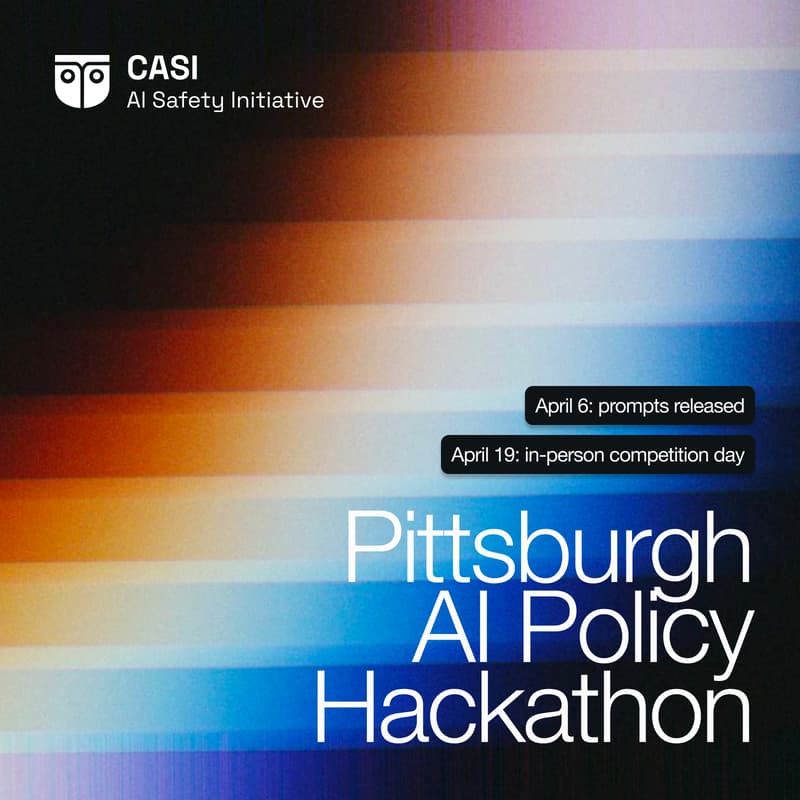
Pittsburgh AI Policy Hackathon, hosted by CASI
[4/6 UPDATE] All policy prompts, partner matching, and submissions are open on our website! Submit your policy briefs by Wed, April 15, 11:59pm ET.
Drop by our office hours (Unit 1E, 201 S Craig St) if you want to talk through the prompts, get feedback on your approach, or ask logistical questions.
Week 1: Wednesday, April 8, 4:00–6:00 PM
Week 2: Wednesday, April 15, 4:00–6:00 PM
Note: We will be accepting late registrations until Mon, April 13. Make sure to formally register yourself/your team on our website.
⸻
The Carnegie AI Safety Initiative (CASI) at Carnegie Mellon University is hosting the inaugural Pittsburgh AI Policy Hackathon, a hybrid policy writing competition open to undergraduate and graduate students across the greater Pittsburgh area.
$4,000+ total prize pool across the brackets. The more people sign up, the higher the chance we up the pool!
Teams of 1-2 will choose from one of our prompts on pressing AI governance challenges and develop a policy brief proposing concrete solutions. Top teams will be invited to present their proposals in-person to a panel of judges on CMU's campus.
Brackets (Tentative):
AI-Enabled Consumer Fraud and Agentic AI
Concentration of Corporate Power in the AI Industry
Data Privacy, AI Training Data, and Copyright
No prior policy experience required. We're looking for rigorous thinking from students across all disciplines: law, computer science, public policy, economics, HCI, political science, philosophy, and beyond.
Timeline:
Monday, April 6: Prompts and scenario materials released asynchronously.
April 6-15: Research and write your policy brief (under 1,500 words).
Wednesday, April 15, 11:59pm ET: Policy brief submission deadline.
Sunday, April 19: Final presentation day on CMU's campus (in-person). Selected teams present to judges, followed by lunch, networking, and a prize ceremony.
FAQs:
Who can participate? Any undergraduate or graduate student currently enrolled at a college or university in the greater Pittsburgh area (CMU, Pitt, Duquesne, Chatham, Point Park, Carlow, and others). No prior experience in policy or AI is needed. Free to enter!
Do I need a team? You can compete solo or with a partner (i.e., teams of 1-2). If you're looking for a teammate, we'll share details to help you with that shortly. If you already have a confirmed teammate, make sure both of you fill out this Luma form.
What do I actually submit? A policy brief of under 1,500 words responding to one of the three prompts. Each prompt will likely be built around a fictional near-future scenario (think a fake newspaper article or a mock Congressional memo) that makes the policy challenge concrete. Full details for prompts will be shared on April 6.
How does judging work? All teams submit their policy brief by the April 15 deadline. Based on the volume and quality of submissions, teams may be selected to advance to the in-person final presentation day on April 19. Finalists present their proposals to a panel of judges, organized by bracket. The day includes lunch, networking, and a prize ceremony.
Since this is a hackathon, will we be writing code? No; you'll write policy briefs. The hackathon takes its name from the style of competition where people come together to solve problems collaboratively under a deadline.
Questions? Reach out to the CASI organizing team at [email protected].