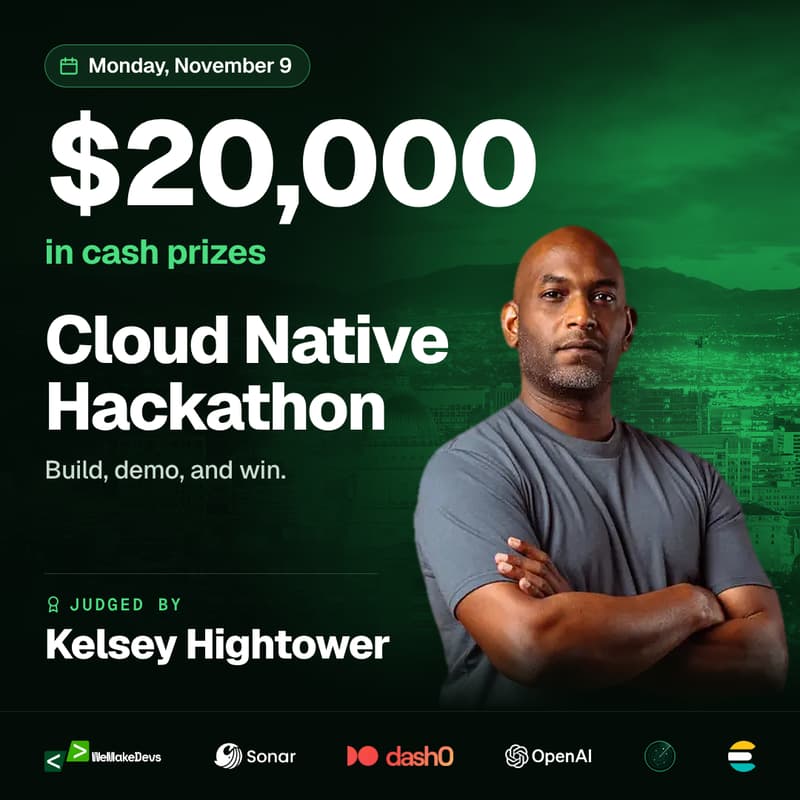

Win $20K at the Cloud Native Hackathon with Kelsey Hightower
Build anything that makes conferences better.
Join us on Monday, November 9 at The Shop Workspace in Salt Lake City for a full day of building with developers from the cloud native community. Pick something that makes conferences painful, fix it using tools from Sonar, Dash0, Radar and Elasticsearch, then demo it to Kelsey Hightower and Joseph Sandoval. There's $20,000 in cash prizes across four tracks, and everyone gets $50 in OpenAI credits plus swag.
Everyone is welcome, whether it's your first hackathon or your fiftieth. This is an in-person event, and we can't cover travel or accommodation.
The problem
Conferences are one of the best parts of tech, and also kind of a mess. There are hundreds of talks and you still pick the wrong one. The room you wanted is full. The best conversations happen in the hallway, but only if you find the right people. Every side event lives on a different page, and by the end of the week you have 40 new LinkedIn connections and no idea who half of them are.
Your challenge is to make conferences easier. That can be before (planning your schedule, travel, finding people to meet), during (talks, rooms, lines, the hallway track) or after (remembering who you met and actually following up). It can be for attendees, speakers, sponsors or the people running the whole thing.
Ideas to get you started
A talk picker that reads your GitHub, builds your schedule and reshuffles it when a room fills up.
A hallway track matchmaker that finds the people in the building working on the same problem as you.
A live crowd map that shows which rooms are packed and which coffee line is shortest.
A side event finder that puts every meetup, happy hour and party in town on one map.
A "who was that again?" assistant that remembers everyone you met and drafts your follow-ups.
A booth crawl planner that tells you where the good swag is.
A recap tool that turns the talks you missed into a five-minute catch-up.
These are just starting points. If it makes a conference easier for someone, it counts.
Sponsors
OpenAI, AI sponsor
Sonar, security sponsor
Dash0, observability sponsor
Radar, SRE sponsor
Elasticsearch, database sponsor
How the tracks work
Sonar, Dash0, Radar and Elasticsearch each have their own track and prize. Use their tool in your project and you're in the running for that track. Your project can enter every track whose tool it genuinely uses, so a project built with three of the tools is in the running for three prizes.
Prizes
$20,000 in cash prizes across the four sponsor tracks
$50 in OpenAI credits for every participant
Swag for everyone
The OpenAI credits are for everyone to build with. There's no OpenAI track or prize.
Sonar: Never Merge Broken
What it is: Gitar is Sonar's AI code verification agent. It reviews your pull requests against your project's conventions, finds problems, generates fixes and diagnoses CI failures. With auto-apply turned on, it commits fixes and keeps iterating against your pipeline, while you stay in control of what gets applied and what can merge.
How to use it: Install Gitar as a GitHub App on your hackathon repo and ship every feature as a pull request, so Gitar catches logic errors and bugs before you merge. Write your project's conventions as review instructions in .gitar/review/, add repository rules for repeatable workflow actions, and turn on auto-apply so Gitar diagnoses failing CI and pushes the fix. It all runs in the browser, so there's nothing to install locally. Start the free 14-day Gitar Pro trial (no credit card needed), which includes auto-apply and custom rules.
Examples
A schedule builder where every feature lands through a Gitar-reviewed PR, with review instructions that make sure session times always handle time zones properly.
A repository rule that kicks in whenever your API changes and checks your frontend still matches it.
Breaking your CI on purpose and letting auto-apply fix it live during your demo.
Judging
Gitar is part of how you built, with features landing through PRs it reviewed, not one PR at the end.
Project-aware setup, with review instructions and repository rules that reflect how your team actually works.
Using CI failure diagnosis and auto-apply to fix real problems.
How well your project makes conferences easier.
Resources
Dash0: Stop Flying Blind
What it is: Dash0 is an observability platform. It collects the signals your running app gives off (logs, metrics, traces, profiles and real-user monitoring) and puts them in one place, so you can see what your software is doing and why it breaks. It's built on OpenTelemetry, so you instrument with the open standard instead of a proprietary agent and there's no lock-in. It also comes with Agent0, a set of AI agents that investigate incidents, explain root causes, write queries and build dashboards from plain-language requests, plus a hosted MCP server that lets Claude Code, Cursor and other coding assistants query your live data. There are integrations for LangChain, OpenLIT, kagent and more.
How to use it: Instrument your project in the first hour with OpenTelemetry auto-instrumentation and you'll have traces and errors in minutes. When your demo breaks or slows down, ask Agent0 "why is my API slow?" instead of digging through logs. Connect the Dash0 MCP server to your coding assistant so it can check what your app is actually doing while you build.
Examples
A live crowd map where check-ins become metrics and a Dash0 dashboard shows which rooms are filling up.
A schedule app instrumented end to end, where your demo shows Agent0 explaining why "My agenda" slowed down when everyone opened it after the keynote.
An AI assistant for attendees traced with OpenLIT, so you can see every LLM call, token and cost in Dash0.
Judging
Depth of instrumentation across your app, including traces, logs, metrics and real-user monitoring if you have a frontend.
Using Agent0 or the MCP server to find and fix something real during the day, and showing it in your demo.
Observability that's part of the product experience, not bolted on at the end.
How well your project makes conferences easier.
Resources
Radar: AI SRE
What it is: Radar is an open-source Kubernetes UI from Skyhook. It shows everything running in your cluster in one place, and its AI SRE finds the root cause when something breaks, either from the Radar UI or from your coding agent (Claude Code, Codex, Cursor and others) through Radar's MCP server.
How to use it: Deploy your project on Kubernetes, either a cloud cluster or a local one with kind, k3d or minikube. Install Radar with curl -fsSL https://get.radarhq.io | sh && kubectl radar and connect your cluster to Radar's AI SRE.
Judging
Your project runs on Kubernetes with Radar connected to it.
Using Radar's AI SRE to find and fix something real during the day, and showing it in your demo.
How well your project makes conferences easier.
Resources
Elasticsearch: Find the Right Talk
What it is: Elasticsearch is the open source search engine and vector database from Elastic. Store your app's data in it and search it by keyword, by meaning with vector search, or both at once with hybrid search, so it can be the database behind your search, recommendations and the RAG for your AI agents.
How to use it: Run it locally with curl -fsSL https://elastic.co/start-local | sh (you'll need Docker), which gives you Elasticsearch and Kibana with every feature unlocked for a month, or start a free Elastic Cloud trial. Then load in your data (talks, speakers, attendees, side events) and query it from Python, JavaScript or any other client.
Examples
A talk search where "something on eBPF and security" finds the right session even when those words aren't in the title.
A hallway matchmaker that stores what everyone is working on as vectors and finds the closest matches in the building.
A conference assistant that answers questions about the schedule using RAG over every talk abstract.
Judging
Elasticsearch is the core data layer of your app, not a side feature.
Smart use of search, whether that's keyword, semantic, vector or hybrid.
How well your project makes conferences easier.
Resources
Judges
Kelsey Hightower
Joseph Sandoval, Principal Product Manager at Adobe and Vice Chair of the CNCF End User Technical Advisory Board
More judges to be announced
Agenda
All times are Mountain Time.
9:00 am: Check-in opens
10:00 am: Breakfast
11:00 am to 1:00 pm: Kickoff, theme and track walkthrough, and sessions from the sponsors, including a hands-on Gitar session from Sonar
1:00 pm to 2:00 pm: Build time (tip: get your app instrumented with Dash0 in this first hour)
2:00 pm: Lunch and a panel Q&A with Kelsey Hightower, where you can share your project ideas and get feedback
Until 6:00 pm: More build time, with coffee breaks in between
6:00 pm to 7:00 pm: Project presentations, judging and winners announcement
What to bring
Bring your laptop, your charger and the will to experiment and learn. To save time on the day, create your Gitar and Dash0 accounts before you arrive. If you're going for the Radar or Elasticsearch tracks, have a Kubernetes cluster ready (cloud, or local with kind, k3d or minikube) and Docker installed if you're running things locally.