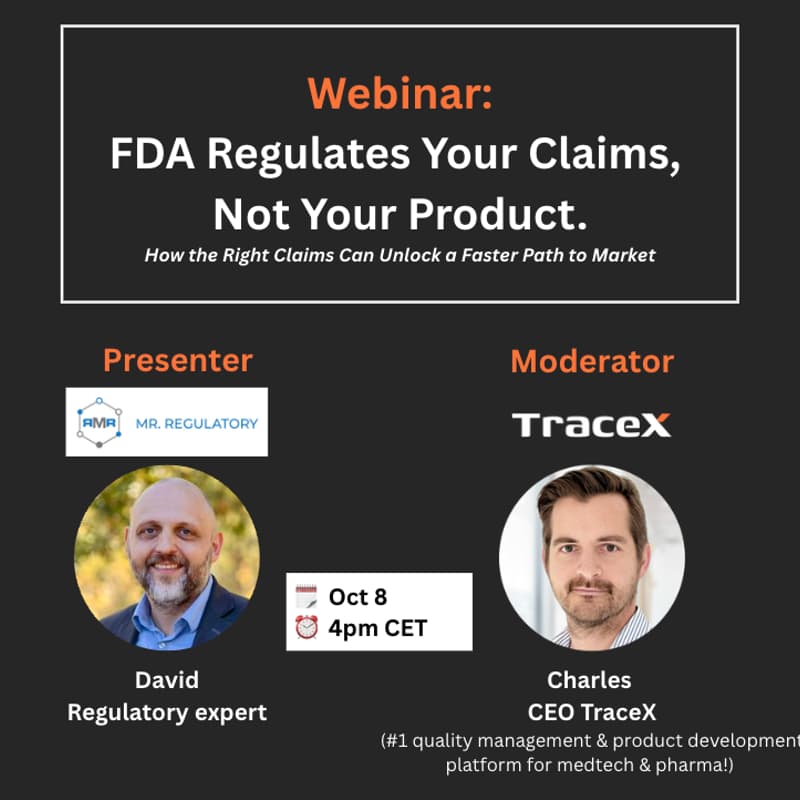
FDA Regulates Your Claims, Not Your Product.
FDA Regulates Your Claims, Not Your Product.
How the Right Claims Can Unlock a Faster Path to Market
Many MedTech companies assume that once they have built a medical technology, the next step is obvious: define the medical use, prepare the regulatory submission, and wait for FDA clearance before going to market.
But what if the product itself isn’t what determines your regulatory path?
The claims you make — what you say your product does, who it is for, and how it should be used — can fundamentally change how the FDA views it.
The same underlying technology may potentially be positioned as a non-medical product, a general wellness product, a product subject to enforcement discretion, or a regulated medical device, depending on its intended use and claims.
And that distinction can have a major impact on how quickly a company can reach the market.
In this webinar, David Pudwill, former FDA reviewer and experienced MedTech regulatory leader, joins TraceX to explore how companies can think strategically about claims and use the spectrum of FDA regulation to build a smarter path to market.
We’ll explore:
How your claims and intended use influence your FDA regulatory pathway
When a product may fall outside medical-device regulation
How the General Wellness pathway can enable earlier market entry
How FDA enforcement discretion works and where it may apply
Why seemingly small differences in claims — such as ovulation planning vs. contraception — can lead to very different regulatory requirements
How companies can launch an initial, less-regulated proposition while developing regulated functionality
Why getting a product in front of users earlier can accelerate learning, iteration, and product-market fit
How to do this without compromising your future regulated strategy
We’ll also look at real-world examples of companies that have used their initial positioning to enter the market, acquire users, generate data and demonstrate value before pursuing more regulated functionality.
David will bring perspectives from both sides of the table — from reviewing medical devices and software at the FDA to helping startups and established companies bring innovative healthcare technologies to market.
This isn't about avoiding regulation.
It’s about understanding precisely what makes your product regulated, what you can claim today, and when you actually need FDA clearance.
Because sometimes, the fastest path to market isn't changing your product.
It's changing what you claim it does.