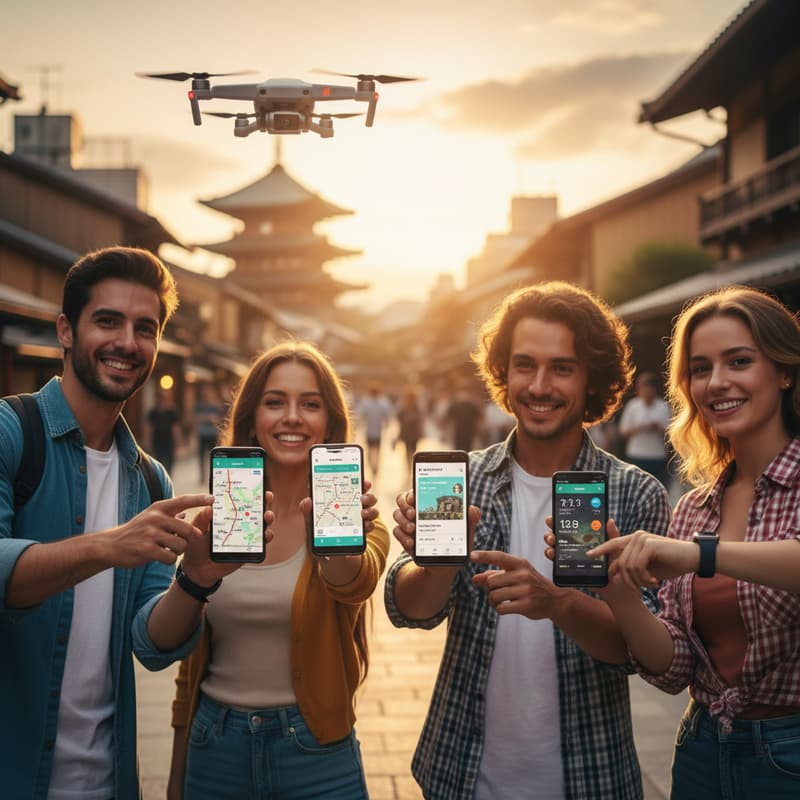

The Role of Technology in Travel
In this discussion, we will explore the good (and maybe bad) sides of using technology on your travels and share tips on how to use it wisely.
Think about how you plan a trip today. You probably use your phone or computer to book flights, find hotels, and check reviews. When you arrive, you use digital maps to find your way and apps to translate languages. Technology has completely changed how we travel. It's made it easier to plan, cheaper to explore, and simpler to share our experiences. This discussion will explore how these digital tools affect our journeys.
Discussion Questions
🧳 A. The New Travel Toolkit
1. What is the first app or website you use when you start planning a trip?
2. Think about a trip 20 years ago. What was the biggest challenge in planning that trip that technology has now solved?
3. How has Google Maps (or other digital maps) changed the feeling of exploring a new city?
4. Have you ever used an instant translation app (like Google Translate) to talk to someone? How did it go?
⚖️ B. The Good vs. The Bad
5. Does having all the information (reviews, maps, menus) on your phone make travel more exciting or less adventurous?
6. People used to get lost, miss trains, or go to bad restaurants by accident. Were these "bad" experiences, or were they an important part of the adventure that we are missing now?
7. How has technology made travel safer? And in what ways might it make us less safe (e.g., data theft, staring at our phones)?
📸 C. The Social Experience
8. Social Media (Instagram, Facebook, etc.): Do we travel to have the experience, or do we travel to post about the experience?
9. When you see a beautiful landmark, what is your first instinct: to look at it or to take a picture of it?
10. Has technology (like video calls and social media) made it easier or harder to meet new people and talk to locals while traveling?
11. How do online reviews (for hotels, restaurants, etc.) help us? How might they hurt local businesses or give us a false impression?
🚀 D. The Future of Travel
12. What is one piece of technology you wish existed that would make traveling better?
13. In the future, will Virtual Reality (VR) become so good that it could replace the need or desire to travel physically? Why or why not?
Key Vocabulary
Category 1: Planning & Booking Tools
Online Travel Agency (OTA): A website (like Expedia or Booking.com) that sells travel services like flights and hotels.
Aggregator (or Metasearch Engine): A website (like Google Flights or Skyscanner) that searches all the OTAs and airlines to find the best price.
Review App: A website or app (like TripAdvisor or Yelp) where travelers post their opinions about hotels, restaurants, and attractions.
Sharing Economy: An economic model where people rent things from each other, using apps like Airbnb (for homes) or Uber/Lyft (for rides).
Itinerary Planner: An app (like TripIt) that organizes all your booking confirmations and plans into one simple schedule.
Category 2: On-the-Go Technology
GPS (Global Positioning System): The satellite technology that powers digital maps and tells you exactly where you are.
Digital Map: An app like Google Maps or Apple Maps that gives you directions for walking, driving, or public transit.
Translation App: A tool (like Google Translate) that can translate spoken words, text, or even writing on a sign in real-time.
Digital Wallet (e-Payment): Using your phone or smartwatch to pay for things (like Apple Pay or Google Pay), so you don't need cash.
eSIM: A digital SIM card in your phone that lets you buy a local data plan without having to swap out your physical SIM card.
Ride-Hailing App: An app (like Uber, Lyft, or Grab) used to call a private car for a ride.
Category 3: The Social & Sharing Experience
Social Media: Apps like Instagram, Facebook, and TikTok, used to share photos, videos, and stories from a trip.
Geotagging: Adding a specific location (like "Eiffel Tower") to your photo or post on social media.
Travel Influencer: A person on social media who gets paid to travel and post about their experiences, often encouraging others to visit.
Blog / Vlog: A travel blog is an online journal with writing and photos. A vlog (video blog) is a journal made of videos, usually on YouTube.
Digital Nomad: A person who uses technology to work remotely (from their laptop) while traveling the world.
Category 4: Emerging & Future Tech
Augmented Reality (AR): Technology that adds a digital layer over the real world (e.g., pointing your phone at a museum painting to see its history).
Virtual Reality (VR): A technology that uses a headset to make you feel like you are in a completely different place, like a "virtual vacation."
Biometrics: Using your unique body parts (like your face or fingerprint) as ID, for example, to get through airport security faster.
Contactless (Tech): Any technology that lets you do something without touching it (e.g., tap-to-pay, keyless hotel entry).