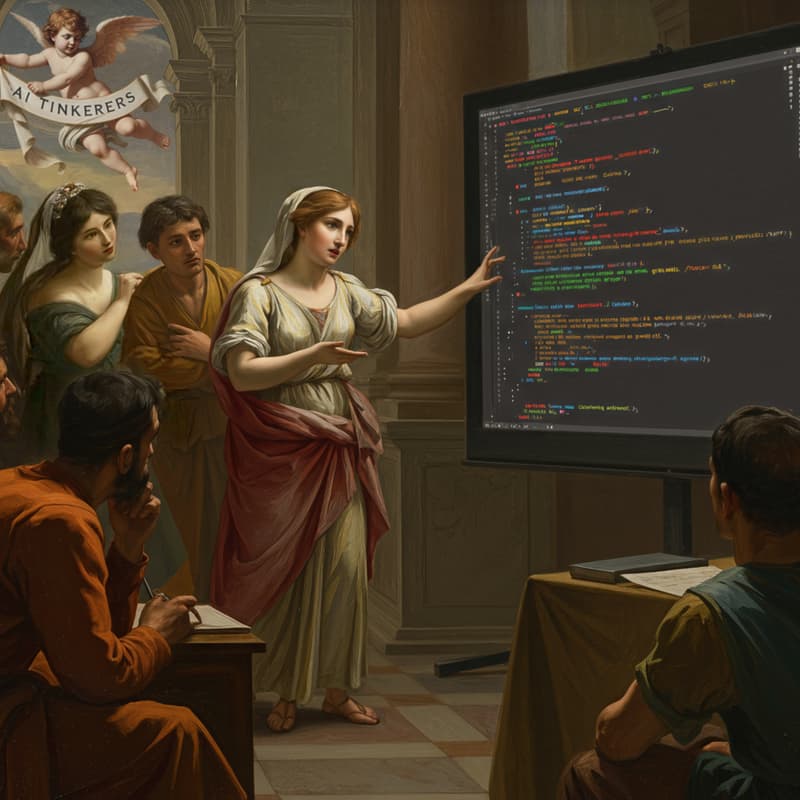

Open Source High-Throughput Vibe Coding
Workshop & Mini-Hackathon 🚀
This event explores how open-source LLMs and agentic tools are changing the way modern software is built — enabling developers to prototype, iterate, and ship ideas at unprecedented speed, without vendor lock-in or paid APIs.
We focus on high-throughput “vibe coding”: using local and open tools to build more, faster, and smarter.
Who is this for?
This workshop is for:
Developers and engineers
Students and researchers
Startup founders and indie hackers
Product builders curious about agentic AI
Anyone interested in building software faster using open-source LLMs
Whether you are experimenting, prototyping MVPs, or exploring new workflows for real projects, this session will give you practical, reusable techniques.
Who is leading the session?
Tomas Arribas is a hands-on technologist with deep experience across the full software stack, including cloud technologies, DevOps, data science & engineering, and AI.
He leads technology as CTO at Chimnie and a co-organizer of the AI Tinkerers Amsterdam meetups. His work includes projects for Google, Toyota, YouTube, Sony, Mars, Armani, and many other global organisations. Tomas has also founded two startups, gaining first-hand experience in turning ideas into real products — and understanding just how hard (and rewarding) that process can be.
Stelios Sotiriadis is the CEO of Warestack, Associate Professor, and MSc Programme Director at Birkbeck, University of London.
Stelios holds a PhD from the University of Derby, completed a postdoctoral fellowship at the University of Toronto, and has worked with organisations including Huawei, IBM, Autodesk, and multiple startups. He has taught at Birkbeck, Boston University, and the University of Notre Dame since 2018 and co-founded Warestack in 2021.
What we’ll cover
A hands-on, practical introduction to open-source, high-throughput AI-assisted development.
You will learn:
How to vibe code for free using open-source LLMs
An introduction to open-source agentic interfaces
MCPs (Model Context Protocols) that are actually useful
Best practices for context management and long-term memory
Parallelising local agents using Git Worktrees for high-throughput development
How to coordinate multiple agents effectively
Real workflows for faster iteration and experimentation
Format
A 2-hour live session, followed by a 1-hour mini-hackathon, including:
Conceptual grounding (kept minimal and practical)
Live demos and hands-on exercises
Real-time agent-driven development
A guided mini-hackathon
Q&A and discussion throughout
Requirements
A laptop (macOS, Linux, or Windows)
Git installed
Comfortable using the terminal
No paid APIs required
Basic familiarity with Git and Python is helpful.
Prerequisites
Fundamental familiarity with software development principles and programming languages is required.