
Mapping affinity landscapes from deep mutational scans
Deep mutational scanning gives you thousands of single-substitution variants and one question for each of them: how much does it bind? The analysis is often done with custom scripts that are hard to re-run later.
This masterclass is for protein engineers, antibody scientists and bioinformaticians who want a standard path from raw reads to a quantitative affinity landscape that another person can repeat.
We'll run a published scan of a broadly neutralizing influenza antibody. Its entire heavy-chain variable domain was mutated and titrated against three different hemagglutinins, in both its germline and its matured form. Every binding constant we fit on screen is checked against the value the authors published.
What you'll learn:
Turning raw reads into a variant table: align to the parent sequence and quantify individual substitutions, using silent-mutation and no-antigen controls to establish the noise floor
Recovering binding constants from sorted bins: reconstruct each variant's distribution across sort gates over a concentration series and fit the titration curve
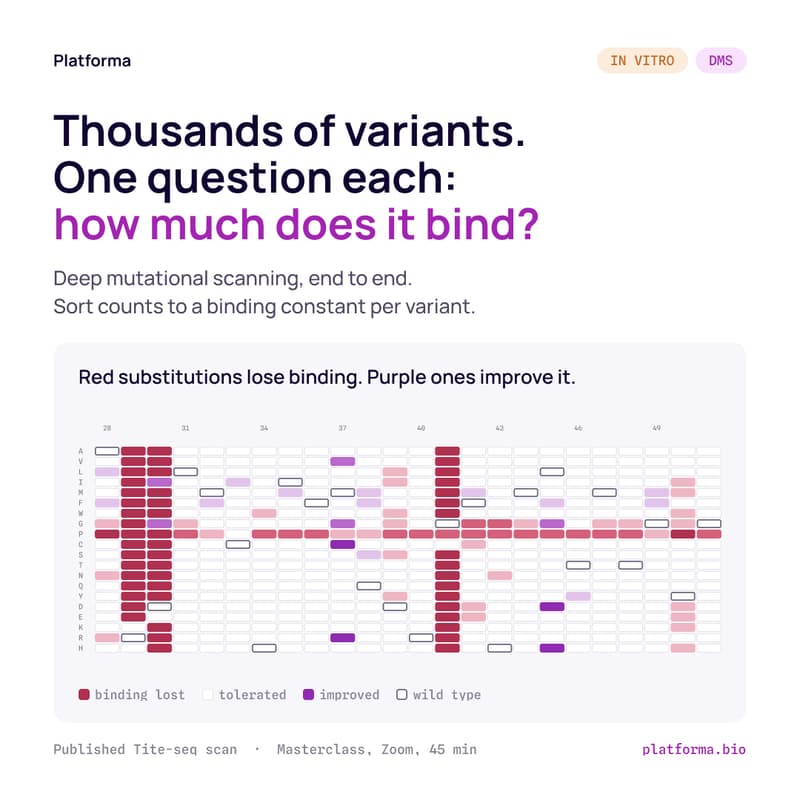
Building and reading affinity landscapes: generate position-by-mutation maps that show which changes improve binding, which are tolerated, and which destroy the phenotype
Finding engineering trade-offs: compare landscapes across antigens to separate gains that narrow specificity from changes that hold or widen breadth, and see how somatic maturation reshaped what was available
Quality control you can show a reviewer: goodness-of-fit filtering, no-antigen baselines, and the limits of any display-system measurement
Who should attend:
Protein engineers and antibody scientists running deep mutational scans, site-saturation libraries or affinity maturation campaigns
Bioinformaticians who rebuild a custom analysis for every scan
Machine-learning teams who need clean sequence-function data and want to understand how it was produced
Discovery and project leads using sequence-function data to guide engineering decisions