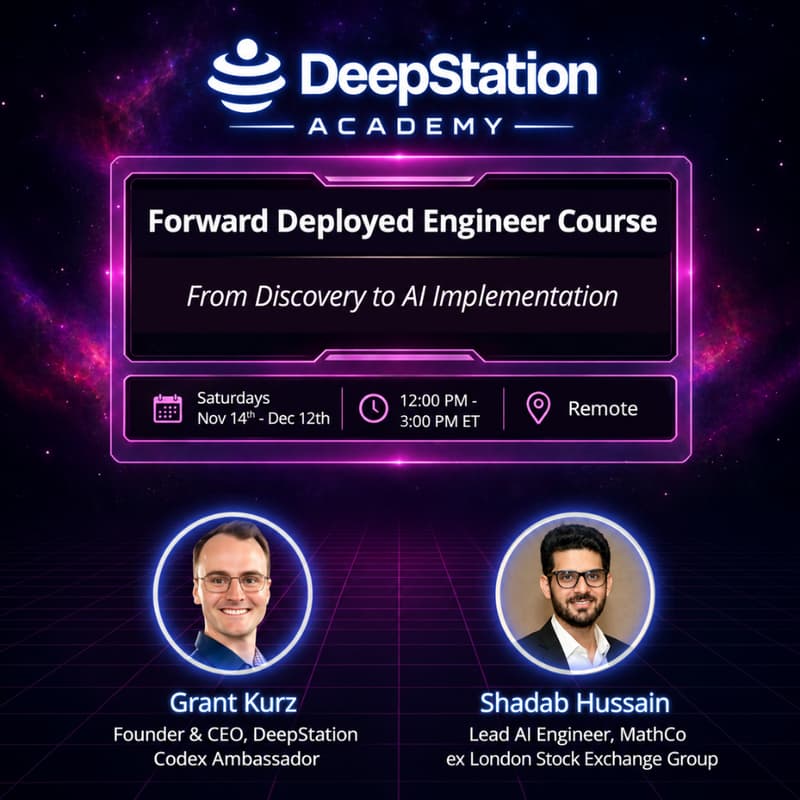

Forward Deployed Engineer Course: From Discovery to AI Implementation
Overview
Forward deployed engineers get dropped into a customer environment, handed an ambiguous problem, and expected to leave behind a working system that someone else can run. This course trains that arc directly.
Five live online three-hour sessions run as one continuous simulated engagement with a fictional enterprise customer, played by the instructor, complete with conflicting stakeholders, messy data, a security team, and an unstated budget ceiling. You finish with a capstone on an industry the course has not taught, presented live to a mock steering committee.
The failure mode this course targets is the impressive two-week demo that dies in security review. You spend as much time on scoping, permissions, evaluation, and handover as on building, because those are the parts that decide whether the work survives.
Who This Is For
Engineers who have shipped with LLM APIs and retrieval and now need to deliver inside a customer's constraints
Solutions and platform engineers moving into forward deployed, customer-facing delivery
Founders and consultants who build AI systems for clients and want them to survive the client's security review
Graduates of our Vibe Code courses ready for an advanced, Python-first engagement
Schedule
🔸 Session 1: Discovery and Scoping (Saturday, November 14) Interview three conflicting stakeholders live, then write the one-page engagement spec: first slice, a success metric that is a number, real non-goals, cost and latency ceilings, and kill criteria.
🔸 Session 2: Customer Data and Access (Saturday, November 21) Build adapters over three messy sources, decide what to do with PII, carry document permissions into every chunk, and write the data findings memo the customer will actually read.
🔸 Session 3: Prototype and Evaluation (Saturday, November 28) Build a grounded prototype on a service layer that survives real providers, with permission-aware retrieval, citations enforced in code, and a refusal path. Then prove it works: a golden set built with the customer, a judge calibrated against human labels, automated tests that catch regressions, and a red-team report against the OWASP LLM Top 10.
🔸 Session 4: Agents in Customer Systems (Saturday, December 5) An agent loop built by hand, tools wrapping real customer actions, approval gates and idempotency on irreversible operations, step and spend caps, full tracing, and trajectory-level evaluation.
🔸 Session 5: Deploy, Operate and Hand Over (Saturday, December 12) Deploy inside private networking and least-privilege identity, define four alarms, survive a simulated outage drill, price the system per unit of work, and hand over a pack an internal team can run without you.
🔸 Capstone (two to three weeks after Session 5) Pick one of four industry briefs (healthcare, pharma and life sciences, retail and CPG, financial services), run the full engagement solo or in a pair, and present a twenty-minute readout to a mock steering committee.
Working With Coding Agents
You work with a coding agent from Session 1 and build the entire engagement alongside one. Every engagement repeats the same shapes, so you encode them as reusable agent skills as you go: discovery and scoping, ingestion and access, evaluation, review discipline, operate and hand over. You leave with a working skill library, not a set of memories. Agent-written code clears the same bar as everything else: the evaluation harness and the test suite.
Office Hours
Stuck between sessions? We've got you. Wednesday office hours from 6 to 7 PM ET every week of the course, plus one optional capstone checkpoint where the instructor plays your brief's stakeholders. Drop in, ask questions, get unblocked, and keep building.
Instructors
Shadab Hussain, Lead Engineer, Data & GenAI, MathCo
Shadab is a technology executive and strategic advisor specializing in AI and quantum computing. As Lead Engineer at MathCo he architects enterprise AI solutions for Fortune 500 clients. He was previously a Developer Advocate at the London Stock Exchange Group. He is a Google Developer Expert in AI/ML and a TEDx speaker, holds the AWS Certified Generative AI Developer Professional certification, and co-founded Quantum Computing India, the nation's largest quantum community.
Grant Kurz, Founder & CEO, DeepStation AI
Software engineer and entrepreneur who builds AI systems for enterprise and universities, and founded DeepStation, a global AI community of 6,000+ industry professionals with 100+ workshops and speakers including Sergey Brin, Co-Founder of Google. His technical work spans RAG systems at Coca-Cola and Stanley Black & Decker, a crypto analytics platform (400,000+ users, acquired by CoinLedger.io), and an AI Call Center solution for a major U.S. political campaign. Featured in Forbes, Coindesk, and OpenAI's blog.
What You Walk Away With
Six engagement artifacts written against a live simulated customer: engagement spec, data findings memo, grounded prototype and demo script, evaluation harness and red-team report, tool-using agent with an adversarial suite, runbook and handover pack
A working system deployed on AWS or Google Cloud inside private networking and least-privilege identity
A capstone engagement on a real industry brief, presented to a mock steering committee
A coding-agent skill library covering discovery, ingestion and access, evaluation, review discipline, and handover
The judgment to scope a first slice, say no to the rest, and defend the work to a security reviewer
Prerequisites
Medium to high comfort with Python: functions, classes, modules, virtual environments, package management
Working familiarity with REST APIs, JSON, SQL, Git, and the command line
Practical exposure to language model APIs, retrieval, and prompting. This course builds on that rather than teaching it
Some prior delivery or customer-facing exposure helps but is not required
What to Bring
Laptop with 16 GB RAM and Docker installed
AWS or Google Cloud account with billing enabled and permission to create networking and IAM resources
API access to at least one model provider such as Amazon Bedrock or Google Vertex AI
A coding agent CLI installed, such as Claude Code
No GPU required at any point
Pre-Work (about 20 minutes)
Clone the engagement repository and run the preflight script
Read the customer intake packet, which is deliberately incomplete
Submit preflight output 48 hours before Session 1 so failures are resolved outside class time
Event Details
📅 Saturdays, November 14 to December 12 (5 sessions)
⏰ 12:00 PM to 3:00 PM ET
📍 Location: Online
📩 Be a Speaker: Open Google Form
🤗 Be a Sponsor: Open Google Form
💬 Follow us on all our socials: https://DeepStation.ai/connect
About DeepStation
We're on a mission to create the world's most connected AI learning community. As an official OpenAI Academy Launch Partner with 6,000+ global members, we're building more than AI skills through expert-led workshops and regional summits. We're creating economic development ecosystems where innovators are made.