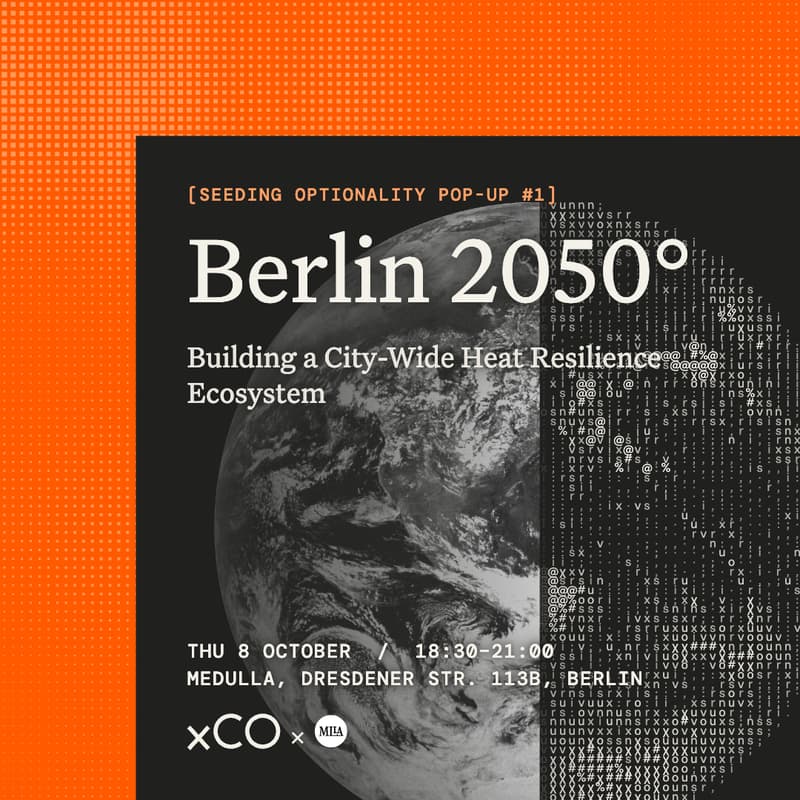

Berlin 2050° — Building a City-Wide Heat Resilience Ecosystem
Seeding Optionality, Session #1 / An xCO Pop-Up Series
In late September, we spent three hours up a hill at Teufelsberg at the Public Vitality Camp (PVC), running a heat risk clinic to identify what it would take to build a city-wide heat resilience strategy for Berlin. Using three everyday sites ("container") in the city — a Plattenbau block in Marzahn, a Kiez library, an S-Bahn station and its adjoining square — participants took on different stakeholder perspectives, working in site-specific groups to surface a hyperlocal and distributed picture of heat risk across the urban landscape.
All three groups arrived at versions of the same questions:
Who is actually allowed to act, and what gives them that standing?
What existing civic, legal and policy measures could be used for city-wide heat resilience?
How do we coordinate across sectoral silos, knowing that not everyone wants to or needs to?
It became clear, despite the focus on heat, that resilience is a fundamentally multidimensional approach. Heat in this context can be an approachable way into a wider landscape of risk: a legible threshold that makes an otherwise abstract systemic coordination question concrete, and reveals the interdependencies across water, health, housing, energy, food systems and public services.
In practice, Berlin already has a heat action plan with seventy measures, as well as a Master Wasserplan and an emerging Chief Resilience Officer role at the state level. But there is limited indication of how the two are meant to work in tandem.
The time to act is also shorter than the plans assume. A developing Super El Niño could make 2027 the hottest year on record, with Berkeley Earth estimating global temperatures of 1.67 to 1.85°C above pre-industrial levels: conditions otherwise not expected until around 2050. Next summer's heat is less an anomaly than an early rehearsal of the Berlin these plans are meant to prepare for.
Join us as we expand on the foundation built at PVC. We have invited our colleagues working on the same questions around the world to share their insights:
Madrid 2050° (Spain) — the city-wide heat resilience work focused on governance and collective intelligence infrastructure, along with new financial arrangements and accountability systems, seeded by xCO, now expanding into a broader cohort of cities starting with Berlin. Explore their learnings here.
Civic Ledger (South Korea) — a heat-risk simulation using the multi-party agreement game, part of the Civic Ledger tool.
And several others in our team working across civic tech, democratic renewal, urban climate neutrality, and more, who just happen to be in Berlin that week (serendipity at work!).
Come if you were at Teufelsberg, or if you work on heat, housing, water, health, energy or public services in Berlin and want to take this further. Bring what you or your team are already doing. A lot is already underway across the city in pieces, and we are keen to catalyse and build interconnections.
The evening
18:30 — doors open
By 19:00 — please arrive, we start on time
19:00–20:30 — discussion
20:30–21:00 — time to stay and talk over snacks and drinks
The session runs in English, with some support on-hand for German speakers.
About Seeding Optionality
For a hundred days, from mid-September to mid-December, xCO is running a pop-up studio at our field office Medulla. Every couple of weeks someone from the team puts a live piece of work in the room — a position we are taking, a capability we know we are missing, a term we are not yet sure holds — and opens it up.
The series is an attempt to do our field-building in public, anchored in one city. We want to find out whether the language we use internally means anything outside it, to join the dots between strands of our work that currently sit apart, and to get to know the people in Berlin — living here or passing through — already working on the same questions. Most of what we bring will be unfinished. Objections and adjacent work are easier to find before a position hardens.
The hundred days follow the 10x100 cycle, a quarterly organising rhythm initiated by Politics for Tomorrow and Dark Matter Labs, which several of us in the space helped build. Public Vitality Camp marked the kick-off in September.
About xCO
Expanding Civilizational Optionality (xCO) is a strand of Dark Matter Labs' work. The range of futures still available to us is narrowing, and most institutions are built to defend what already exists rather than to keep options open. xCO works on widening that range, and on the capabilities, capital and institutions that keep more futures possible.
Three ideas sit underneath the work, and Berlin is one of the first places we are putting them out into the world:
Existential becoming — what shifts in someone when they stop treating the conditions of their own life as a background somebody else maintains.
Existential capital — capital that has noticed it both shapes the future and depends on it.
Existential entrepreneurship — building what needs to exist, rather than competing for markets that already do.
We are putting these out to see what resonates, with whom, and where that can start to build traction. There is a lot that needs to happen in the world, and we are looking for people to learn and build with.
About Medulla
Medulla is a physical space for turning shared urgency into collective resilience by building new collaborations and infrastructures of prosperity. It brings together organisations, practitioners, and communities working across different fields to respond to the technical, ecological, economic, and cultural crises shaping our shared future.
Dark Matter Labs moved into Medulla in May, alongside Politics for Tomorrow / nextlearning, One Resilient Earth, VVSSL and a handful of independent collaborators, all working on resilience.