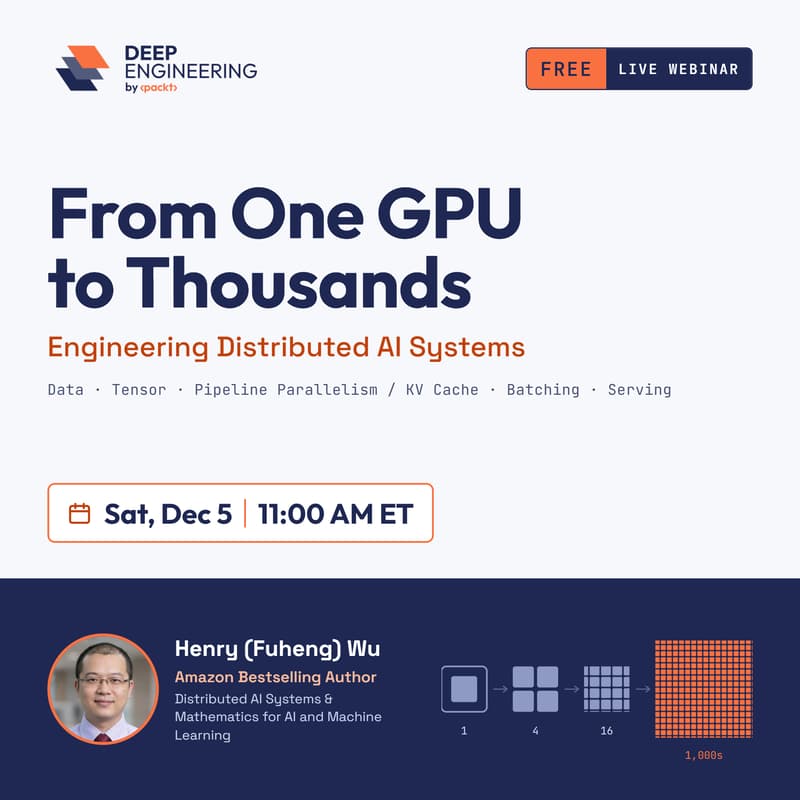

From One GPU to Thousands: Engineering Distributed AI Systems
Modern AI models have outgrown a single GPU. They are too large to fit in one device’s memory and too expensive to train or serve without spreading the work across many machines.
So how do AI systems actually scale? What changes when you move from one GPU to a cluster? And why is serving a model at scale a different problem from training it?
In this free live webinar, Henry (Fuheng) Wu will break down how AI systems scale from a single GPU to large GPU clusters, across both training and inference.
Rather than focusing only on tools and frameworks, the session will help you understand the architecture and engineering trade-offs behind distributed AI, and how teams make these decisions in real-world systems.
What You’ll Learn
Why modern AI models need distributed systems in the first place
The computational and memory limits that push models beyond a single GPU
How data, tensor, and pipeline parallelism work, and when each is used
Why communication between GPUs often becomes the real bottleneck
How KV caching, batching, and memory management make inference efficient
What drives serving efficiency in production LLM systems
How to experiment with distributed AI concepts using accessible hardware
Real-world engineering insights from building enterprise-scale AI services
Who Is This For?
This session is designed for:
ML and AI engineers who want to understand how large models are trained and served
Software and backend engineers moving into AI infrastructure
MLOps and platform engineers working with GPU clusters
Developers building with LLMs who want to understand what happens under the hood
Anyone curious about how AI systems scale beyond a single machine
You don’t need prior experience with distributed systems. A basic understanding of how machine learning models are trained will help, but the session will start with the fundamentals.
What You’ll See
Henry will walk through how a model’s workload is split and scaled, first for training and then for inference. He’ll show where the bottlenecks appear at each stage and how engineers work around them. You’ll also see how you can explore these concepts yourself without access to a large cluster.
By the end of the session, you’ll have a clear mental model of how distributed AI systems work, why they’re built the way they are, and where to start if you want to go deeper.