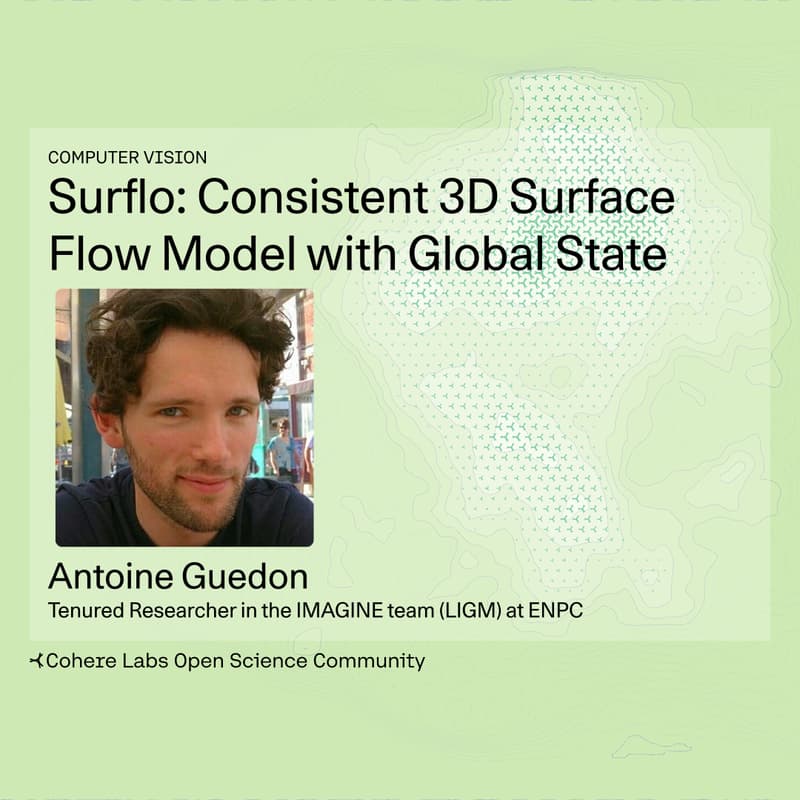

Antoine Guedon - Surflo: Consistent 3D Surface Flow Model with Global State
Geometry is invariant to viewpoint, which makes any collection of images a redundant encoding of a single 3D state. Existing feed-forward reconstruction models fail to exploit this: per-view methods emit overlapping, unaligned pointmaps that grow linearly with input count, while global-latent methods commit to a fixed, low-resolution output. We introduce Surflo, which compresses a variable number of unposed RGB views into K latent tokens-one global state-and decodes oriented 3D surface points by independently transporting them from noise onto the surface via flow matching. This frees the output from any fixed grid or token budget: the same latent yields from a few thousand to a million points in a single forward pass. To suppress the local inconsistencies inherent to independent per-point decoding, an inference-time guidance term correlates nearby points by injecting a photometric gradient during ODE integration. Surflo matches or surpasses feed-forward baselines on surface metrics, runs an order of magnitude faster than optimization-based methods that require hundreds of views, and is the only feed-forward approach to combine a global latent with arbitrary-resolution decoding.
Bio:
I am a tenured researcher in the IMAGINE computer vision lab in Paris. I just finished my postdoc in the GeomeriX team at École Polytechnique, advised by Maks Ovsjanikov, and visited UC Berkeley's AI Research lab (BAIR) as a research scholar for a few months, hosted by Angjoo Kanazawa. Before that, I received my PhD from École des Ponts ParisTech, where I was advised by Vincent Lepetit. Earlier, I studied at École Polytechnique (X2016) and at École Normale Supérieure Paris-Saclay, where I obtained the MVA MS degree.
My research focuses on reconstructing and understanding 3D worlds through deep learning. I have worked on autonomous agents that jointly learn to reconstruct and explore 3D environments, as well as on 3D reconstruction from images using Gaussian Splatting and Flow Matching.