Three Zines, Three Seeds: A Summer Residency Art Show
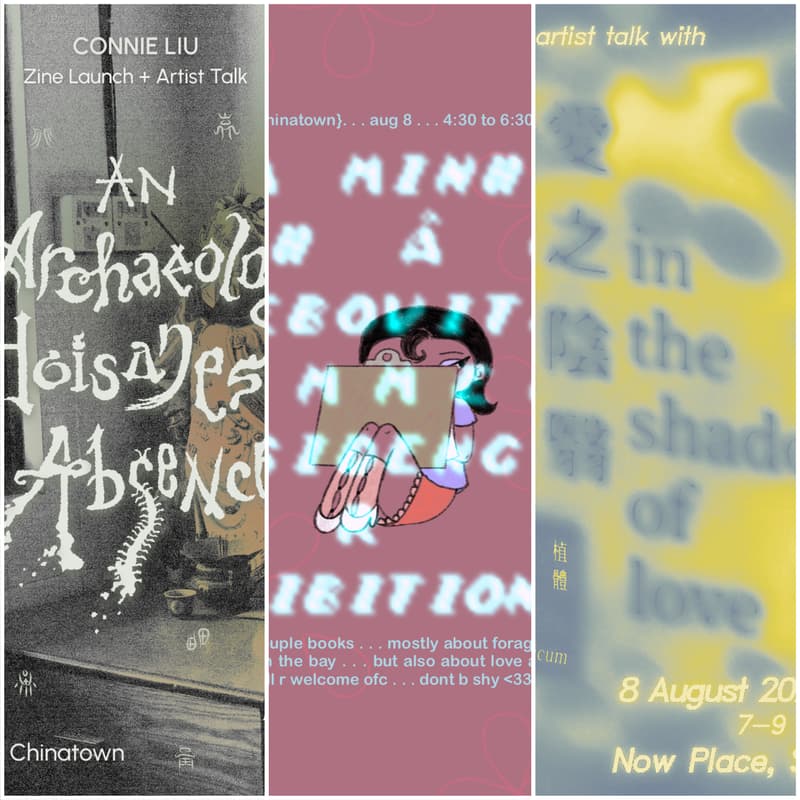
Our resident artists close out a summer of making. Come join us for the summer residency art show featuring Connie Liu, Eva Minh-châu Liebovitz, and RCRC, each presenting a zine and an exhibition born out of their time in residence.
Across the afternoon and into the evening, we move through three distinct worlds and three ways of holding what we value: a dictionary for a disappearing dialect, a playbook to the plants of the Bay, and a field journal to a garden growing out of love.
Come for one, stay for all three. Each session includes time to sit with the work and a conversation with the artist. The exhibition will run through August till early September.
✦ Event Flow ✦
2:00 PM — Connie Liu, An Archeology of Hoisanese Absences
4:30 PM — Eva Minh-châu Liebovitz
7:00 PM — RCRC, Plant Body Corpus Botanicum 植體
Each session runs roughly two hours, opening with half an hour of free roam, followed by an hour of facilitated conversation and Q&A, and closes with half an hour to mingle and pick up a zine.
✦ Exhibition Descriptions ✦
✧
Connie Liu
An Archeology of Hoisanese Absences
2:00 – 4:00 PM
An Archeology of Hoisanese Absences is a zine, an exhibition, a dictionary, a journal entry, and a memorial.
Hoisanese, once the lingua franca of Chinese America, is a language rich in onomatopoeia, emotional expressiveness, and vivid colloquialisms. Existing primarily through speech rather than writing, it contains countless everyday phrases and ways of feeling that have never had a standardized written form. Within the broader movement to revitalize fading dialects as their primary speaking populations age, An Archeology of Hoisanese Absences imagines a fictional history and speculative dictionary of Hoisanese vernacular, sentiments, and domestic histories that have never before existed on the page.
Drawing from the artist's family lineage of farmers and laborers, and unable to access their heritage through written language, the artist turns to physical craft and stone carving as methods of understanding language, memory, and record-keeping. Interwoven with photographs and anecdotes from family archives before and after immigration, the zine becomes a relic of invention in the face of time, loss, and erasure. Through labor, the artist finds kinship with ancestors who also lived outside systems of literacy, whose histories survived through memory, voice, and gesture rather than text.
✧
eva minh-châu liebovitz
summer residency exhibition
4:30 – 6:30 PM
i have two friends, angel & noelle, who show me there is food & medicine all around us in the bay. everywhere we go, they see things i don't know to see & never learned to look for, but i am learning now. i love them for teaching, one of the most loving acts you can do.
using this residency, i wanted to give my community one small tool. things you see every day can still change in meaning. the background of our lives ~ the trees in a parking lot, the branches poking through the chain-link fence ~ can still come into focus and touch us. my hope is that a few perfect afternoons, eating freely with people you love, give you a glimmer of how our lives could be/should be & ignite you. <3
✧
RCRC (Ruichen Rei Camus)
Plant Body Corpus Botanicum 植體
7:00 – 9:00 PM
Plant Body/Corpus Botanicum/植體 began with a random sketch of a blinking eye inside a pea. It grew, slowly, into a field of imaginary plants. Each one is a fragment of the human body, unfurling from the forms of plants. I collected them, categorized them and gave each one three names, in Chinese, English, and Latin.
As an act to make them physical and tangible, I carved these plants into blocks of wood, a medium my grandfather worked with throughout his life. Pressed in ink, then onto cloth, these woodcut prints serve as a field guide to my exotic garden when light. When dark, they shimmer, gazing back at me.
A field journal runs alongside, tracing the blurry intersection of human and plant. It is a reflection on my love for plants, and on the shadowy feeling that being loved has cast on me. After all, plants and I, all living beings, are we that different?