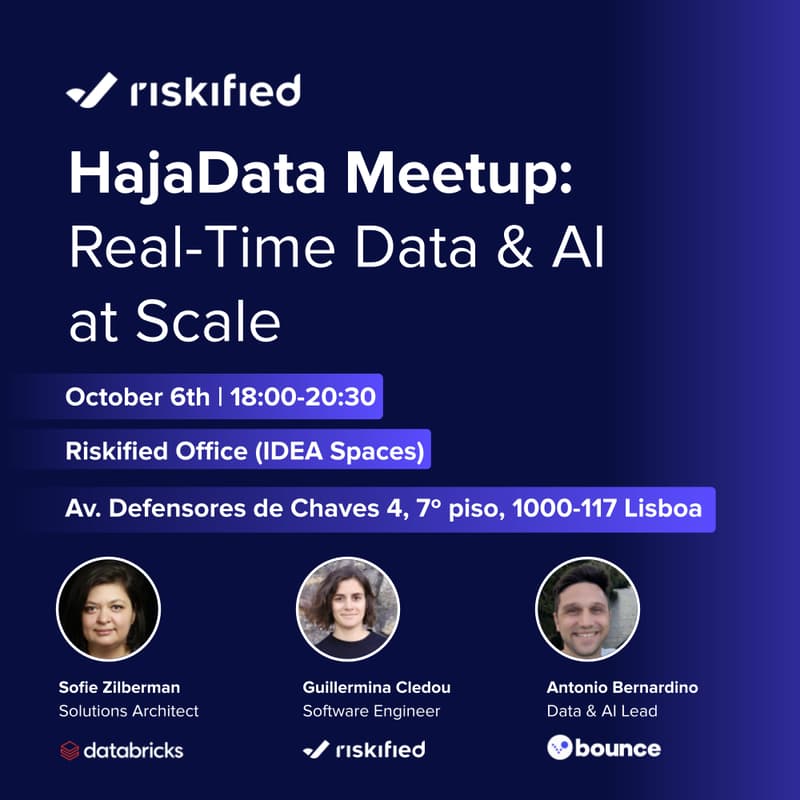

HajaData Meetup: Real-Time Data & AI at Scale
Join us for another HajaData meetup in Lisbon, bringing together the local data community for an evening of technical talks, practical insights, and good conversations.
This time, we’ll dive into the challenges of building and operating modern data systems at scale — from replaying real-time production flows over millions of historical events, through the evolving world of real-time streaming with Apache Spark and Flink, to what happens when AI agents start operating directly on top of the data warehouse.
We’ll hear from engineers and data leaders from Riskified, Databricks, and Bounce, sharing real-world architectures, challenges, tradeoffs, and lessons learned along the way.
----
Agenda:
18:00 - 18:30 - Mingling, drinks, and snacks
18:30 - 19:00 - Replay the Past, Validate the Future: Taking Online Flows Offline at Scale - Guillermina Cledou, Software Engineer at Riskified
19:00 - 19:30 - When Streaming Titans Collide: Spark 4.0™ and Apache Flink in the Age of Real-Time AI - Sofie Zilberman, Solutions Architect at Databricks
19:30 - 20:00 - Enabling Humans & AI Agents to Operate on the Data Warehouse at Scale - Antonio Bernardino, Data & AI Lead at Bounce
20:00 - More drinks and mingling
The talks will be delivered in English.
----
// Replay the Past, Validate the Future: Taking Online Flows Offline at Scale - Guillermina Cledou, Software Engineer at Riskified
What if you could take the same flows running online in production and replay them offline across millions of historical events?
Real-time systems are built to process events as they happen, but understanding the impact of a change before it reaches production requires something very different, running that same production logic over massive amounts of historical data. Bridging these two worlds means turning online flows into scalable offline workloads, while keeping the behavior as close to production as possible.
In this talk, we’ll share how we built a replay system that does exactly that, the architectural challenges we encountered, and the tradeoffs we made along the way.
By the end, you’ll have practical patterns for bridging online and offline processing, reusing production logic at scale, and building replay systems that let you evaluate changes before they reach production.
About the speaker:
Guillermina is a Software Engineer at Riskified, where she helps design and evolve the machine learning-based systems that decide millions of fraud cases a day. She has a computer science background and a research past, but these days she's happiest building the infrastructure that lets people test their ideas without holding their breath.
// When Streaming Titans Collide: Spark 4.0™ and Apache Flink in the Age of Real-Time AI - Sofie Zilberman, Solutions Architect at Databricks
For years, the line was clear: Apache Flink owned ultra-low-latency, event-driven processing while Apache Spark dominated high-throughput streaming. Spark 4.0 redraws this line. Real-Time Mode brings continuous low-latency processing to Structured Streaming, and the new transformWithState API delivers the flexible state management that event-driven systems demand.
In this session, we will dive into a technical discussion of both Spark and Apache Flink, exploring Spark’s transformWithState and RTM alongside Flink’s mature event-time engine.
As the two engines converge, we’ll examine what still sets them apart under the hood, in execution pipelines, in state backends, and in architectural philosophy, and, just as importantly, where those differences no longer matter in practice.
Whether you’re optimizing a pipeline, upgrading to Spark 4.0, or architecting a greenfield platform to serve AI agents, you’ll leave with clear criteria for choosing the right engine.
About the speaker:
Sofie designs and optimizes real-time data pipelines using Apache Flink, Kafka, and Apache Iceberg, building fast, reliable, and scalable systems for streaming and streaming analytics. With experience in both streaming and batch processing, she focuses on making data workflows efficient, observable, and high-performing. She enjoys solving complex challenges in large-scale data processing, always looking for ways to push the boundaries of performance and reliability. Passionate about Data Lakehouse technologies, she enjoys sharing knowledge through talks, hands-on sessions, and discussions on streaming architectures and real-time analytics frameworks.
// Enabling Humans & AI Agents to Operate on the Data Warehouse at Scale - Antonio Bernardino, Data & AI Lead at Bounce
For most of the data warehouse's history, the assumptions underneath it were stable. Access was granted to a known set of humans, through a known set of BI tools, with a permissions model that changed slowly enough to review by hand. Query patterns were predictable because people wrote them, and people are rate-limited by nature - by attention span, by working hours, by the time it takes to think through a JOIN.
That assumption no longer holds. AI agents now sit directly on top of the warehouse: reading schemas, generating SQL, and executing actions that used to require a human in the loop. They don't query at human cadence or human volume, and they don't fail the way humans fail - a human writes a bad query and notices; an agent can generate a plausible-looking, syntactically valid, semantically wrong query and run it ten thousand times before anyone looks.
This shift breaks assumptions at every layer of the stack. At the data layer, access control designed around static roles and a handful of BI tools has no good answer for a caller that is non-deterministic, high-volume, and capable of writing novel queries against production data in real time. At the agentic layer, an agent's ability to reason correctly about your warehouse is only as good as the schema and metadata you expose to it — and most warehouses were never documented with a non-human reader in mind. And at the operational layer, cost, latency, and correctness all need enforcement mechanisms that don't depend on a human noticing something looks wrong, because increasingly, no human is looking until the bill or the incident shows up.
About the speaker:
Antonio is a Data & AI lead at Bounce, where he designs and scales AI tooling & workflows that enable everyone to tackle data-related tasks autonomously. Currently based in Lisbon, Antonio has been working with LLMs since 2018, having trained and fine-tuned various transformer-based models since then. He is passionate about driving automation and radical simplicity in every system.
----
See you soon!