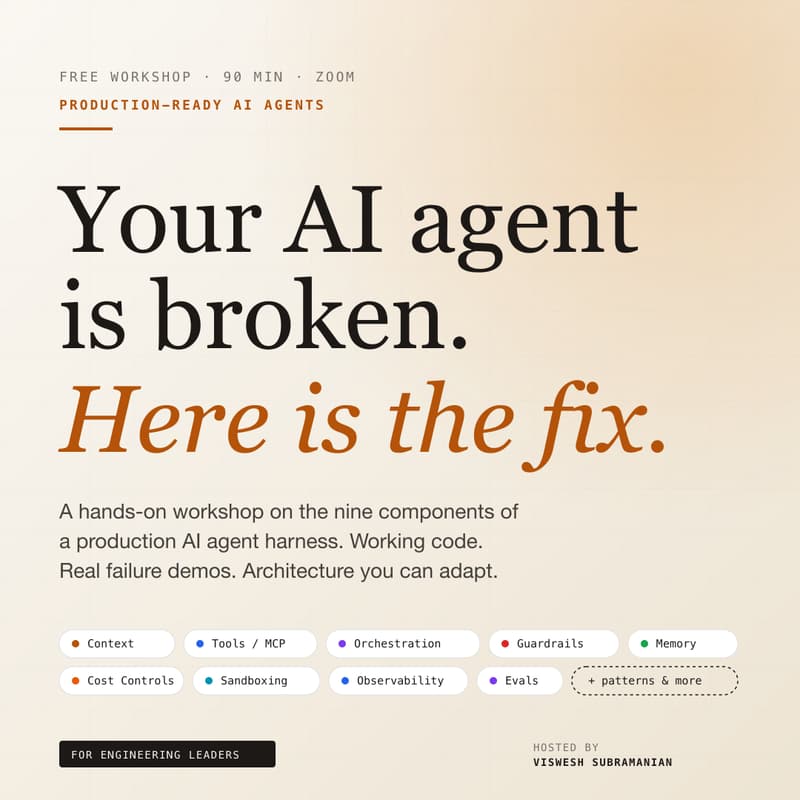
From Agent Demo to Agent System: A Production Architecture Workshop
Most AI agents look great in demos and break in production. This workshop walks through the architecture that keeps them alive — not theory, working code, real failure modes, and a reference repo you can clone.
What you get
Hands-on walkthrough of production-ready AI agent architecture
Nine harness components taken from a broken baseline to a fully wired system
Architecture you can adapt to your own stack
Who this is for
Engineering leaders shipping AI agents, or planning to
Directors, VPs, senior managers, staff engineers making build-vs-buy calls
Teams already running agents in dev and hitting production blockers
Anyone whose finance team asked "what does one AI ticket cost?" and could not answer
Not for
Researchers chasing SOTA benchmarks
ML scientists tuning models
Folks looking for prompt engineering tricks
What you will learn
Why agents break in production — seven concrete failure modes and what each one costs
How to build a harness around any LLM — nine components: context engineering, tool access, orchestration, guardrails, memory, cost controls, sandboxing, observability, evals
Why the harness is the moat — model quality is commoditizing; enterprises are deciding build/buy and Harrison Chase built Deep Agents reverse-engineering Claude Code patterns
Two-layer permission model — guidance in the prompt, enforcement in infrastructure. Prompts get jailbroken; servers don't
Deterministic vs probabilistic safety — why compliance teams won't accept "it works 80% of the time"
Memory architectures — vector vs graph vs hybrid, when to use each, and where the industry is heading
Cost controls — model routing that cuts 60–70% of spend, budget caps that stop runaway loops, circuit breakers for failing providers
Observability patterns — Langfuse traces, LLM-as-judge evals, how to debug
Migration playbook — how to add harness components to agents already in production. Order matters: observability first, then safety, then quality
What you will leave with
Architecture diagrams for all nine components
A decision framework for framework selection (Claude Agent SDK, OpenAI Agents SDK, LangGraph, Deep Agents, CrewAI)
The full
ecommerceSupportAgentrepo to clone and runA ramp-up guide covering every concept for deep reading
Format
15 min — business case and broken agent demo
45 min — walk through the four highest-impact components: context engineering, guardrails, cost controls, observability
15 min — full demo of the complete system
15 min — Q&A and what your team should do next
Live on Zoom. Recorded. Replay sent after. Free.