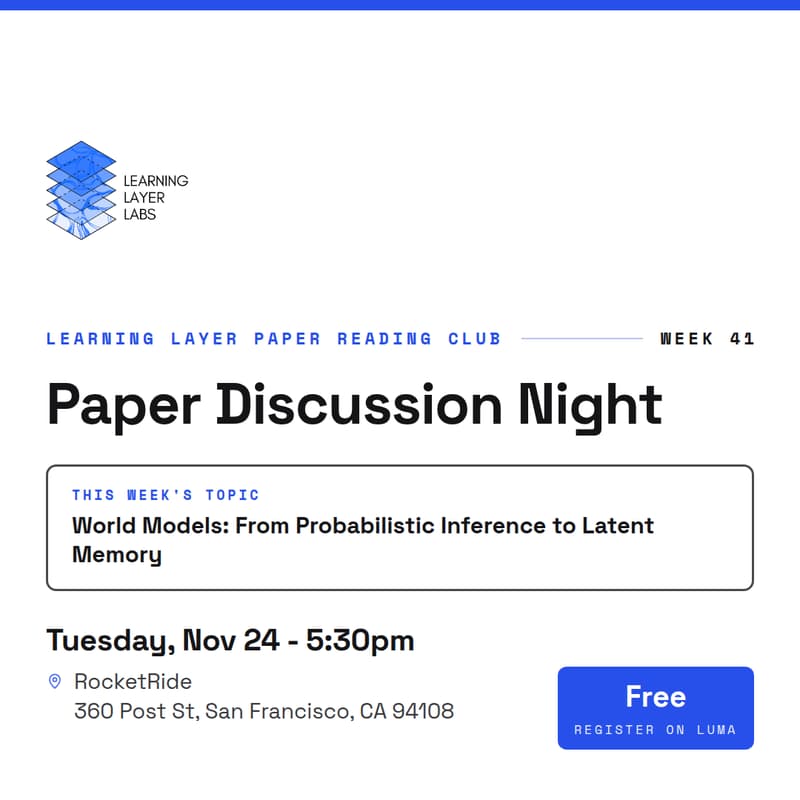

Learning Layer Paper Reading Club - Week 42 - World Models and Latent Memory
This week's topic: World Models: From Probabilistic Inference to Latent Memory
About the session:
How can AI systems build internal models of the world, update their understanding as new information arrives, and use that knowledge to adapt their behavior?
In this session, we'll explore the foundations of probabilistic world models, introducing key ideas from Bayesian inference, latent-state modeling, and sequential prediction through mathematical intuition and accessible examples.
We'll then connect these foundations to a growing family of neural architectures that use learned latent representations to maintain memory and adapt their predictions, with particular attention to recent developments in adaptive language models.
Along the way, we'll discuss different approaches to representing and updating information, the relationship between latent states and neural network parameters, and open questions surrounding memory, uncertainty, and continual learning.
Primary reference papers:
LatentTrack: Sequential Weight Generation via Latent Filtering: https://arxiv.org/abs/2602.00458
Recursive State-Augmented Language Models: Persistent Latent-State Adaptation of Pretrained Language Models: https://arxiv.org/abs/2611.16375
Several related architectures will be covered as supplementary references. The plan is to introduce the foundational ideas in the first half, then use these papers to motivate a broader discussion of adaptive neural memory and world models.
This week's discussion lead is Omer Haq. Omer is a machine learning researcher and mathematical physicist whose work spans probabilistic AI, continual learning, dynamical systems, and physics-inspired neural architectures. His background is rooted in theoretical and mathematical physics, with doctoral research and publications on wave scattering, resonant phenomena, and metamaterials.
His research experience spans a broad range of disciplines, from DARPA-funded programs at the intersection of machine learning, statistical signal processing, and adaptive sensing to investigating the foundations of memory, reasoning, and adaptation in AI systems at research-focused startups.
His current research explores the mathematical foundations of adaptive intelligence, with particular interests in Bayesian learning, neural operators, world models, uncertainty quantification, and continual learning. His recent work focuses on architectures that enable neural networks and language models to adapt dynamically, maintain persistent memory, and learn from experience.
LinkedIn: omer-haq-phd GitHub: Haq94 Google Scholar: https://scholar.google.com/citations?user=74Q3FRQAAAAJ
No preparation required — come read and discuss with us.
What is the Learning Layer Labs Paper Reading Club?
An initiative from https://www.learninglayer.ai, a lab with the goal of reducing AI anxiety in the world.
What is the format?
Discussion based. Expect a low pressure environment to share insights and opinions with the group.
What are the group goals?
Stay on top of AI research and improve understanding of AI fundamentals + math.
Who is welcome?
Everyone! Try to put in at least some time on the paper and come prepared with questions or things you'd like to discuss, but it's ok to just show up!
Learning Layer Labs team:
Thomas Redfern ( The backbone who runs every paper reading )
Mat Allen (The new fella bring order and organization)
Devinder Sodhi (The guy you talk to for sponsoring)