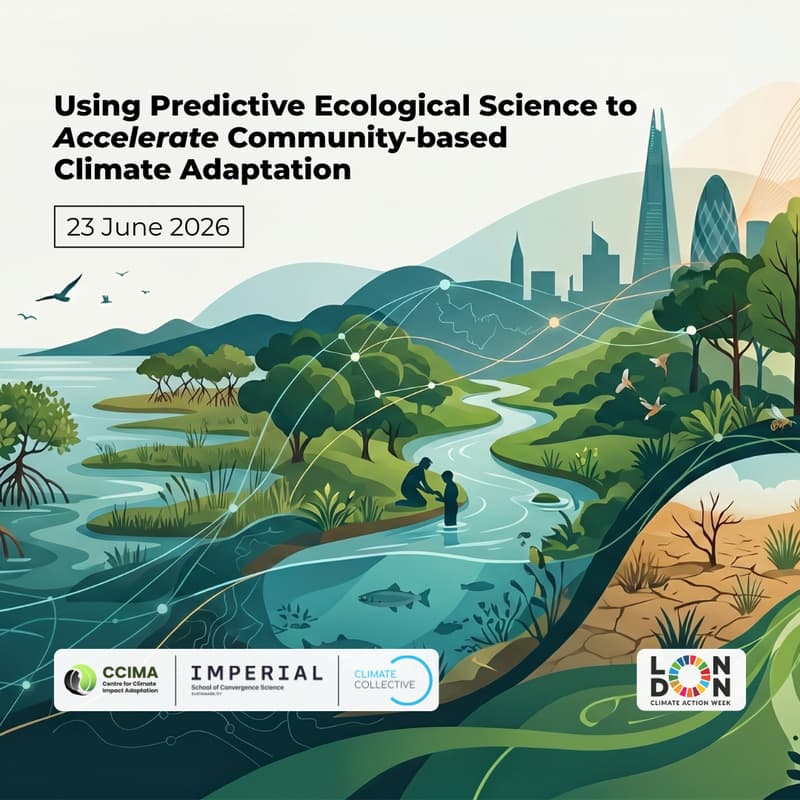
Using Predictive Ecological Science to Accelerate Community-based Climate Adaptation
This London Climate Action Week event focuses on a new approach to Adaptation & Resilience: Using predictive ecological models – based on cutting-edge biodiversity and ecosystem science – to devise climate adaptation strategies that are rapidly implementable, highly investable, and optimised for both long-term climate resilience and enhanced ecosystem service benefits (as defined in the UN SEEA-EA framework).
Most discussions of nature-based solutions for climate adaptation treat biodiversity as a co-benefit of ecosystem restoration efforts. This event starts from the opposite premise, grounded in modern ecological science: Biodiversity is, in fact, the fundamental driver of ecosystem function and climate resilience, controlling how critical ecosystem services such as carbon storage, water regulation, food security, and livelihood resilience evolve in response to climate change.
Moreover, modern ecological science can predict this biodiversity-ecosystem relationship under various climate change scenarios. This enables, for the first time, the development of targeted adaptation solutions that are optimised for place-based climate resilience; enhancement of key ecosystem services for local communities; and return on investment, e.g., via predictable, risk-mitigated carbon storage and credit outcomes.
Hosted by Imperial College London's School of Convergence Science in Sustainability, the Centre for Climate Impact Adaptation (CCIMA), Imperial Global Hub India, and the Climate Collective Foundation (CCF), this event will bring together leaders from research, philanthropy, finance, policy, climate-tech innovation and community-led implementation to explore how such cutting-edge ecological science, community-based approaches and climate finance can be rapidly brought together to accelerate climate adaptation, with particular attention to India and South Asia.
The session will include opening remarks, a keynote address, a tightly moderated panel, a CCIMA case study, Q&A and a networking lunch. The aim is to build practical partnerships around science-based, ecosystem-centred adaptation, and identify funding and implementation pathways for scaling credible resilience solutions.
Keynote Speaker
Abinash Mohanty
Global Sector-Head Climate Change & Sustainability, IPE Global
Panel Topic
Economic drivers, hurdles, and perceptions of risk in the rapid implementation of climate adaptation.
Panel Speakers
D. Michael Adams - Founder & CEO, Ocean Assets - BlueDeals
Will Pearse - Associate Professor of Evolutionary Ecology, Imperial College London
Ramanshu Ganguly - Partner and Lead: Adaptation & Resilience, Energiva Ventures
Vassilis Gkoumas - Economist, World Wildlife Fund (WWF) - UK
Note: This event is invite-only with limited capacity. Only approved registrations will get access to the event.