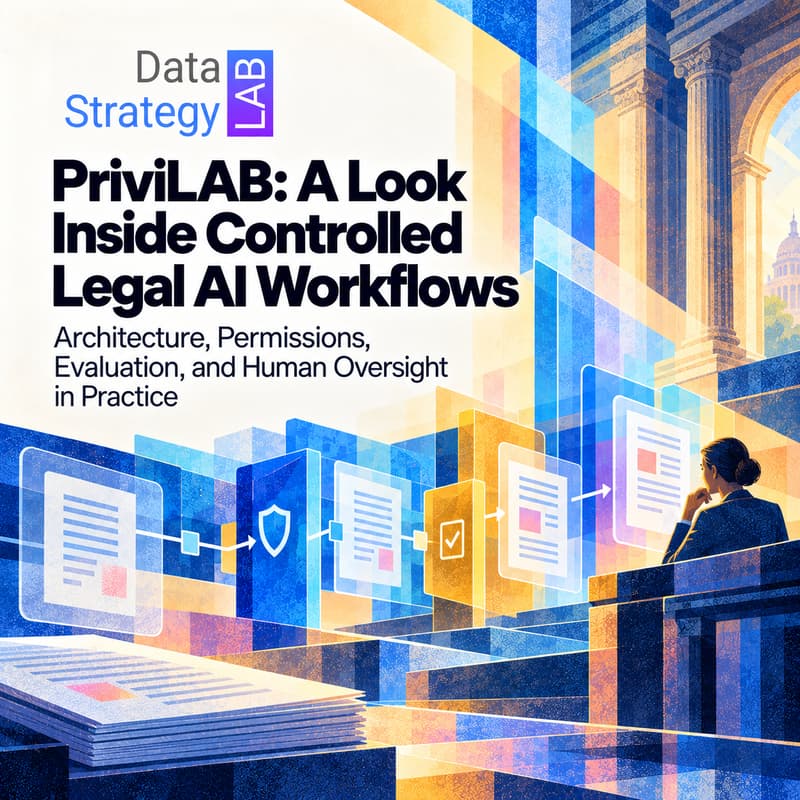

PriviLAB: A Look Inside Controlled Legal AI Workflows
PriviLAB: A Look Inside Controlled Legal AI Workflows
Architecture, Permissions, Evaluation, and Human Oversight in Practice
About
As law firms move beyond standalone AI assistants, technical teams face new challenges. AI systems must connect to internal knowledge, respect access permissions, produce verifiable results, and support appropriate human oversight.
What does it actually take to build an AI workflow that a law firm can control, evaluate, and trust?
Join Data Strategy Lab for a deep dive into PriviLab, our reference framework for building controlled, permission-aware AI workflows.
We'll walk through the architecture, explain the design principles, and demonstrate how different components work together to control what an AI system can access, how its outputs are evaluated, and what happens when a workflow fails a critical check.
What We'll Explore
PriviLab brings together several technical patterns relevant to firms developing their own AI capabilities or extending existing platforms.
In this session, we'll explore:
Architecture and Technology Stack: How to organize AI models, tools, retrieval, evaluation, and human review into a structured workflow.
Permission-Aware Retrieval: How access decisions can be enforced before information enters the model's context, especially when working with sensitive data.
AI Models and Provider Flexibility: How to separate workflow controls from specific AI models to support different model and deployment choices.
Evaluation and Reliability: How task-specific checks, source verification, and critical evaluation gates can help determine whether an AI-generated output is ready for review.
Human Oversight and Safe Failure: What happens when permissions are missing, evaluation criteria fail, or a reviewer rejects an output.
Throughout the discussion, we'll distinguish between capabilities demonstrated in the reference implementation and the additional engineering, integration, and governance work required for real-world deployment.
What You Will Take Away
By the end of this webinar, you'll have a clearer understanding of:
How to structure AI workflows around permissions, evaluation, and human oversight;
Engineering components and design decisions involved in building controlled AI systems;
How an open reference architecture can inform the development or evaluation of firm-specific AI solutions; and
Which questions technical and legal teams should resolve before moving from a demonstration to an operational workflow.
Who Should Attend
This session is designed for law firm leaders who are already exploring or using Generative AI.
We welcome participation from:
CIOs, CTOs, and law firm technology leaders;
managing partners and law firm operations executives;
knowledge management and information governance leaders;
legal risk and compliance professionals; and
other AI innovation and legal engineering professionals.
Speakers
Andrew Tsintsiruk - Founder & Managing Partner, Data Strategy Lab; Lead Architect, PriviLAB
His work focuses on connecting models to governed knowledge, evaluating outputs, and building human decision points into workflows.
Adrian Erlinger - Business AI Strategist, Data Strategy Lab
He helps organizations turn AI experiments into workflows with owners, review paths, and measures of value.
Antonia (Toni) Dumas - Responsible AI & Data Governance, Data Strategy Lab; Attorney (privacy, cyber & AI)
She advises on privacy, security, and trust in digital products and tool adoption.
About Data Strategy Lab
Data Strategy Lab helps knowledge-based organizations in the Washington, DC area move from AI experimentation to practical implementation. We combine AI strategy, workflow redesign, systems and data engineering, systems integration, task-specific evaluation, and governance implementation to help organizations build reliable AI capabilities that improve productivity, strengthen knowledge management, and support professional judgment.
This session is educational. DSL is not a law firm and does not provide legal advice.