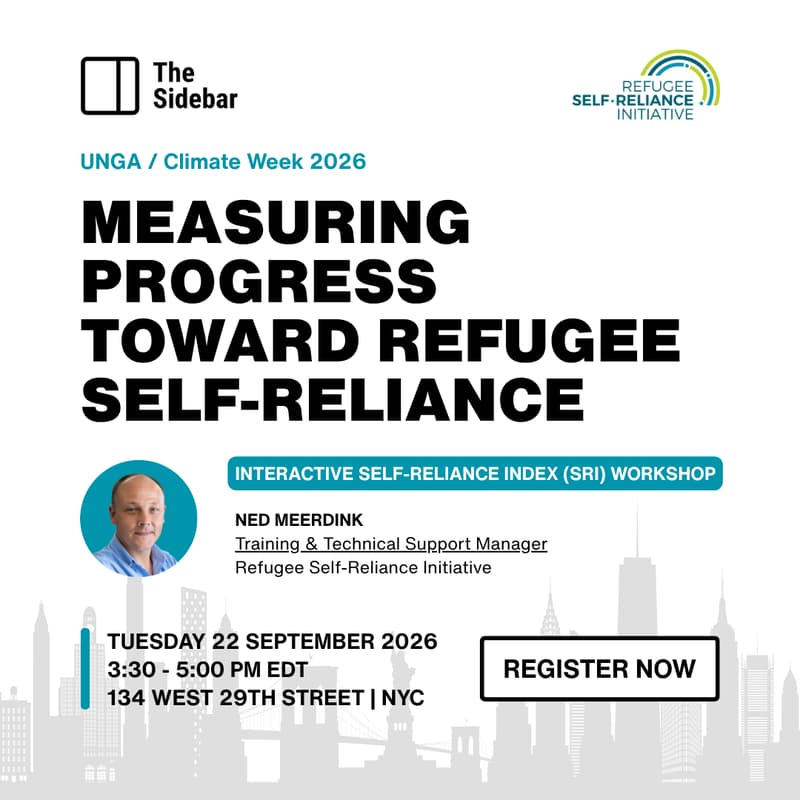

Measuring Progress Toward Refugee Self-Reliance
About the session
What does it actually mean for a refugee to become more self-reliant?
Income matters. But income alone cannot tell you whether someone has stable housing, access to healthcare, enough food, documentation, education, safety, social connections, or the ability to navigate the systems around them.
And that creates a measurement problem.
Programs designed to support refugee self-reliance need to know whether people's lives are actually becoming more stable over time. Donors need to understand whether investments are working. Governments and humanitarian organizations need evidence that can inform decisions.
But what we choose to measure shapes what we are able to see.
This interactive workshop introduces the Self-Reliance Index (SRI), a holistic measurement tool designed to assess refugee self-reliance across multiple dimensions rather than reducing progress to a single economic indicator.
Led by Ned Meerdink, Training & Technical Support Manager for the Refugee Self-Reliance Initiative (RSRI), participants will explore both the practical use of the SRI and the thinking behind it.
How do you turn something as multidimensional as self-reliance into something that can be measured?
Which dimensions matter?
How can measurement identify barriers that a program might otherwise miss?
How can organizations track change over time without confusing what is easy to count with what actually matters?
And how can the resulting evidence influence program design and decision-making rather than simply becoming another reporting requirement?
These questions are particularly important in a humanitarian system under enormous pressure. As organizations look for approaches that can support refugees beyond emergency assistance, the ability to understand whether people are genuinely progressing toward greater self-reliance becomes increasingly important.
The workshop will draw on applications of the SRI across different contexts, alongside emerging academic and practitioner work using the tool, to examine both what holistic measurement can offer and the questions practitioners should ask when applying it.
What to expect
This is a 90-minute interactive workshop rather than a presentation about measurement.
For approximately the first hour, Ned will introduce the conceptual approach behind the Self-Reliance Index, walk participants through the tool itself, examine how it has been applied in different settings, and explore why holistic measurement matters in the current humanitarian context.
The final 30 minutes will open into discussion, questions, and exchange with participants, creating space to interrogate the methodology, compare experiences, and explore potential applications.
The aim is for participants to understand not only what the SRI measures, but how to think more critically about measuring self-reliance itself.
Who this is for
This workshop is for practitioners designing and implementing refugee programs, humanitarian and development organizations, policymakers, donors, monitoring and evaluation specialists, researchers, refugee-led organizations, and others trying to understand whether interventions intended to support refugee self-reliance are actually producing meaningful change.
What you will get out of it
A practical introduction to the Self-Reliance Index and the conceptual framework behind it
A stronger understanding of why refugee self-reliance needs to be measured across multiple dimensions
Examples of how the SRI is being applied in different operational and research contexts
Practical ways measurement can inform program design, monitoring, learning, and decision-making
An opportunity to examine the strengths, limitations, and potential applications of holistic self-reliance measurement with other practitioners
Featuring
Ned Meerdink, Training & Technical Support Manager, Refugee Self-Reliance Initiative (RSRI)
Hosted by
Refugee Self-Reliance Initiative (RSRI)