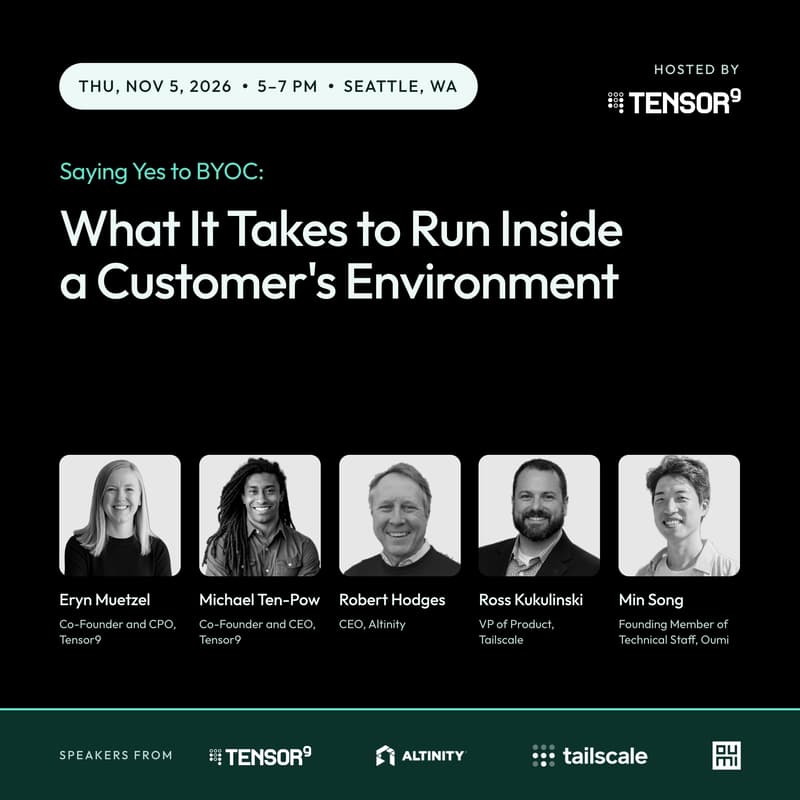

Saying Yes to BYOC: What It Takes to Run Inside a Customer's Environment
Enterprises are asking vendors to run software inside their own environments instead of buying it as SaaS, usually because of rules about where their data can sit or a security team that won't approve it leaving the network.
When that ask comes in, many vendors say no, because they imagine maintaining the product twice, forever. We are hosting an evening with teams that said yes and can tell you what it actually took. Expect the parts that went wrong, not just the parts that went right.
Each speaker gives a short talk, then we'll get them on a panel and take your questions.
If you're working through this, you'll be in good company. Come spend an evening with people who've been through it.
Agenda
5:00pm: Networking
5:30-6:30pm: Talks and speaker panel
6:30-7:00pm: Networking
Speakers
Eryn Muetzel, Co-Founder and CPO, Tensor9
Michael Ten-Pow, Co-Founder and CEO, Tensor9 (Panelist)
Robert Hodges, CEO, Altinity
Ross Kukulinski, VP of Product, Tailscale
Min Song, Founding Member of Technical Staff, Oumi
Talk Descriptions
What It Takes to Say "Yes" to BYOC
Speaker: Eryn Muetzel, Co-Founder and CPO @ Tensor9
Enterprises push for BYOC for reasons that compound: data residency and sovereignty, security teams that won't let sensitive data leave their boundary, and cost. Moving the biggest, most sensitive datasets out to a vendor's SaaS is expensive, and egress plus duplicated storage adds up fast.
Most vendors never say "yes," because they assume BYOC means a second version of the product running next to the SaaS: two codebases, every upgrade done twice. It doesn't have to work that way. We'll walk through the sharp edges and the ways through them. How a control plane reaches into a customer's environment. Where the shared-responsibility line actually falls. Why you're often better off leaving some dependencies managed than absorbing every one of them yourself. And the one most teams underestimate, that equivalent functionality is not identical runtime behavior, with concrete examples of where that bites, and how to handle it.
Come away knowing why enterprises want BYOC, why it's more achievable than the horror stories suggest, and how to say "yes" with confidence.
Debunking Three Myths on Oumi’s Path to BYOC
Speaker: Min Song, Founding Member of Technical Staff, Oumi
Since GPT-3.5 launched, working in AI has meant constantly racing against a market that changes every few months. At Oumi, we made an early bet that companies would want to build and own custom models instead of relying only on frontier APIs, and that helped our open-source platform gain early popularity. But turning that popularity into an enterprise business forced us to debunk three myths: that broad adoption naturally leads to revenue, that customers mainly want custom models to save money, and that BYOC or on-prem deployments are too risky for an early-stage startup. We found that many of the strongest customers were large enterprises that cared more about accuracy, privacy, and data residency. In this talk, I’ll share how those lessons changed our strategy and how Tensor9 helped us say yes to those customers much faster.
BYOC Moves the Software. What About Access?
Speaker: Ross Kukulinski, VP of Product, Tailscale
Moving software into a customer's cloud changes more than where it runs. Vendors still need to deploy updates, monitor performance, and troubleshoot problems. Customers want to control how those connections happen, without opening up their infrastructure to unnecessary risk.
So how do you give vendors the connectivity they need without compromising the customer's security requirements?
In this talk, we'll explore the networking challenges behind Bring Your Own Cloud, from control-plane connectivity to secure operational access. Using Tensor9's integration with Tailscale as a practical example, we'll look at how identity-based private networking can simplify connectivity across cloud environments, reduce reliance on public endpoints, and avoid turning every customer deployment into a bespoke networking project.
Altinity talk abstract coming soon…