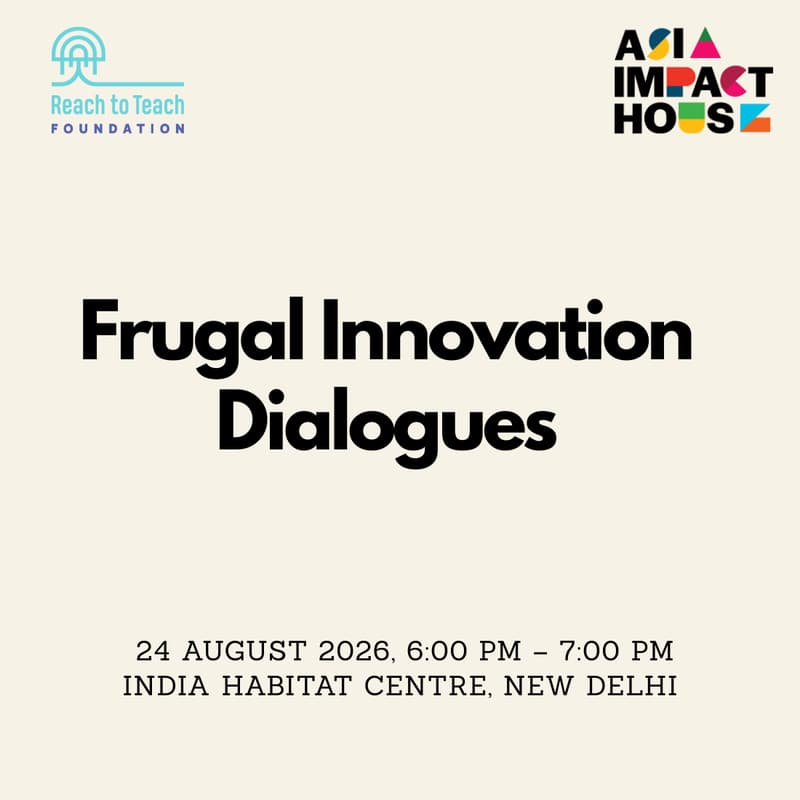

Frugal Innovation Dialogue
About Event
In education systems operating with limited resources, weak connectivity, and significant learning gaps, innovation cannot be measured by novelty alone. The real test is whether solutions are affordable without compromising quality, can work within existing public systems, and can ultimately be adopted and scaled by governments. Reach to Teach Foundation’s Frugal Innovation Dialogues was created to interrogate exactly this question: what actually counts as good frugal innovation?
As part of Asia Impact House, Reach to Teach Foundation, in partnership with MASH, is convening the second edition of the Frugal Innovation Dialogues — carrying forward a conversation first launched at the Skoll World Forum in Oxford. While the inaugural dialogue focused on defining and diagnosing good frugal innovation, the second edition will move from diagnosis to test, bringing practitioners together with the funders, policymakers, multilaterals, and public-system leaders who determine what gets financed, adopted, and scaled.
Designed as an invitation-only working roundtable, the discussion will explore what it takes for resource-conscious innovations in education to move beyond promising pilots and become credible, system-ready solutions — particularly across low-tech and no-tech contexts in Asia-Pacific.
Discussion Themes
Frugal innovation without lowering the bar — what does high-quality, inclusive innovation look like in low-resource, low-connectivity education settings?
Frugal AI in low-tech and no-tech environments — how can AI meaningfully strengthen learning without assuming infrastructure that does not exist?
Teachers as part of the innovation — rethinking teacher capability and designing solutions around educators rather than treating them as a constraint.
What governments can actually absorb — the adoption, financing, and integration pathways required for innovations to move from pilots into public systems.
Cross-geography replication — what can travel across India, South and Southeast Asia, and the Pacific, and what must be redesigned for local contexts?
Building a stronger evaluation framework — moving beyond cost per beneficiary to assess quality, equity, learning outcomes, and systems fit.
Who Should Attend
This invitation-only convening is designed for leaders from:
Philanthropic foundations, family offices, and CSR
Government and education policy bodies
Multilateral and development organisations
Impact investors and education funders
Education innovators and implementing organisations
Ecosystem builders and systems-change organisations
Organisations working on AI, EdTech, and resource-conscious education models
Practitioners working across South and Southeast Asia and the Pacific