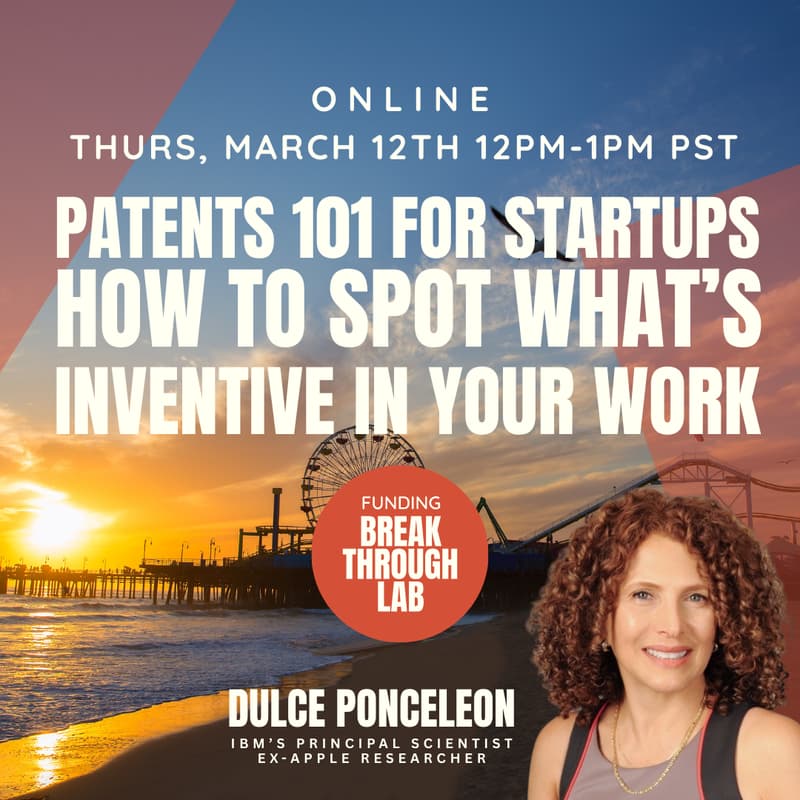

Startup Patents 101: How to Spot What's Inventive in Your Work
Dulce Ponceleon is a senior computer scientist and inventor with a career spanning two of the world’s most iconic technology companies — IBM and Apple. A former Master Inventor at IBM, a distinction earned through sustained, significant contributions to the company’s patent portfolio, she holds 77 granted patents across information security, blockchain, data compression, information retrieval, and user experience, with 30+ granted since 2020.
Over two decades as an inventor, Dulce has developed a rare skill: teaching engineers and researchers to think like inventors — spotting the technical choices buried in everyday work that are actually patentable. She has guided many through filing their first patent disclosure, a milestone that can define an innovator’s career. A recipient of IBM’s Best of IBM award, Dulce brings deep experience with disruptive technologies and standards bodies, where she learned to think simultaneously as an engineer and a strategist — understanding not just what’s innovative, but what’s protectable. She now brings that expertise to startups, helping founders understand what makes their work inventive — and how to navigate the US patenting system (USPTO) to protect it.
Abstract
Startups take very different approaches to Intellectual Property (IP). Early-stage founders often struggle to decide how much attention to give to the topic — some move quickly and postpone thinking about patents until much later, while others invest early in filings that may or may not align with their core technical advantage. This talk offers a practical framework to recognize which technical ideas in your work may actually be worth protecting, before the window of opportunity disappears.
Based on decades of experience, and through real-world examples from software systems, security, and product development, we show how founders and engineers can turn surprising observations into defensible intellectual property. We also cover patent fundamentals—novelty, non-obviousness, and utility—translating them into practical questions you can apply during product development.
Key Takeaways
1. You cannot schedule an invention — but you can train yourself to have an inventor’s eye. Learn to look at your own engineering decisions the way a patent evaluator does.
2. Most patents don’t result from a sudden moment of genius. Inventions can emerge from friction, anomalies, and the moments when something works better than it should.
3. Your prior career may be your most underused asset. Knowledge obvious in one domain is often novel in another — and that asymmetry is one of the most reliable sources of startup IP.
Funding Breakthrough Lab is a San Francisco 501(c)(3) nonprofit pre-accelerator that helps founders strategize, fundraise, and grow their startups. With a mission to build a better tomorrow, we’ve created a thriving community of over 19,000+ subscribers where education, networks, and resources come together to unlock founder potential.
We specialize in helping early-stage entrepreneurs navigate the complexities of fundraising—whether through grants, venture capital, or alternative funding paths—while championing diversity, inclusion, and authenticity.
Founded by Natalie Pan, an engineer, community builder, and executive coach, Funding Breakthrough Lab provides the tools and support you need to move from idea to investment.
Apply now for the next cohort and gain the credibility, connections, and confidence to secure funding for your startup: fundingbreakthroughlab.org