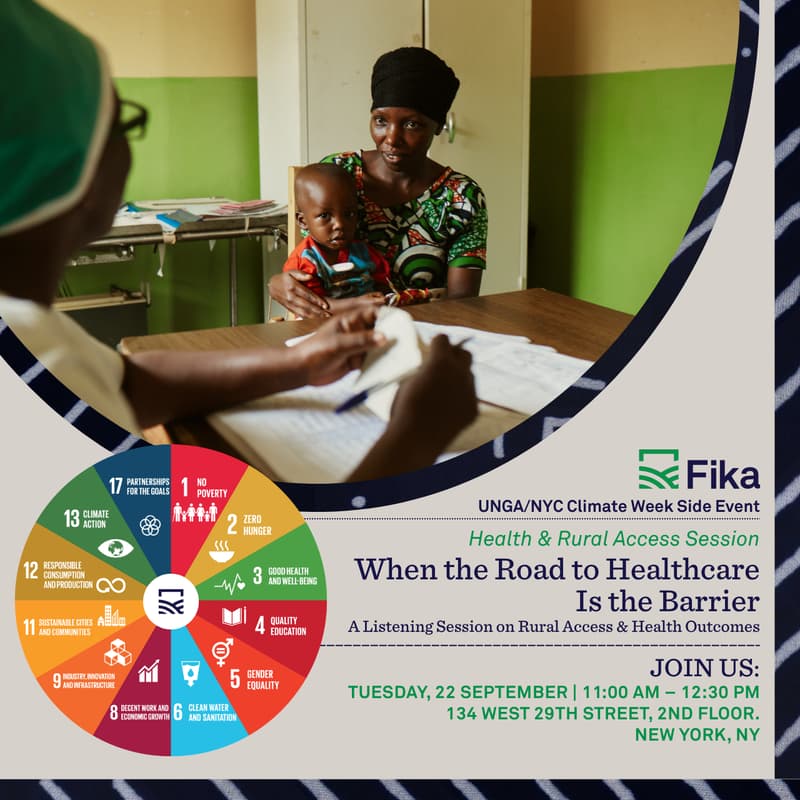

When the Road to Healthcare Is the Barrier
A health system can have trained workers, available medicines, and functioning facilities, but none of that delivers its full impact if people cannot reliably reach care.
Across many rural communities, distance, travel time, seasonal isolation, unsafe crossings, and unreliable transport shape whether and when people interact with the health system. These barriers may be particularly consequential when time and continuity matter most: reaching emergency obstetric care, completing childhood immunizations, accessing treatment, delivering medicines, or enabling community health workers to reach remote households.
Yet physical access can sit at the edges of health systems thinking, treated as an infrastructure or transport problem rather than a determinant of whether healthcare actually reaches people. This session will test that assumption. Where does rural connectivity already feature in health planning, and where is it a blind spot? Which health outcomes are most sensitive to unreliable access? And what evidence would make governments, funders, and health practitioners treat connectivity as part of health systems strengthening?
Fika works with governments on rural access through infrastructure, geospatial analysis, and decision-support tools and is exploring how that experience could contribute to health. Rather than arriving with a predetermined solution, Fika will use this session to listen. Participants will be invited to challenge the premise, identify where existing health-sector approaches already address these problems, and examine where new collaboration could add value without duplicating work already underway.
The goal is to sharpen a practical question with implications across infrastructure and global health: when access to care is constrained by the journey itself, what should health systems do differently?
What to expect
A small, informal listening session with most of the time devoted to participants' experience and expertise. Co-facilitated by Moving Health, Fika will briefly frame the question before inviting global health practitioners, government representatives, funders, and researchers to explore where rural access matters most and what the health sector already knows.
Insights from the conversation will inform a concise Rural Access and Health Learning Brief capturing what participants validated or challenged, important evidence gaps, and potential opportunities for further research or collaboration. Comments will not be attributed without permission.
Who this is for
This session is for global health practitioners, government leaders, funders, researchers, health systems experts, infrastructure and transport practitioners, and others interested in how geography and physical connectivity shape access to healthcare in rural communities.
What you will get out of it
A deeper exploration of where physical access may be constraining health outcomes in rural communities
Perspectives on which health services and outcomes are most sensitive to distance, travel time, and seasonal isolation
Insight into how governments and health partners currently identify and respond to geographic barriers to care
A clearer view of the evidence needed to connect rural access with health planning, financing, and decision-making
Opportunities to identify research, policy, and implementation partnerships across health and infrastructure
Hosted by
Fika