
Beyond Enrichment: Finding true binders in display campaigns
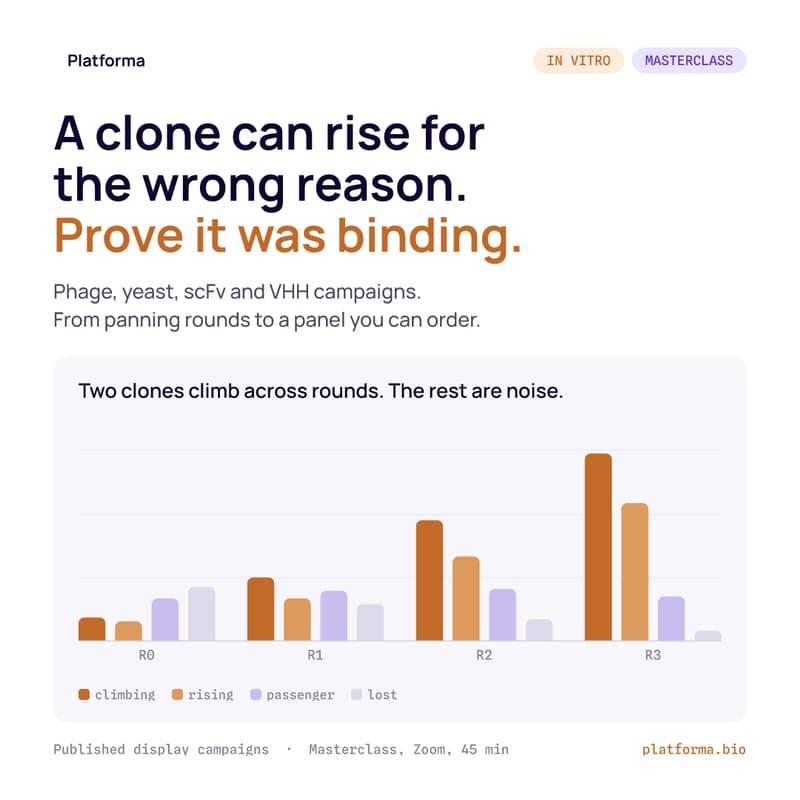
A clone can become more common across rounds without binding better. It may grow or express better. Or a dominant neighbour may carry it along.
By the final round you have a ranked list that looks convincing. How much of it is real is the open question?
This webinar is for scientists and discovery leaders running in-vitro display campaigns in phage, yeast, RNA or peptide who want to separate true binders from amplification artifacts, and finish with a shortlist that is both diverse and developable.
We run a published display campaign end to end, live, from raw FASTQ to a panel ready to order. Along the way we show the quality checks that tell you whether a selection worked at all, and the ones that tell you a library has failed.
What you'll learn:
Getting clean clonotypes from any library format: scFv, VHH or Fab, short read or long read, with the error correction that removes sequencing noise
Reading enrichment properly: calculate fold change across rounds on clusters rather than single clones, so a family of near-identical variants counts once
Telling specific from sticky: use control arms and unselected baselines to isolate binding to your target rather than to the plastic
Proving the selection worked: rarefaction, diversity collapse and CDR3 spectratype changes that distinguish an enriched library from a dead one
Finishing with a panel you can order: apply sequence liability and humanness filters, spread the picks across distinct families, and export the list
Who should attend:
Protein engineers and antibody scientists running display campaigns and affinity maturation
Bioinformaticians supporting selection analysis who want enrichment, quality control and liability screening on one reproducible path
Discovery and project leads deciding which candidates go to expression and characterization