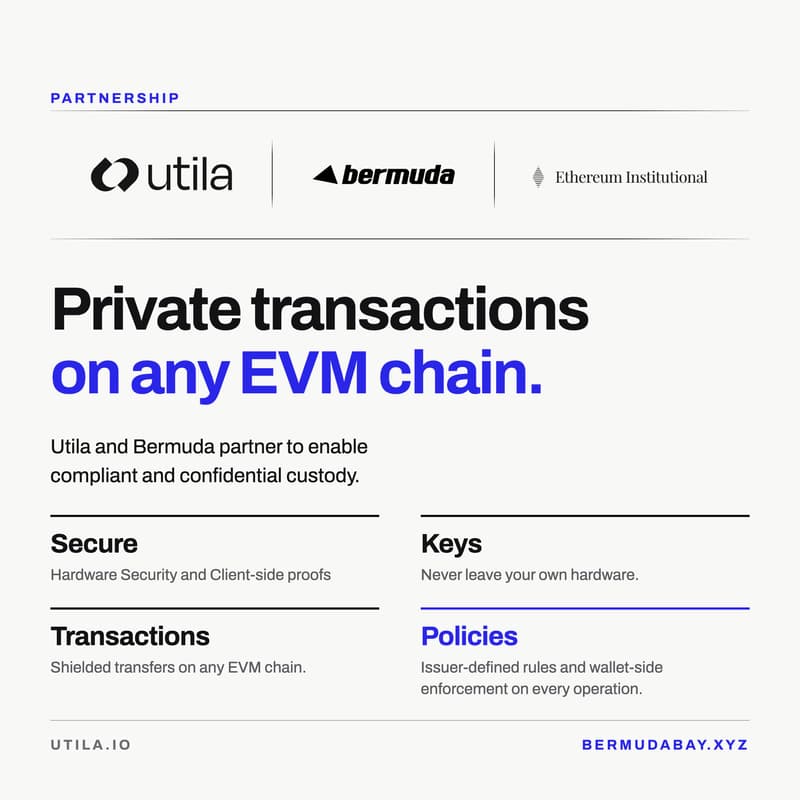

Private transactions and custody on any EVM chain
A joint online event by Bermuda, Utila, Ethereum Institutional, and Optimism on how banks, financial institutions, and digital asset businesses achieve privacy and compliance on public EVM chains.
On the panel: Karl Floersch, co-founder and CTO of Optimism; Angel Gomez, Sales Director at Utila; Matthew Dawson, co-founder of Ethereum Institutional; Alexander Wilke, co-founder and CEO of Bermuda. Panel discussion and open Q&A.
Privacy has been fundamental to institutional adoption. Yet institutions were forced to make trade-offs: Different chains, accepting a less-liquid asset, or weaker custody.
This has come to an end: Utila and Bermuda partnered to enable private transactions on any EVM chain. Arbitrary assets secured by hardware security modules and policies can be sent privately and used in any DeFi application.
Utila and Bermuda are hosting a joint seminar for anyone working on custody, settlement, and privacy on shared infrastructure. Banks, asset managers, market infrastructure operators, regulators, digital asset businesses, and the teams building for them are all welcome.
We are joined by Karl Floersch, co-founder and CTO of Optimism, and Matthew Dawson, co-founder of Ethereum Institutional. Karl leads the technology behind the OP Stack and has worked on privacy on Ethereum since the network's early days. Matthew was the Ethereum Foundation's first Enterprise Lead and now runs institutional engagement at Ethereum Institutional.
What the seminar covers
Key control. Why supervisors in Hong Kong, Japan, Singapore, and the EU converge on certified hardware and offline key generation, and what it takes to run wallet keys inside an HSM the institution owns and operates, on-premises or air-gapped.
The stack around the key. An HSM secures one thing. Multi-chain connectivity, address management, policy engines, approval quorums, AML screening, audit logs, and reconciliation are what turn a secured key into a working operation.
Confidentiality on chain. Shielded balances, stealth addresses, compliance screening on every transfer, atomic settlement, DeFi, and selective disclosure to supervisors and auditors.
Live walkthrough. A repo operation where each counterparty sees only its own allotment. A cross-border transfer that settles atomically while the flow stays confidential. An issuance that becomes public when the issuer publishes aggregates, on its own schedule.
Panel discussion and open Q&A. Bring the hard questions. Regulatory posture, threat models, integration effort, and where this breaks.
Who should come
Custody, treasury, digital asset, risk, compliance, and technology teams at central banks, commercial banks, and regulated financial institutions. Market infrastructure and exchange operators. Crypto-native businesses handling client assets. Supervisors and policymakers. Anyone whose work touches how privacy and compliance coexist on a public network.
The companies
Utila is an institutional digital asset operations platform with more than $200 billion in processed transaction volume, connecting directly to leading HSMs so keys are generated inside the institution's own hardware and never leave it.
Bermuda is a compliant privacy layer that drops into any network, keeping balances and history confidential while every transfer is screened against compliance policy and settlement stays atomic.
Ethereum Institutional is an independent non-profit founded by the Ethereum Foundation's enterprise team, dedicated to accelerating the institutional adoption of Ethereum, its L2s and applications by translating institutional requirements into credible on-chain deployments.
Optimism builds the OP Stack, the open-source framework behind more than 30 production chains including Unichain, Soneium, Ink and World Chain, and provides enterprise-grade infrastructure and support for institutions running their own chain on Ethereum. Together, they account for about 15 percent of all crypto transactions.
Learn more at utila.io, ethereuminstitutional.org, optimism.io and bermudabay.xyz.