Applied Frontier #1: Loop Engineering | Frontier Labs
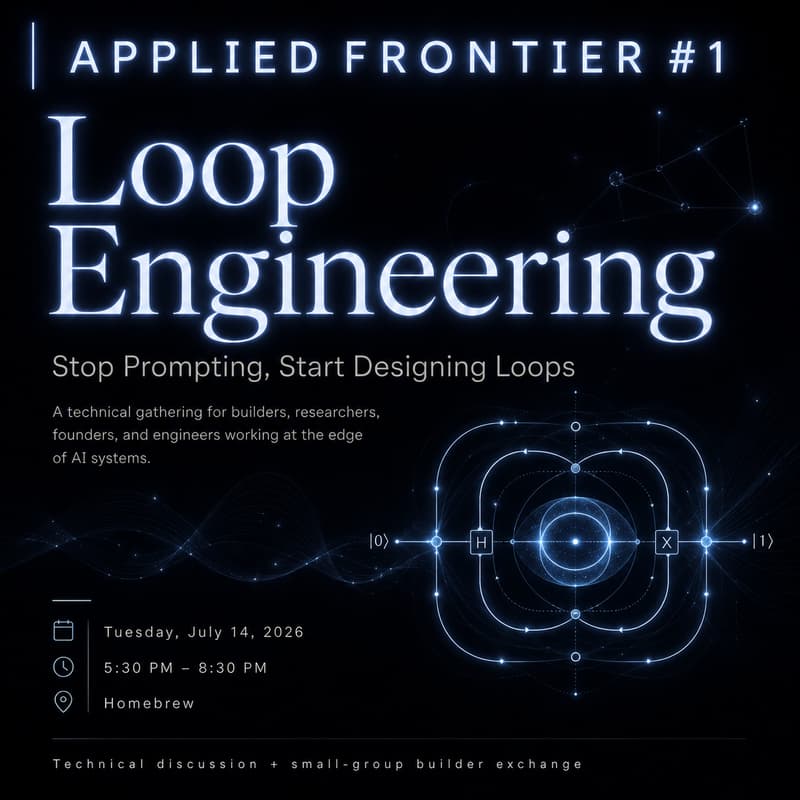
Applied Frontier #1: Loop Engineering
Stop Prompting, Start Designing Loops
Frontier Labs is an intimate technical gathering for builders, researchers, founders, and engineers working at the edge of AI systems.
This first session goes deep on Loop Engineering, a shift that is quickly changing how serious teams work with coding agents.
For the last two years, the craft was prompt engineering. You held the agent one turn at a time. You typed, read the output, adjusted, and typed again.
That era is ending.
As Peter Steinberger of OpenClaw put it, “You shouldn’t be prompting coding agents anymore. You should be designing loops that prompt your agents.”
Boris Cherny, who built Claude Code at Anthropic, says it even more directly: “I don’t prompt Claude anymore. I have loops running that prompt Claude. My job is to write loops.”
Loop Engineering is the practice of replacing yourself as the person who constantly prompts the agent, and instead designing the system that prompts it for you.
You define the goal. The loop finds the work, hands it out, checks the result, records what is done, and decides what should happen next. It can run on a schedule, work unattended, and continue making progress while you sleep.
This session is about how to build those loops well, where they break, and what separates a loop that demos from a loop you can actually trust.
What We’ll Discuss
The anatomy of a real loop
We will break down the core primitives that make durable loops work:
Automations as the heartbeat for scheduled discovery and triage.
Worktrees for parallel agents that do not collide.
Skills and SKILL.md files that codify project knowledge so the agent stops guessing.
Connectors and MCP so the loop can act inside your real tools.
Sub agents that separate the maker from the checker.
External state files in places like markdown or Linear, because the model forgets and the repo does not.
Harness versus loop
We will clarify where harness engineering ends and loop engineering begins.
A harness is the environment a single agent run lives inside. A loop sits one level above that. It runs on a timer, spawns helpers, feeds itself, and keeps moving.
Designing tool agnostic loops
The same loop shape is now appearing across Codex, Claude Code, and other agentic coding systems through concepts like /loop, /goal, automations, worktrees, and sub agents.
We will focus on how to design loops that survive across tools, instead of arguing about which cockpit you happen to be using.
The maker and checker split
The model that wrote the code is often the worst judge of whether the work is actually done.
We will discuss verifier sub agents, separate review models, /goal style stop conditions, and the cost of making “done” mean something real.
Where loops leak
We will also talk about the failure modes practitioners are already seeing:
Unattended mistakes.
Intent debt that compounds faster than you can read the output.
Token costs that swing wildly.
Comprehension debt.
Cognitive surrender, where the operator slowly stops having an opinion and simply presses go.
Who This Is For
This is for a limited group of deeply technical people who are actively building, researching, or seriously exploring agentic systems.
That includes AI engineers, founders building AI products, researchers working on agents and evals, infrastructure builders, tooling builders, product minded engineers, and technical operators running AI systems in production.
Come with a loop you have built, or a loop that burned you.
How This Works
This is not a networking meetup.
It is a high signal technical discussion with a small group of serious builders.
Come prepared to share what you are building, put your hard problems on the table, challenge assumptions, and reason through open questions together.
Why It Matters
Loop Engineering is not just a new tactic. It is a shift in where the leverage lives.
The point is not that the work got easier. The point is that the leverage moved from writing prompts to designing the systems that write them.
Two people can build the same loop and get completely different outcomes. One person moves faster because they deeply understand the work. Another uses the loop to avoid understanding the work at all.
The loop does not know the difference.
The engineer does.
Frontier Labs #1 is a place to learn how to build the loop, and stay the engineer.
Event Details
Date: Tuesday, July 14, 2026
Time: 5:30 PM to 8:30 PM
Location: Homebrew
Format: Technical discussion and small group builder exchange
Capacity: Limited