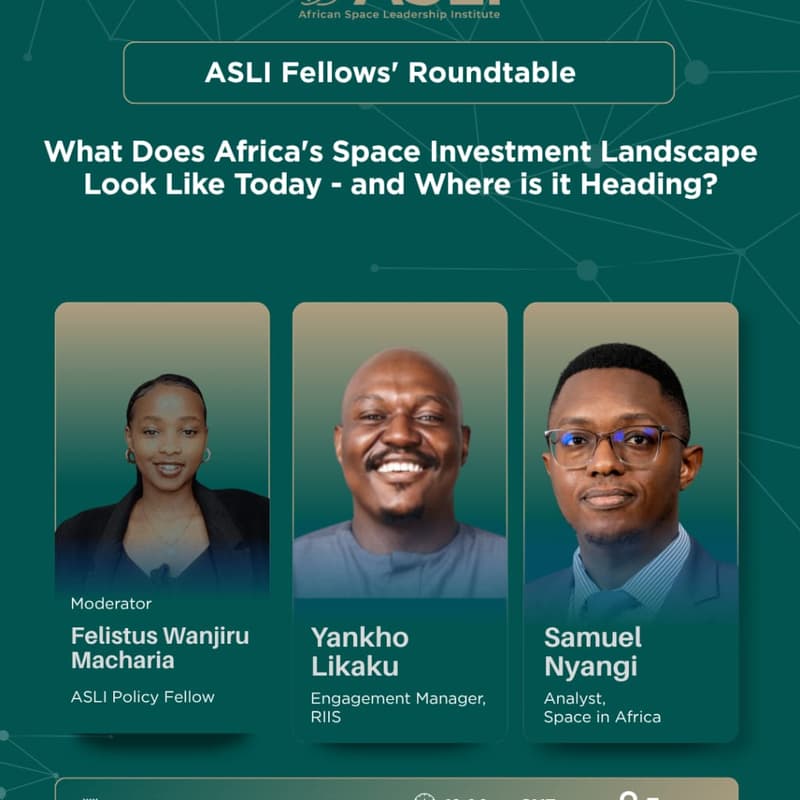
ASLI Fellows' Roundtable: What does Africa's Space Investment Landscape Look Like Today - and Where is it Heading?
The African Union adopted the African Space Policy and the African Space Strategy in 2016, following four years of work by the African Space Working Group. The framework led to the establishment of the African Space Agency (AfSA). The Agency and the African Space Council were officially inaugurated in April 2025, following the completion of its headquarters in Cairo, Egypt. The question ten years after the adoption of the policy and strategy framework is whether the instruments, institutions and investments behind them, reflect and respond to the development needs in food security, disaster management, climate resilience, health, connectivity and economic transformation.
The ASLI Colloquium which was held from 26-27 August 2026 provided a clear diagnosis. Continental governance institutions exist, but much of their operating machinery is still being assembled. AfSA took roughly twelve years from conceptualisation to inauguration. Domestic risk capital, procurement frameworks and commercial demand appears to be weak. African investment in African space ventures is small when compared with external grant and development finance. Research lacks structured paths to market, ecosystem data is fragmented, and Africa has no robust baselines for measuring progress. Participants at the Colloquium agreed on one direction: the next phase must move from creating institutions to coordinated, funded and accountable execution.
The upcoming roundtable takes that conclusion of the Colloquium as its starting point. Rather than revisit what has been built, it will examine different areas that need deeper analysis before they can be turned into action, research and policy inputs for the review of the 2016 documents.
This debut roundtable will be moderated by Felistus Macharia (ASLI Policy Fellow)
Lead discussants
Yankho Likaku - (Engagement Manager, Research Institute for Innovation and Sustainability)
Samuel Nyangi (Analyst, Space in Africa)
Yankho Likaku is an Engagement Manager at RIIS, where he manages the Space Practice and co-leads the Strategy Centre of Expertise (CoE). He specialises in strategy, innovation ecosystems, policy analysis, and the development of practical pathways for strengthening Africa’s space economy. Over the past five years, Yankho has worked across the African space sector, leading and supporting Pan-African initiatives focused on space ecosystem development, Earth Observation, entrepreneurship, commercialisation, investment readiness, and public–private collaboration. His work has included assessing the maturity of national space ecosystems, developing strategic roadmaps, supporting governments and institutions with decision-making frameworks, and creating pathways for startups, entrepreneurs, and established businesses to participate more effectively in the space economy. With cumulative 10 years of experience in strategy, consulting, policy, process improvement, and innovation across emerging markets, Yankho brings a practical perspective on the transition from policy and institution-building toward implementation, sustainable investment, market development, and measurable socio-economic impact. His work particularly focuses on how African space ecosystems can strengthen local demand, mobilise African-led and international investment, enable private-sector participation, and translate space capabilities into commercially viable solutions that address development and economic priorities across the continent.
Samuel Nyangi is a Space Industry Analyst at Space in Africa, where he leverages his background in astronomy and space science to provide strategic foresight for the continent’s growing space sector. He was instrumental in developing the valuation strategies and financial models used to assess the African space economy, a sector now projected to reach USD 39.52 billion by 2030. Samuel's experience cuts across space ecosystem development, market entry strategies, and cost-benefit assessments for African and global clients. His work focuses on translating complex technical data and sector developments into actionable business insights for private-sector and institutional stakeholders. Through his comprehensive analyses of industry trends, Samuel plays a pivotal role in strengthening Africa's competitive position and integration within the global space economy.