
Experimental Quantum-Computing-Enhanced Sensing with Superconducting Circuits
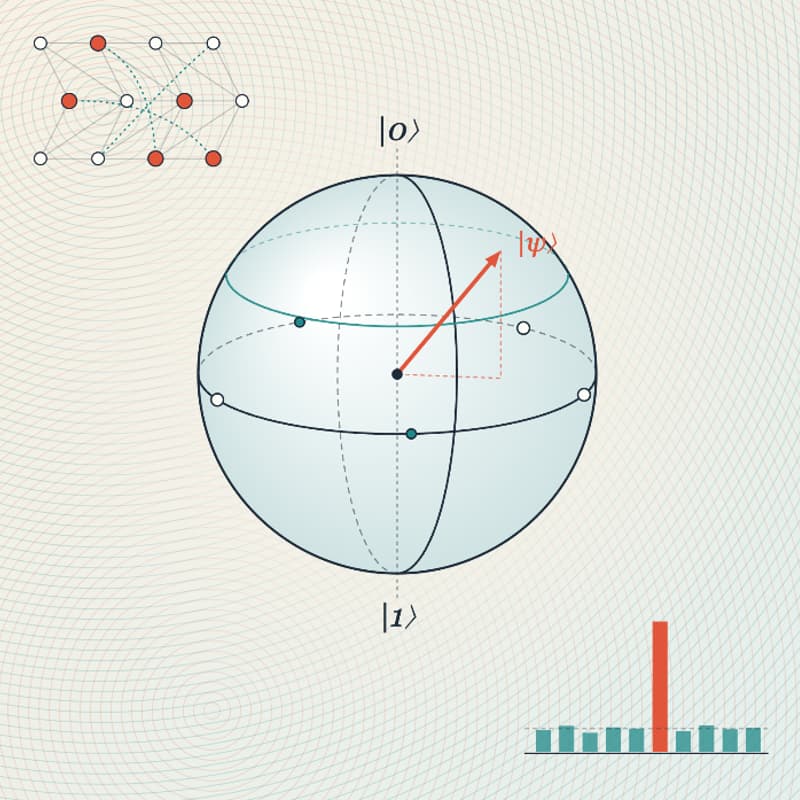
In this talk, I will present two experimental demonstrations of quantum computational sensing using superconducting circuits. The first implements Grover’s search algorithm to detect signals of unknown frequency across a broad bandwidth. Using a hybrid qubit–boson system, we demonstrate that Grover-based amplitude amplification enhances both sensitivity and sensing bandwidth, reducing the sensing resources required to reach a target detection accuracy by more than an order of magnitude. I will further motivate the advantages of such computational sensing protocols by presenting our work on in-device estimation of non-linear functions of an incoming magnetic field. We demonstrated up to a 20% improvement in accuracy over conventional sensing methods like dynamical decoupling, when it comes to decision problems, by adding computational layers prior to measurement enabling task-efficient information extraction. These two complementary demonstrations of quantum computational sensing show that such protocols can provide an advantage in small, near-term devices, even in the presence of imperfections and decoherence. Together, these experiments establish quantum computation as a practical resource for pushing the boundaries of quantum sensing.
Mathieu Ouellet studies complex systems, quantum mechanics, and symmetries at the University of Pennsylvania in Philadelphia.