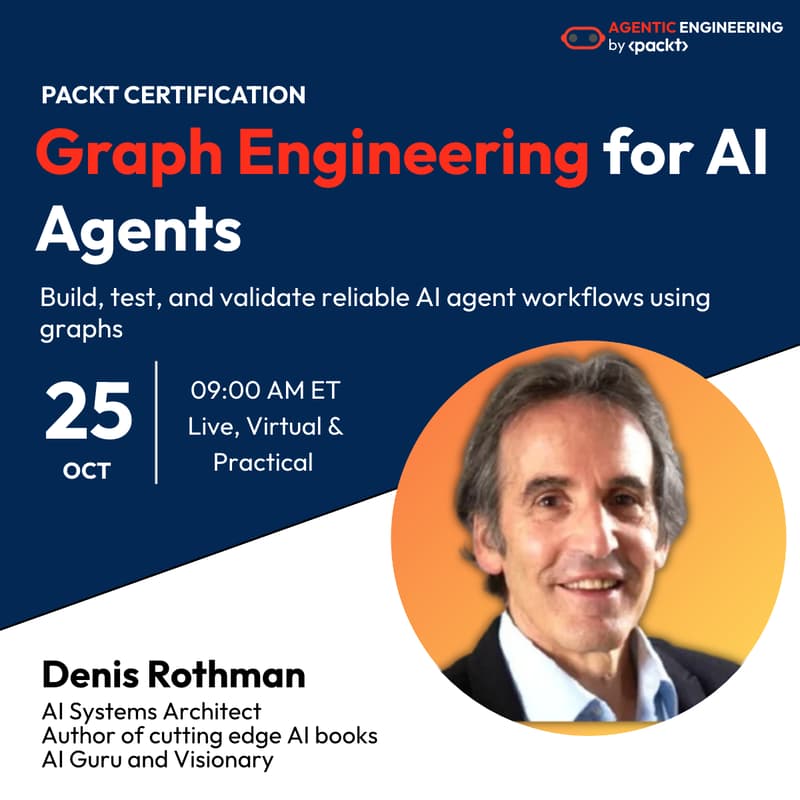

Graph Engineering for AI Agents
Graph Engineering for AI Agents is a one-day, hands-on workshop for engineers and architects responsible for taking agentic systems beyond demos and into production.
Led by Denis Rothman, the workshop introduces a graph-based approach to designing and evaluating agent workflows. Instead of treating an agent system as a sequence of prompts and tool calls, you’ll model it as an explicit graph where dependencies, reliability, costs, execution paths, and failure points can be measured before the system runs.
Across five hands-on labs, you’ll learn how to compile agent plans into directed acyclic graphs (DAGs), calculate reliability across multi-step workflows, identify the most cost-effective ways to improve them, enforce production constraints before execution, use GraphRAG for relationship-aware retrieval, and trace and certify complete agent workflows.
Every lab ends with measurable acceptance criteria and a pass/fail verdict, giving you a practical framework you can apply to your own agent systems.
What you'll learn
By the end of the workshop, you'll be able to:
Model agent workflows as graphs: Turn an agent plan into a DAG, identify dependencies, calculate execution levels, and detect cycles, orphan nodes, dangling references, and unregistered agents.
Measure reliability before execution: Calculate how reliability changes across multi-step agent workflows and quantify the exception budget of a proposed plan.
Improve reliability efficiently: Compare pruning, verification gates, and redundancy to determine which intervention provides the greatest reliability improvement for its cost.
Govern agent plans before they run: Build a deterministic validation gate that checks graph structure, depth, token budgets, registered capabilities, and required reliability thresholds before execution.
Choose between Vector RAG and GraphRAG: Understand when similarity search is sufficient and when relationship-aware graph traversal is needed for multi-hop questions.
Build retrieval with provenance: Use graph traversal to produce explicit paths showing how retrieved facts are connected to the original query.
Trace agent execution and detect drift: Record execution across graph boundaries, compare runs against a baseline, and identify how changes at one node propagate downstream.
Certify the complete workflow: Bring structural checks, reliability, budgets, provenance, governance, and trace results together into a final certification scorecard.
What you'll build
The workshop includes five hands-on labs, each building toward a complete graph-engineering workflow:
Lab 1: Compile an agent plan into a DAG
Convert an agent plan into an explicit graph and automatically detect structural problems.
Lab 2: Measure and repair reliability
Calculate terminal reliability and exception budgets, then test different approaches for improving the workflow.
Lab 3: Build a governance gate
Evaluate multiple agent plans against structural, reliability, and token-budget requirements and produce a deterministic PASS or REJECT verdict.
Lab 4: Build a GraphRAG retrieval workflow
Compare vector retrieval with graph traversal and answer multi-hop questions while preserving a provenance path for every fact.
Lab 5: Execute, trace, and certify
Run the approved graph, create a baseline trace, introduce controlled drift, identify its downstream impact, and produce a final certification scorecard.
Who is this workshop for?
This workshop is designed for:
Senior AI/ML Engineers building or operating agentic systems
AI Engineers moving agent workflows from prototypes into production
Solution and Platform Architects designing production AI architectures
Tech Leads and Engineering Leads responsible for reliability, cost, and governance
Teams working with production AI agents that must meet KPIs, SLAs, compliance requirements, or cost constraints
Engineers working with multi-agent systems, RAG, GraphRAG, agent orchestration, or tool-using agents
About the Instructor
Denis Rothman is a leading author and expert in Artificial Intelligence, specializing in generative AI, Transformers, and Multi-Agent Systems. With a career dedicated to bridging the gap between complex theory and practical application, his work is a cornerstone for developers and architects building next-generation AI.
Prerequisites
You should be comfortable working with Python. No experience with a specific agent framework is required.
The workshop is intentionally framework-independent. The concepts and engineering contracts can be applied to systems built with LangGraph, CrewAI, custom orchestration frameworks, or other agent stacks.