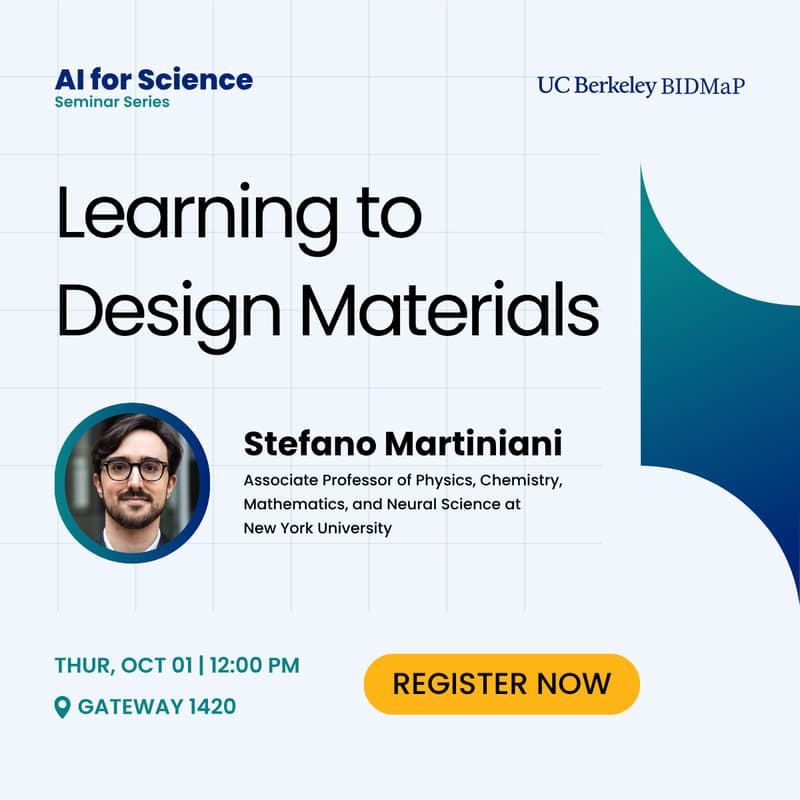
Stefano Martiniani: Learning to Design
About this Seminar
Infrastructure for Science that Compounds in the Age of AI Agents
AI agents that autonomously conduct research risk breaking a delicate balance in science. The scientific paper is a lossy format: methodological choices and assumptions compressed into a few pages, with peer review and community scrutiny providing the warrant that results are sound. This trade-off worked because the rate of new work stayed roughly matched to the community's capacity to scrutinize it. Agents now threaten that balance, accelerating production far faster than scrutiny can keep up and deepening an already well-documented trust and reproducibility crisis. But the same technology is also an opportunity: agents can document exactly how results are produced at a level of detail that was previously too onerous to maintain by hand, if we build the infrastructure to capture it.
Nature conceals the principles governing molecular and materials function within combinatorial spaces too vast to explore exhaustively. Progress in materials discovery thus depends on learning, from limited data, how composition and structure give rise to desired properties. Generative AI offers a principled approach by casting the problem as learning a transport map from a simple base distribution to the distribution of chemically valid structures, enabling both unconditional discovery and property-conditioned generation. In this talk, I will present the Open Materials Generation (OMatG) family and PropMolFlow, state-of-the-art generative frameworks for inorganic crystals and small molecules. I will then show how policy-gradient reinforcement learning can be extended to flow-based generative models, and how it can align OMatG with target objectives beyond the training data, dramatically accelerating crystal structure prediction. Finally, I will discuss how these ideas extend to molecular crystals and some recent unpublished work.
This talk explores how AI can help scientists design new materials with desired properties, speeding up a search through countless possible combinations of atoms.
https://bidmap.berkeley.edu/seminars/stefano-martiniani-learning-design-materials
Our Speaker:
Stefano Martiniani
Stefano Martiniani is Associate Professor of Physics, Chemistry, Mathematics, and Neural Science at New York University. His interdisciplinary theory group develops AI methods to accelerate scientific discovery across molecules, materials, and living systems, and investigates organizing principles in complex systems. He obtained his PhD at the University of Cambridge as a Gates Scholar, then held a postdoctoral appointment in Physics at NYU (2017–2019) and an assistant professorship in Chemical Engineering and Materials Science at the University of Minnesota (2019–2021). His honors include the NSF CAREER and AFOSR YIP awards, the IUPAP Early Career Scientist Prize, Simons Foundation Faculty Fellowship, and University of Cambridge Outstanding Thesis Prize."
The Bakar Institute of Digital Materials for the Planet (BIDMaP) accelerates the discovery, development, and deployment of advanced materials to address some of the most urgent challenges facing our planet. By combining cutting-edge chemistry with artificial intelligence, machine learning, and robotics, BIDMaP is reimagining how materials can be designed and optimized for clean energy, clean air, clean water, advanced batteries, and sustainable chemical production.