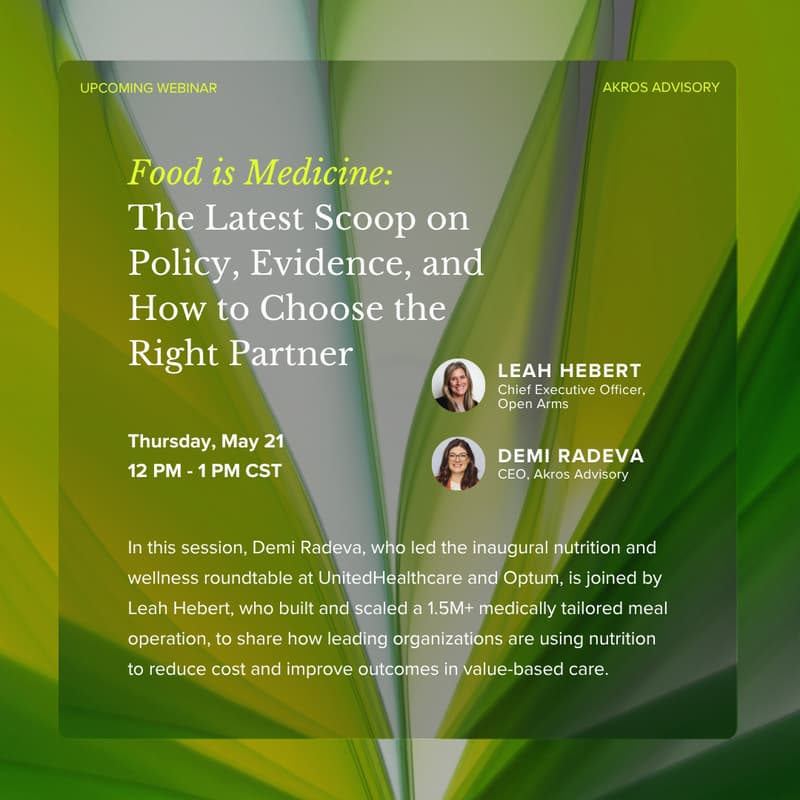
Food is Medicine: The Latest Scoop on Policy, Evidence, and How to Choose the Right Partner
As healthcare shifts toward value-based care, nutrition is emerging as one of the most powerful—and underutilized—clinical interventions. In this webinar, we’ll break down the latest Food is Medicine policy developments and what they mean for Medicaid MCOs, ACOs, and other risk-bearing organizations looking to reduce total cost of care. You’ll gain a clear understanding of the real drivers behind avoidable utilization—from chronic disease instability to unmet social needs—and why traditional interventions often fall short.
We’ll also explore the growing body of evidence supporting medically tailored meals, including their impact on emergency department visits, hospitalizations, and overall healthcare spend. Attendees will learn how leading organizations are integrating nutrition into care management workflows to stabilize high-risk populations and improve outcomes.
Finally, we’ll provide a practical framework to evaluate and select the right Medically Tailored Meal partner, using Open Arms MN as an example. This session is designed to move beyond theory and equip you with actionable insights to make informed partnership decisions. After the session, you’ll take home a checklist to use when evaluating potential MTM partners.
Why Attend
Stay ahead of policy shifts: Understand the latest Food is Medicine proposals and how they impact reimbursement, benefits design, and program funding.
Address real cost drivers with evidence-backed solutions: Understand how nutrition instability impacts utilization, cost, and adherence
Evaluate vendors with confidence: Get a clear framework to differentiate between MTM vendors based on clinical rigor, scalability, and measurable ROI.
Who Is This For
Medicaid MCO leaders responsible for managing high-cost, high-need populations and reducing avoidable utilization
ACO executives and population health teams focused on total cost of care, quality performance, and risk-based contracts
Payviders / IDNs integrating clinical care and financial risk, seeking scalable interventions for chronic disease management
Care management, SDOH, and innovation leaders evaluating Food is Medicine programs or vendors
Health plan decision-makers exploring medically tailored meals as a benefit, pilot program, or value-based intervention