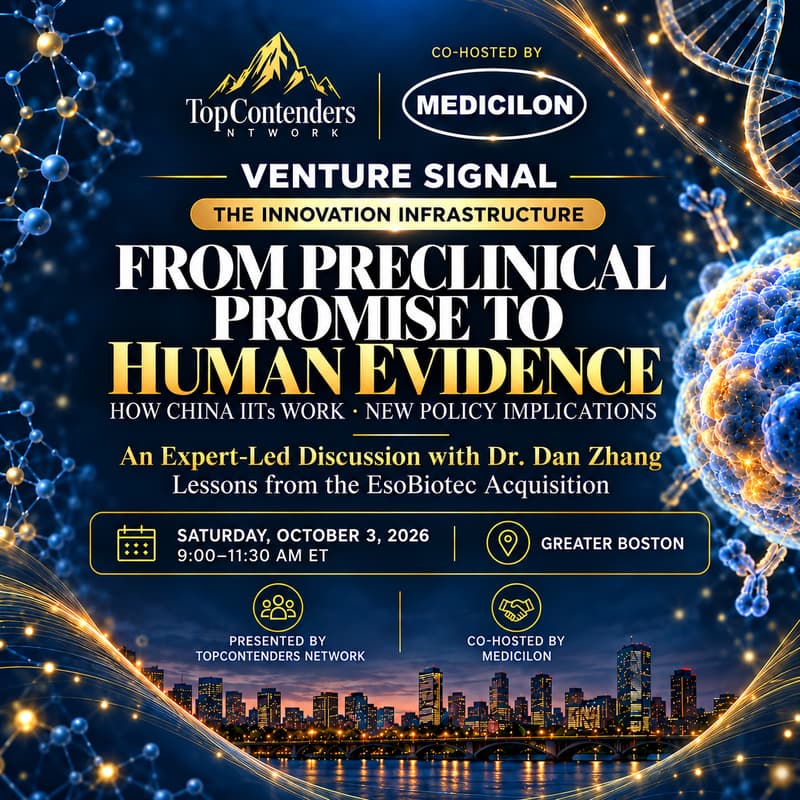

Venture Signal: The Innovation Infrastructure -- From Preclinical Promise to Human Evidence
Venture Signal: The Innovation Infrastructure
From Preclinical Promise to Human Evidence
How China IITs work, emerging policy implications, and lessons from the EsoBiotec acquisition
An expert-led, two-part discussion with Dr. Dan Zhang
Presented by TopContenders Network
Co-hosted by Medicilon
Saturday, October 3, 2026 · 9:00–11:30 AM ET
Greater Boston · Hosted at Medicilon’s Lexington facility
Doors open at 9:00 AM for coffee and networking. The program begins promptly at 9:30 AM.
About the Program
For an emerging biotech company, one of the most important value-creating milestones is the transition from promising preclinical results to credible evidence in humans.
This edition of Venture Signal: The Innovation Infrastructure examines the scientific, clinical, manufacturing, institutional, and regulatory capabilities required to make that transition. Co-hosted at Medicilon’s Greater Boston facility, the program connects local development resources with an expert discussion of investigator-initiated clinical research in China.
Investigator-initiated trials may provide an opportunity to generate early human evidence, particularly in areas such as cell and gene therapy. However, the process involves much more than identifying a hospital and enrolling patients. Asset readiness, preclinical evidence, CMC and manufacturing controls, protocol design, investigator and hospital selection, ethics review, data integrity, and long-term regulatory strategy must all be considered.
In this two-part discussion, Dr. Dan Zhang will explain how investigator-initiated clinical research in China works—from initial asset assessment and local partnerships through clinical execution and early human data.
The program will also examine China’s evolving policy environment, the relationship between IIT and IND pathways, and how companies should evaluate the potential and limitations of IIT-generated evidence for subsequent global development, financing, licensing, or acquisition discussions.
What We Will Explore
What types of biotech assets may be appropriate for investigator-initiated clinical research
What evidence and preparation may be required before approaching investigators and hospitals
How hospitals, principal investigators, ethics committees, clinical partners, and manufacturers work together
How CMC, product quality, protocol design, patient selection, and data integrity affect the credibility of study results
How China’s evolving policies may affect biomedical innovation, clinical research, and technology translation
When an IIT may be appropriate—and when a formal IND pathway may be necessary
How companies and investors should evaluate the potential and limitations of IIT-generated evidence
What early human evidence can contribute to global development, partnering, financing, and strategic transactions
Why the EsoBiotec Case Matters
In March 2025, AstraZeneca agreed to acquire EsoBiotec for $425 million upfront, plus up to $575 million in contingent payments tied to development and regulatory milestones—giving the transaction a potential total value of $1 billion. The acquisition was completed in May 2025, during a period in which ESO-T01 had also entered investigator-initiated clinical research in China.
The EsoBiotec case does not suggest that every China IIT will produce a billion-dollar outcome. It provides an opportunity to examine how early human evidence may help reduce uncertainty around an emerging platform—and how that evidence can be considered alongside the platform, intellectual property, team, pipeline, manufacturing strategy, and other factors in partnering, financing, and acquisition decisions.
The discussion will also consider lessons from Legend Biotech and the broader development of cell and gene therapies through cross-border clinical collaboration.
Featured Expert
Dr. Dan Zhang is an experienced life-sciences executive and advisor whose work spans clinical development, CRO and CDMO services, CMC, and cross-border biopharmaceutical collaboration.
Through his involvement with organizations including ClinChoice and Hillgene, he has supported biotechnology companies in evaluating and executing clinical-development strategies in China. His experience includes coordinating investigator-initiated studies, clinical and manufacturing partners, and programs designed to generate early human evidence for subsequent development and partnering.
Moderator
Mark Zheng is Founder of TopContenders Network and a Venture Partner at VU Venture Partners. He will moderate the discussion and connect the clinical and regulatory considerations with company building, investment readiness, cross-border partnering, and asset value creation.
About the Co-host
Medicilon is co-hosting this Venture Signal program and providing its Lexington facility for the discussion.
Its participation reflects the broader purpose of The Innovation Infrastructure series: connecting biotech innovators with the specialized organizations, facilities, expertise, and development pathways that can help move promising science toward clinical and strategic value.
Who Should Attend
This program is designed for:
Biotech founders and executives
Preclinical and early-clinical-stage companies
Cell and gene therapy teams
Translational scientists and academic innovators
Clinical, regulatory, CMC, and manufacturing professionals
Investors evaluating emerging therapeutic platforms
Business-development and licensing professionals
Companies considering clinical development or partnerships in China
Agenda
9:00–9:30 AM
Coffee, registration, and networking
9:30–9:40 AM
Welcome: From Preclinical Promise to Human Evidence
9:40–10:25 AM
Session 1: Generating Early Human Evidence Through China IITs
How the process works, what an asset needs, who is involved, and what emerging policy developments may mean for biotech companies.
10:25–10:35 AM
Break and informal conversation
10:35–11:15 AM
Session 2: From Early Evidence to Strategic Value
An expert conversation exploring IIT versus IND, cross-border development, and lessons from Legend Biotech and the EsoBiotec acquisition.
11:15–11:30 AM
Moderated Q&A and discussion
Registration
Complimentary admission. Registration is required and subject to approval.
Capacity is limited. Priority will be given to biotech founders, asset owners, translational scientists, investors, and professionals working in clinical development, cell and gene therapy, and cross-border collaboration.
The event will be hosted at Medicilon’s facility in Lexington, Massachusetts. The exact address and arrival instructions will be provided to confirmed participants.
Disclosures
This event is intended for educational and networking purposes only. Nothing presented constitutes investment, legal, tax, financial, clinical, or regulatory advice.
An investigator-initiated study does not automatically replace an IND-authorized clinical trial. The regulatory relevance and subsequent usability of any evidence depend on the product, applicable pathway, study design, institutional oversight, manufacturing controls, data quality, and regulatory requirements.
References to individual companies and transactions are presented as case studies for discussion and do not imply that any particular clinical pathway caused or guarantees a financing, licensing, regulatory, or acquisition outcome.
Photos or recordings may be taken for event recap and promotional purposes. Please notify the organizer if you prefer not to be included.
Presented by TopContenders Network
Co-hosted by Medicilon
Organized as part of the Venture Signal program, a TopContenders Network initiative from MZ Services Inc.