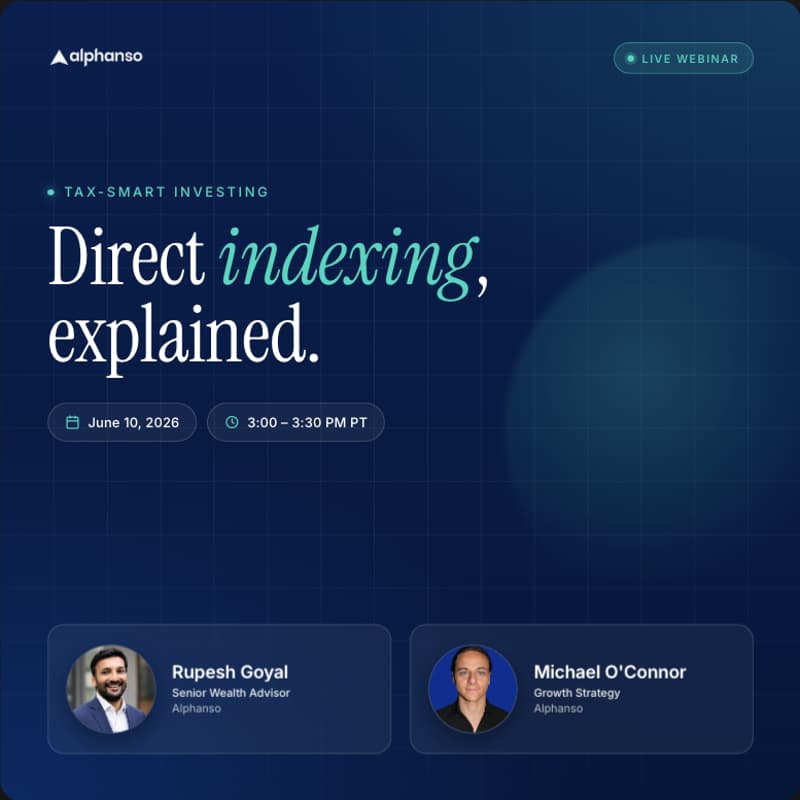

Direct Indexing Explained: How It Works, When It's Worth It, and What It Costs
About Event
You've worked hard to build up savings and investments — and you've probably got a chunk of your own company's stock in the mix too. Direct indexing is a smarter way to own the market: you get the same broad investing you'd get from a basic index fund, but with two extra perks — it can lower your tax bill, and it lets you avoid piling up even more of your own company's stock. This session explains what it is in plain English, whether it's worth it for you, and how to set it up without it becoming a hassle.
What we'll cover:
What direct indexing actually is — instead of buying one fund that holds 500 companies, you own small pieces of those companies directly, which is what makes the rest possible
How it stacks up against a regular index fund (like the ones most people already own) — same investments, similar cost, but more control
How it can shrink your tax bill — even when the market is up overall, a few individual stocks will be down, and selling those at a loss can cut what you owe the IRS, often a few thousand dollars a year
When it's worth doing — who actually benefits (and who's better off just keeping a simple index fund)
How to leave your own company's stock out — so you're not doubling down on the one company you already depend on for your paycheck
Why starting sooner helps — the tax savings build up over time and can offset future profits, including when you eventually sell your company shares
How it stays low-effort — once it's set up, the buying, selling, and tax savings happen automatically in the background
A real example: someone with about $600K invested switches from a regular fund to direct indexing, leaves their employer's stock out, and saves around $7K on taxes in the first year — savings that keep paying off down the road
Live Q&A with Michael and Rupesh
Bring whatever's on your mind — what you're currently invested in, how much of your company's stock you're holding, the account you're thinking about, or just questions about whether this is even right for you. We'll walk through it with you live.
Speakers
Rupesh Goyal, Senior Financial Advisor, Alphanso Wealth. Rupesh helps tech employees at big and fast-growing companies make smart decisions about their stock and investments. He's helped a lot of people use direct indexing to lower their taxes and avoid being too reliant on their own company's stock — without giving up steady, broad investing.
Michael O'Connor, Business Development, Alphanso Wealth. Michael has spent 5+ years in tech — from small startups to bigger funded companies. He's good at explaining money strategy in plain language and understands how these decisions play out for everyday employees.