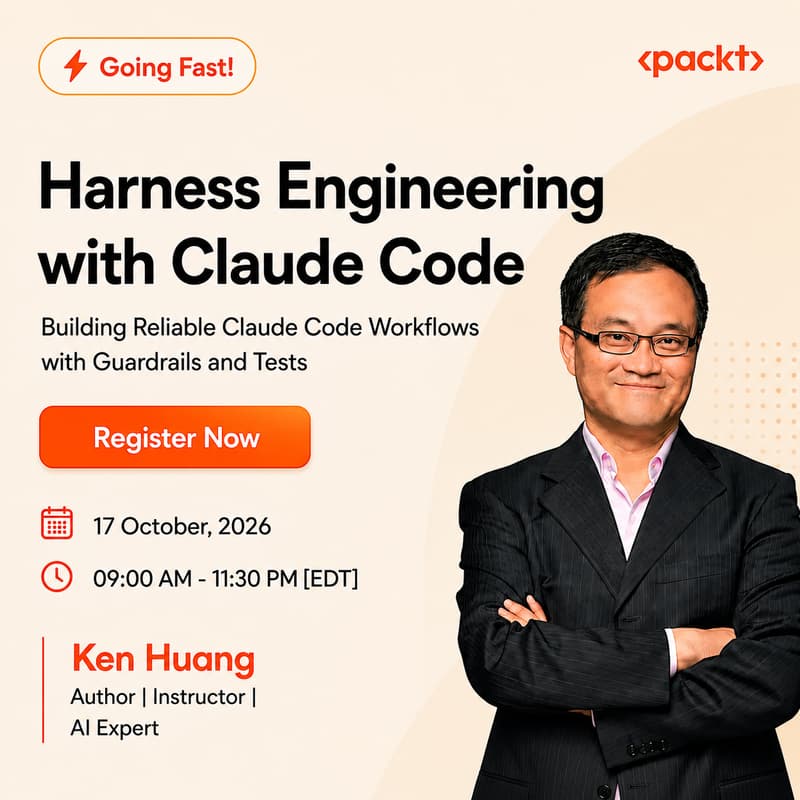

Hands-On Harness Engineering with Claude - C2
AI coding agents can move fast, but speed without structure quickly creates risk.
If you’ve used tools like Claude Code or Codex, you’ve probably seen both sides: impressive acceleration on one hand, and unpredictable behavior, shaky outputs, or risky actions on the other. The difference between a useful coding agent and an unreliable one usually isn’t the model alone. It’s the harness around it.
This workshop teaches harness engineering: the practical discipline of building the surrounding system that makes agent behavior more reliable, testable, constrained, and trustworthy. You’ll learn how to combine specs, instructions, permissions, hooks, tests, observability, and human review into workflows that make AI coding safer and more repeatable.
Rather than relying on prompting alone, this session shows you how to create a real engineering framework for AI-assisted development, one that optimizes for trust, predictability, and production readiness, not just speed.
Meet your instructor: Ken Huang
Ken is a prolific author and renowned expert in AI and Web3, with numerous published books spanning business and technical guides as well as cutting-edge research. He is a Research Fellow and Co-Chair of the AI Safety Working Groups at the Cloud Security Alliance, Co-Chair of the OWASP AIVSS project, and Co-Chair of the AI STR Working Group at the World Digital Technology Academy. He is also an Adjunct Professor at the University of San Francisco, where he teaches a graduate course on Generative AI for Data Security.
Who should attend?
Developers using Claude Code (or Codex) in real projects
Engineers who want more reliable AI-assisted development workflows
Technical leads and architects designing team-wide AI engineering practices
Platform and developer experience teams creating shared coding-agent workflows
Builders exploring multi-agent and tool-augmented development systems
It’s especially useful for teams that want to move from “AI works sometimes” to “AI works predictably enough to trust.”
By the end of this workshop, you’ll be able to:
Identify common failure modes in Claude Code workflows
Build stronger workflows using instructions, rules, permissions, and hooks
Turn requirements into clearer specs with scope, constraints, and acceptance criteria
Use guardrails to control what agents can access and execute
Apply deterministic pre-action and post-action checks
Use tests to validate agent output and turn past failures into long-term safeguards
Create reusable workflows with skills, plugins, and MCP tools
Decide when multi-agent patterns are useful and how to manage handoffs safely
Build more trustworthy AI development workflows that prioritize reliability over raw speed
You’ll leave with a practical system for making Claude Code workflows more dependable in real engineering environments.
What you get with the ticket:
Full HD live workshop access + replay for 120 days
Certificate of completion to showcase your new skills
Access to the GitHub repository with all session code