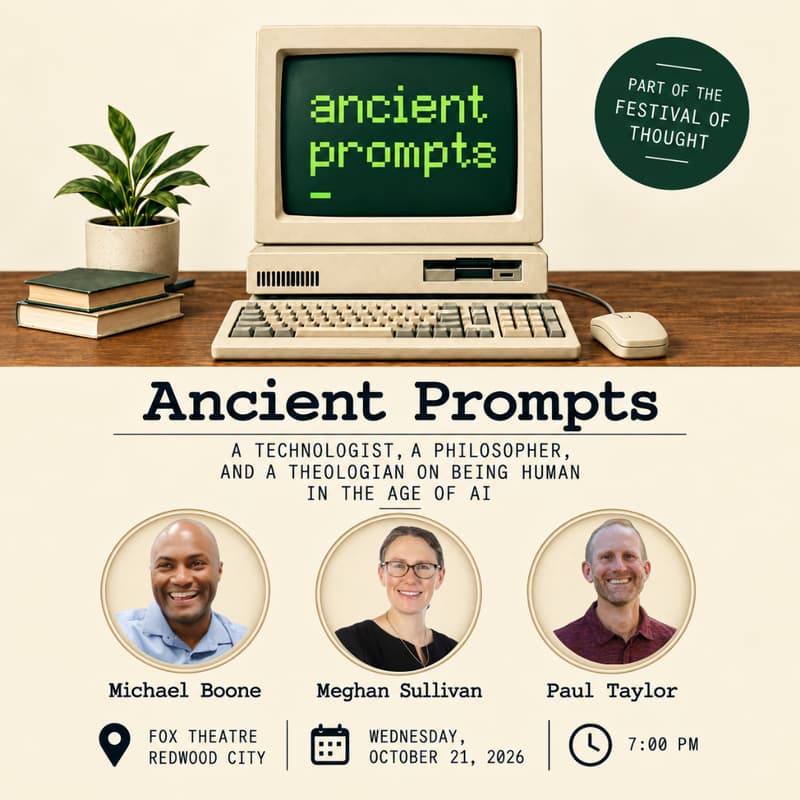

Ancient Prompts-A technologist, a philosopher, and a theologian on being human in the age of AI
Come as you are — this is for technologists, students, church folks, and anyone who's curious. No background required.
You'll hear from a technologist, a philosopher, and a theologian, talking it through together:
Michael Boone — NVIDIA
Meghan Sullivan — Notre Dame Institute for Ethics and the Common Good
Paul Taylor — Bay Area Center for Faith, Work & Tech
The Question
What does it mean to be human when machines can think, create, and even talk like us? This isn't about whether AI will take your job, or whether it's "conscious." It's the deeper question underneath both: if a computer can do so much of what used to make us special (thinking, creating, judging, even having a conversation), what's actually still ours?
Most conversations about AI get stuck between two extremes: big philosophical ideas that never get put into practice, and company promises you can't check for yourself. We want to try something different. We'll start with real technology that's already here, and with the documentation that's supposed to tell you what it does, and then ask what it means for the people on the other side of it.
We'll take up three everyday questions, each grounded in something real:
Learning. If you can just ask an AI for the answer, what's still worth learning yourself? We'll look at AI skills now being published, signed, and evaluated openly, where you can see what a tool is built to do before you rely on it, and ask what forming a person requires that delivering information can't supply.
Connecting. We already talk to screens and bots all day. What does real human connection need that a machine can't give us? We'll look at conversational agents and digital humans, and at how the design choices that make an assistant pleasant to talk to are the same ones that can make it a substitute.
Work and life. As AI takes over more tasks, what happens to the sense of purpose that work used to give us? We'll look at companies retraining workers whose roles are changing, and ask which distinctly human skills become more valuable, not less, as work is augmented rather than replaced.
People have been wrestling with these questions for two thousand years. We're just asking them again, with newer tools in the room.
Michael Boone leads Trustworthy AI Product at NVIDIA, where his team builds the transparency tools and processes that back up NVIDIA's AI commitments. He started out as a licensed civil engineer working on highway and transit projects before moving into tech.
Prof. Meghan Sullivan is the Wilsey Family College Professor of Philosophy at Notre Dame and founding director of its Institute for Ethics and the Common Good, which leads the DELTA Network, a Lilly Endowment-funded effort to bring Christian principles of dignity, embodiment, love, transcendence, and agency to questions about technology. She is the author of The Good Life Method and Time Biases, and her course "God and the Good Life" has helped thousands of students think through what makes a life meaningful.
Paul Taylor co-founded the Bay Area Center for Faith, Work & Tech after eighteen years pastoring a Palo Alto church, and now spends his time connecting faith and tech leaders across Silicon Valley. He's a regular voice in conversations about what it looks like to follow Jesus at the intersection of faith, work, and technology.
This event is co-hosted by the Bay Area Center for Faith, Work & Tech, Notre Dame’s Institute for Ethics and the Common Good, and The Center for Ethical Intelligence.