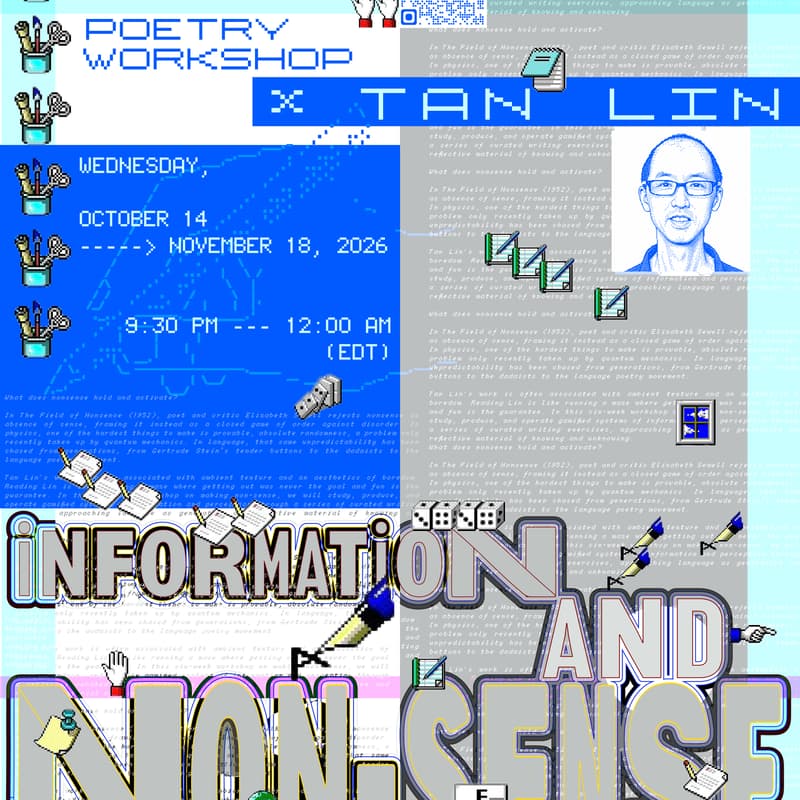

Six Week Poetry Workshop x Lin Tan
6 Week Poetry Workshop x Tan Lin: Information and Non-Sense
What does nonsense hold and activate?
In The Field of Nonsense (1952), poet and critic Elizabeth Sewell rejects nonsense as absence of sense, framing it instead as a closed game of order against disorder. In physics, one of the hardest things to make is provable, absolute randomness, a problem only recently taken up by quantum mechanics. In language, that same unpredictability has been chased from generations, from Gertrude Stein’s tender buttons to the dadaists to the language poetry movement.
Tan Lin's work is often associated with ambient texture and an aesthetics of boredom. Reading Lin is like running a maze where getting out was never the goal and fun is the guarantee. In this six-week workshop on making non-sense, we will study, produce, and operate gamified systems of information and perception through a series of curated writing exercises, approaching language as generative and reflective material of knowing and unknowing.
Course description:
This course examines various formats and forms for making and not making sense. Class will examine rule-bound composition, metadata, prison escape schemes of writing, information architectures, and the book as an information delivery system. The focus of the course will be directed at non-sense making of various sorts in order to examine notions of understanding and making sense. A selected reading list accompanies the course. We’ll read and discuss these books while writing through the course. Every week, a writing assignment will be generated and workshopped.
Syllabus
Week 1: Tender Buttons by Gertrude Stein
OBJECTS
A CARAFE, THAT IS A BLIND GLASS.
A kind in glass and a cousin, a spectacle and nothing strange a single hurt color and an arrangement in a system to pointing. All this and not ordinary, not unordered in not resembling. The difference is spreading.
GLAZED GLITTER.
Nickel, what is nickel, it is originally rid of a cover.
The change in that is that red weakens an hour. The change has come. There is no search. But there is, there is that hope and that interpretation and sometime, surely any is unwelcome, sometime there is breath and there will be a sinecure and charming very charming is that clean and cleansing. Certainly glittering is handsome and convincing.
There is no gratitude in mercy and in medicine. There can be breakages in Japanese. That is no programme. That is no color chosen. It was chosen yesterday, that showed spitting and perhaps washing and polishing. It certainly showed no obligation and perhaps if borrowing is not natural there is some use in giving.
ROOMS
Act so that there is no use in a centre. A wide action is not a width. A preparation is given to the ones preparing. They do not eat who mention silver and sweet. There was an occupation.
A whole centre and a border make hanging a way of dressing. This which is not why there is a voice is the remains of an offering. There was no rental.
So the tune which is there has a little piece to play, and the exercise is all there is of a fast. The tender and true that makes no width to hew is the time that there is question to adopt.
To begin the placing there is no wagon. There is no change lighter. It was done. And then the spreading, that was not accomplishing that needed standing and yet the time was not so difficult as they were not all in place. They had no change. They were not respected. They were that, they did it so much in the matter and this showed that that settlement was not condensed. It was spread there. Any change was in the ends of the centre. A heap was heavy. There was no change.
Burnt and behind and lifting a temporary stone and lifting more than a drawer.
Excerpts from Tender Buttons
Tender Buttons is a 1914 book by the American writer Gertrude Stein consisting of three sections titled "Objects", "Food", and "Rooms". The short book consists of multiple poems covering the everyday mundane. Stein's experimental use of language renders the poems unorthodox and their subjects unfamiliar.The book offers “studies in description” of objects, in which, as in cubist still life, the object being described seems to be veiled by the medium of description. In the cubism of Picasso and Braque, the veils were the planes into which the painter broke up the canvas. In Stein’s writing, as Marjorie Perloff has shown, words themselves make abstract patterns that seem to stand in the way of their descriptive or referential functions.
Tender Buttons has provoked divided critical responses since its publication. It is renowned for its Modernist approach to portraying the everyday object and has been lauded as a "masterpiece of verbal Cubism". Its first poem, "A Carafe, That Is a Blind Glass", is arguably its most famous, and is often cited as one of the quintessential works of Cubist literature.
Week 2: Texture Notes by Sawako Nakayasu
Bicycle texture.
Take five radically different groups of people. The groups may radically differ in the usual categories (such as size, shape, color) or others (such as surface area, scent, hair texture, politics, emotional predicaments). Lead them by the hand, and then let go and give them a choice: field of flowers, field of gold, field of dreams, field of vision, field of applicants , field of corn, field of bicycles, field of bicycles.
Thickness of the anti-tropism.
Devil in my kitchen
Lets loose all the contents of my refrigerator and they scatter, all the food, condiments, ice cubes, and they plant themselves, on the table, atop the tv, at the base of a potted plant, and they grow roots, dig in before they rot in place all over the place all over the place.
Character sketch:
Fullness in its attempt to achieve itself. Spread thin to the point of being everywhere.
I gather, and gather, and gather, but once the spilling sets in again I spill into the nearest ocean – in order to let the spilling be even, in order to be fair, to be fast, to be true – which is why I need to live near oceans.
I hierarchy where fast truth is better than its slow equivalent, and a commonality of the things which are not true no matter how hard you look or how hard I swim, in how near which ocean.
Is always at the approach, that danger called good enough.
I bring it all, everything that fits, all of it spilling over, I stumble forth with it all of it, if only to arrive at process.
Excerpts from Texture Notes
Is there a relationship between the population density of Tokyo and the pinkest part of a hamburger? Can one touch the inside of a noun to learn the difference between one bicycle and a field of bicycles? How close is yellow to need? How far are human fears from the fears of insects? Through a sequence of prose investigations, directions, theoretical performances, and character sketches, Sawako Nakayasu’s Texture Notes presses itself against everything.
The book features 48 original journal entries dated from 2003 to 2004, arranged in a variety of textures and rhythms. With echoes of Zukofsky poetics and Steinian word-play, Nakayasu explores the poetic challenge of describing physical textures in the external world: bicycles, fresh laundry, love in the air. To this end, the kaleidoscopic prose fragments resist simplistic interpretations, playing with formal categories of definition in a choreography of word-objects reminiscent of the early Modern objectivist poets.
Here is a book of liminal cartography, where textures are percolated by thought and propelled by feeling, where intellectual frottage meets sunlight, moonlight, the pain of seeing something beautiful and an entire town enamored by a simple rock. Once again, Nakayasu’s writing explodes with genre-bending fury and fine-tuned improvisation, leaving in its wake a largess of feeling for the things of the world.
Week 3: Gyms by Kyle Booten
Excerpts from Gyms
Gyms is a book of poems written with nine custom “word gyms,” algorithmic systems designed to place my poetic faculties under stress and strain. With these gyms, I attempt to use digital media—which is often so toxic—to sternly care for my own mind. The gyms force me to deploy obscure allusions, weighty words, and off-kilter metaphorical conceits. They twist my language beyond its normal syntax and comfortable diction. They help me to pay close attention to works of art and to the world I inhabit.
Kyle Booten’s Gyms documents Booten’s process of developing nine different “gyms”—computer programs that, as he composes poems, place his human mind under unusual strain, trigger its unused muscles, and test its focus and endurance. One gym goads him to pick up and ponder weighty allusions. Another challenges him to painstakingly perceive and describe the features of various artworks. Still another stretches his verse’s syntax beyond the limits of human cognition. Gyms is a collection of poetry, but it is also the lab notebook of a speculative and idiosyncratic Human-Computer Interaction research, or of an applied, empirical approach to the future of poetic form. It invites the reader to imagine—and, more than imagine, create—their own answers to the question: how can we program ourselves to think the uncomputable?
Week 4: Help by Steven Zultanski
From Steven Zultanisky’s essay “A Description of a Book”
Death-obsessed, whiny, disengaged, and overinvested—the four long poems in Help theatricalize feelings that are usually considered childish. The author set up conversations and games between friends which were then transcribed, edited, and embellished. Participants were asked to talk about the deaths of acquaintances, secret hiding places, unmet needs, and childhood methods for rejecting attention. The resulting poems mostly read like scripts for unrealized plays. Real-life speech is pinned to the page, stuck. Individual voices appear like specimens. Someone demands endless love, but not from anyone in particular. Memories are intensely personal but frustratingly general, like the psychological droppings of missing protagonists. The effect is both unsettling and surprisingly warm.
In Help, the characters find intimacy in secondhand stories, morbid gossip, and performative neediness. As they converse about death and solitude, their titillation is indistinguishable from empathy. These poems take that titillation seriously on its own terms, promising no payoff beyond the rather common pleasures of voyeurism and confession.
Week 5: Anarchism is Not Enough by Laura Riding
LANGUAGE AND LAZINESS
Language is a form of laziness; the word is a compromise between what it is possible to express and what it is not possible to express. That is, expression itself is a form of laziness. The cause of expression is incomplete powers of understanding and communication: unevenly distributed intelligence. Language does not attempt to affect this distribution; it accepts the inequality and makes possible a mathematical intercourse between the degrees of intelligence occurring in an average range. The degrees of intelligence at each extreme are thus naturally neglected: and yet they are obviously the most important.
Prose is the mathematics of expression. The word is a numerical convenience in which the known and the unknown are brought together to act as the meeting-place of the one who knows and the one who does not know. The prose word accomplishes no redistribution of intelligence; it merely declares the inequality, and so even as expression it has no reality, it is an empty cipher.
Poetry is an attempt to make language do more than express; to make it work; to redistribute intelligence by means of the word. If it succeeds in this the problem of communication disappears. It does not treat this problem as a matter of mathematical distribution of intelligence between an abstract known and unknown represented in a concrete knower and not-knower. The distribution must take place, if at all, within the intelligence itself. Prose evades this problem by making slovenly equations which always seem successful because, being inexact, they conceal inexactness. Poetry always faces, and generally meets with, failure. But even if it fails, it is at least at the heart of the difficulty, which it treats not as a difficulty of minds but of mind.
ALL LITERATURE
All literature is written by the old to teach the young how to express themselves so that they in turn may write literature to teach the old how to express themselves. All literature is written by mentally precocious adolescents and by mentally precocious senescents. How not to write literature, how not to be precocious: cultivate inattention, do not learn how to express yourself, make no distinction between thoughts and emotions, since precocity comes of making one vie with the other, mistrust whatever seems superior and be partial to whatever seems inferior—whatever is not literature. And then, if you must write yourself, write writing-matter, not reading-matter. People will think you brilliant only if you tell them what they know. To avoid being thought brilliant, avoid knowing what they know. Write to discover to yourself what you know. People will think you brilliant if you seem to be enjoying yourself, since they are not enjoying themselves. To avoid being thought brilliant, avoid pretending to be enjoying yourself. Make it clear that you know that they know that nothing is really enjoyable except pretending to be enjoying yourself.
Excerpts from Anarchism Is Not Enough
Anarchism Is Not Enough is a manifesto against systematized thinking, a difficult book by a famously "difficult" writer. It examines social myth, language, and the arts to argue for a radically anti-social conception of poetry that refuses systems, utility, and cultural consolations. The work’s stance is aphoristic and polemical, recasting poetry as a stubborn “nothing” set against the world’s organizing myths. It calls language a form of laziness, treats prose as mere calculation, and defines a poem as a vacuum that criticism keeps trying to fill with “something.”
The scope of its critical imagination makes it the most radical work of Laura Riding's early period. This period begins in 1923 with her first published poem, intensifies in late 1925, when she left America for Europe and Robert Graves, and ends in 1939, when she returned to America. Soon thereafter she renounced any further writing of poetry, married Schuyler Jackson, and published almost nothing for a quarter of a century.
Week 6: Selected poems by Madeleine Zuzevich
Excerpts from OFFICIAL DOCUMENTS
“The poems of OFFICIAL DOCUMENTS are elegantly unruly: mercurial, musical, perceptive. Madeline Zuzevich touches us with a linguistic sleight of hand that is both tender and diagnostic. Her eccentric studies of speech and culture are simultaneous studies of detachment and intimacy; longing and belonging. The “official” doesn’t quite become unofficial, it becomes fishy, slippery, and all the more vital. Wry, sometimes dark, always charged and enigmatically precise, this is an unrivaled first book. Madeline Zuzevich is a remarkable new poet.”
–Terrance Hayes
“Madeline Zuzevich’s poems come to us as if from a former time, a time when the poem, not the poet, was the product. Though the voice of the poet is strong and present, the stories she tells veer quickly away from our world into one very like ours, but much weirder. And in this world, it is the telling that is key. These poems are exciting because they are linguistically magical, and they are untethered from the world, while still delighting in the world’s mundanity. Recommended for all who delight in funhouse mirrors.”
–Matthew Rohrer
Selected Work by Tan Lin:
*Poetry
Sent & scented with 10 emoticons
U R a “swan” inside my
afternoon.
Delirium is a trinket
cut in half.
2:50: river plaid state
2:51 gymnasium lily
In the bath tub
I wrote NOTES
about
yr fleece and yr math.
I wrote a Lincoln and baked
myself awake
I swam all summer,
indeterminately
(your) oblong
comets
thumb velvet
in an indentation
of purring.
2:53
Eleven dogs cried
the color of reptiles,
plus or minus the inside,
hurt in Leffe
a pattern
in a tablecloth repeats.
At 2:54 (some articles of loathing)
(the Teflon in a river *
of beer
U R November,
what) is a year
Black,
and a few
ellipses
) *)
in a summer powder
Copyright © 2024 by Tan Lin. Originally published in Poem-a-Day on October 4, 2024, by the Academy of American Poets.
4C -NESS
What would it be like to look at a poem? It would be the most beautiful thing in the room that could stand to be looked at. It would be more beautiful than the thing itself. A beautiful poem is a poem that can be repeated over and over again. You are reading about a poem comprised of a thousand wayward looks. Look. A beautiful poem is a painting that can be repeated over and over again. Repetition is the only thing that makes something more perfect than it already is. For this reason, there is always a gaze that does not reach inside the face (I was looking at). That should be the gaze of poems that think they are paintings.
Andy Warhol understood this and he repeated the look of a painting every time he painted the same thing over and over and over and over. That is why he painted over the faces of photographs. Nothing is more beautiful than a face when it is repeated like (a word for) make-up. Novels were the earliest form of photography known to the human retina. That is why books are rarely mistaken for paintings. Paintings, unlike words, die the minute they attach themselves to a wall. Someone else said, "Excitement is the only thing in the world that cannot be predicted."
figure 1
figure 2
EAN 8/13
'NIAGARA FALLS IS JUST A KIND OF PAINT.'
INSERT PAGE 2^
'尼亞加拉瀑布只是一種塗料。
PRADA
Like our various selves, literature should function as a pattern with a label on it, like the lines in a parking lot at the local A&P or the indistinguishable, partially imagined street names found in private, gated communities throughout North America: Elm Place, Elm Tree Lane, Ellingham, Elsingham, Ellen Tree Road, Elmwood Ave., Elm Circle Rd., etc. The most beautiful books are the most invisible ones, just as a pink chemise with embroidered flowers by Marc Jacobs would be almost meaningless without a label and just as a Prada shoe should carry a red stripe down its sole or a bag by Louis Vuitton should have its initials prominently scrambled all over its surface in order to be read. And by read I mean not read in any meaningful way. After all, who has really read a bag by Louis Vuitton or a sweater with a deliberately unraveled collar by Martin Margiela although I have read these things for many hours of the afternoon?
Excerpts from Seven Controlled Vocabularies and Obituary 2004. The Joy of Cooking
Excerpts from The Patio and the Index on Triple Canopy:
A poetic memoir on the performance of legality and the haze of reverse migration, exploring family history and memory.
years before I became a grown-up or "General American" speaker, up until age nine or so, I found myself astonished at thinking, on any number of occasions of speaking with my father, that I was able to understand his Chinese perfectly—even though he was clearly and plainly talking to me in English. Or to put this as an adult later would: My father was always a Chinese-speaking person in my mind, even when we were mowing the grass together and even after I graduated from high school. It was this same feeling that made it possible for me to think that I had outgrown my father sometime in high school.
Yuen Ren Chao, my mother's teacher at Berkeley and the linguist who most influenced the preceding paragraph and from whose book Language and Symbolic Systems I have borrowed my recollection of much of my father's speaking habits, has said that length "is usually a measure of the amount of meaning," but in my father's case, it was the shortness of English that meant more. And so, in English and mostly over time, the words my father spoke meant more and then much more, and by more I mean untypical and unedited by life or the habits of language.
In regard to tokens, the good thing about a box of chocolates on Valentine's Day is that the box says something you do not have to, and the good thing about a token is that buses take them. The bad thing is that a token can be wrong. Listening to my father's words did not remind my sister and me of his language but of things that his language might not comprehend. Of course my father's real life cannot be spoken on a bus, only spoken of, and even then only at a distance, the distance found in a novel or play. In linguistics, this is realism in reverse, and is called persistence and is not to be confused with longevity or a real-life death, which would end the existence of my father's English. So, oddly, whereas my aunt's was a kind of voice I heard intermittently on television, my father had the voice of a very long playing record or a Wollensak tape recorder. And so, although I have no tape recordings or videos of my aunt or my father, I have TV shows for my aunt, and a few letters of my father's.
In spite of the permanent low fidelity of the letters, and perhaps because of them, nothing that my father said could be believed in its entirety, except when he was at his most theatrical or when he was impatient and shouted at us. Which of the following non-dichotomies involves a third person retelling things my mother and father told my sister and me?
My father was not a family man.
My mother told us that she did not really want to have children.
Yet I believed what my parents told me because I believed that stories told by a family, even if they are jokes, grocery lists, tall tales, or digressions and comments to itself, are obedient and pragmatic, which meant that things, even simple, self-explanatory, "emotional" things, in a family were things that they were not—and thus could be figured out. Like everything else in the world, happiness is constructed out of the boring and the predictable and the taken-for-granted; and these things are humanly made just like the things of the world. As anyone who has had a relationship with a grown-up will tell you, no one can make anyone else happy, and this is particularly true of families and the stories they tell. The happiness inside a family is already there, and the most unhappy thing a family can do is talk about it. The same can probably be said about love, which is felt most keenly amid the banal and the given and the unspoken. Our loves are exceedingly ordinary and they live forever in ordinariness.
Our families should be the same. Like love, they should not give, they should take something away we thought should be there. Mathematically speaking, a family can only predict what will not make a child as unhappy as she thought she was going to be. In this way, so many of the things in our house, like our general sense of familial relations (unhappiness and happiness), were always getting misplaced. However, it is very beautiful to misplace happiness, for that is the only way it can be recovered.¹¹ My father could never find anything he needed, and in this way he performed a valuable act of psychotherapy every time he lost something, especially his electric Black & Decker drill and the lawn and garden implements, particularly his Wilkinson lopping shears—because only by losing something can you replace it with something you were not looking for. A family is the sum of whatever is missing in that family and the world of things
is a form of unappeasable persistence. Everyone who has had a family knows a family is unappeasab[le] just like every other family. And so I too came to [de]sire misplaced diaries, lopping shears, and eventually children of my own, and these in turn became the knowledge that my mother and father loved each other in a way that did not seem to exist in any demonstrable manner and yet persisted for many long years. Like most children, I wondered, What is love when it does not appear where it appears to be? And now, having grown up, I wonder, When is love defined by the things it reproduces in its absence?¹² When is a feeling we thought we were having not really a feeling at all but something I saw in a photograph or read in a book? When is an emotion the most generic thing imaginable? In my head there are thus always two plans, a Plan A and a Plan B, that describe a system and the unorganized traditions of a childhood, like the rhymes and fairy tales and snack foods and TV shows that service it:
Plan A goes roughly like this, and it might read as a treatise on how to look at a photograph or diagram [or] the delivery system that is a novel:
I still have my father's hammer and the last pair of lopping shears he used to cut down things in our garden, a pair of lopping shears made by the Wilkinson Sword Co. that has lightweight aluminum handles and that I gave to my father as a Christmas present two years before he decided to buy a house in Santa Barbara—and move away from Athens and my mother, calling out of the blue the next year and asking her to join him in California for the summers. And this my mother did till 1989, the year in which my father died of a heart attack.¹³
Art Work
Besides writing, Tan Lin has also been producing digital, video, and performance works that explore "ambient literature," slow reading, and digital distraction. His video and projection pieces have been exhibited internationally at venues like MoMA/PS1, the Whitney Museum, and the Yale Art Gallery.
–The Ph.D Sound, 2012
Produced for Artists Space in 2012. With a soundtrack by dj Mosco. The work explores communications platforms such as Twitter, SMS, status updates, IM chats, programming languages, video game walk-throughs, the couplet, and the Powerpoint slide, as they affect reading and genre. The screening event performs an audience’s reading in an environment that has absorbed everything next to it in the room – from bibliographies to the smell of wet spanghum peat moss, the perfume Wet London Pavement, Glade Everglade Air Freshener and the music of New Order and Lucky Dragons.
–Eleven Minute Painting, 2002
First exhibited as a computer and video monitor installation piece for 27 Merging Artists at the Spike Gallery (NYC), June 19-July 20, 2002, the work folds together the aesthetics of a desktop presentation, automated speech, and data visualizations, with a verbal enquiry into why paintings are mute. It uses time-based media to make a blue painting that speaks in the name of a poem and the form of a slide show. The video projection of the work was screened at New Langton Arts Center, (San Francisco, CA, April 2002), the Whitney Museum of American Art (New York, NY, January 10, 2003), and at the Drawing Center.
Excerpts from an interview between Colin Marshall and Tan Lin on 3 Quarks Daily:
We’ve mentioned this concept of ambient text. When I first came across you using a phrase like that in some interview somewhere, I immediately latched onto it. It lines up with things I already like: ambient music being another current with that same name, or ambient video. How does ambient text relate to that wider movement?
For me, the ambiance is a mode of absorption. A lot of this is just colored by, I came out of this language poetry movement premised on difficulty, non-lyric, things that have not to do with memorization or the expression of a self or a voice. Ambiance was, for me, a way of dealing in a sort of avant-garde or experimental context with some of these ideas, and to diffuse them, simply because I thought the aesthetic autonomy that was promulgated from within seemed, in some ways, slightly outmoded, in that, really, so much that we experience to day has to do with ease of absorption, labeling things.
We live in a very administered world, and I wanted literature not to set itself apart from that but to somehow inhabit that space, create a space within that for some resistance or some resonance or some way of moving around it. This is the sort of Rem Koolhaas: you have an architectural space, but it got deprogrammed by the people who actually used it after the fact. He advocates for all these non-programmable architecture spaces where you might have a school and a mental hospital in a shopping mall. All those things could be combined in a non-programmed space. But architects don’t generally want to do that; they want to use a building in very, very specific ways that are outlined in advance
I want to get back to an issue you mentioned earlier, which is writing in a way that makes it relaxing, like meditation or yoga. First, how is that achieved?
For me, it just meant creating text that was short-form, that touched on personal, anecdotal things, that was kind of funny, sort of minor and inconsequential, that sort of thing. That, for me, translates into a kind of relaxation. It mirrors so much content that I read. I love reading celebrity gossip and that sort of thing. I just feel like it’s interesting to think about what the lines between so much of the textual stuff that one reads can be brought closer to the literature category. Normally these are sort of oppositional.
I was interested in relaxation as a way of easing the boundary between what’s considered discrete literary and high literary production and other forms of literary production. Reading restaurant reviews on Yelp, for example, some of them are extremely well-crafted. I thought. “Huh. Why can’t that be a form of literature too? Why does there have to be such a clear boundary between these two things?” Relaxation in that sense also has to do with genre distinctions and their loosening.
Instructor Bio:
Tan Lin is the author, most recently, of 7 Controlled Vocabularies and Obituary 2004. The Joy of Cooking: and Insomnia and the Aunt.His non-fiction writing has appeared in the New York Times Book Review, Art in America, Artforum, Purple, Cabinet, and Triple Canopy. He is the recipient of a 2012 Foundation for Contemporary Arts Grant, a Getty Distinguished Scholar Grant, and a Warhol Foundation/Creative Capital Arts Writing Grant. His art and video works have been screened at numerous museums, including MoMA/PS 1, Yale Art Museum, New Museum, and the Drawing Center. 7 Controlled Vocabularies received the Association for Asian American Studies Award for Poetry/Literature. He is currently working on a novel, Our Feelings Were Made By Hand.