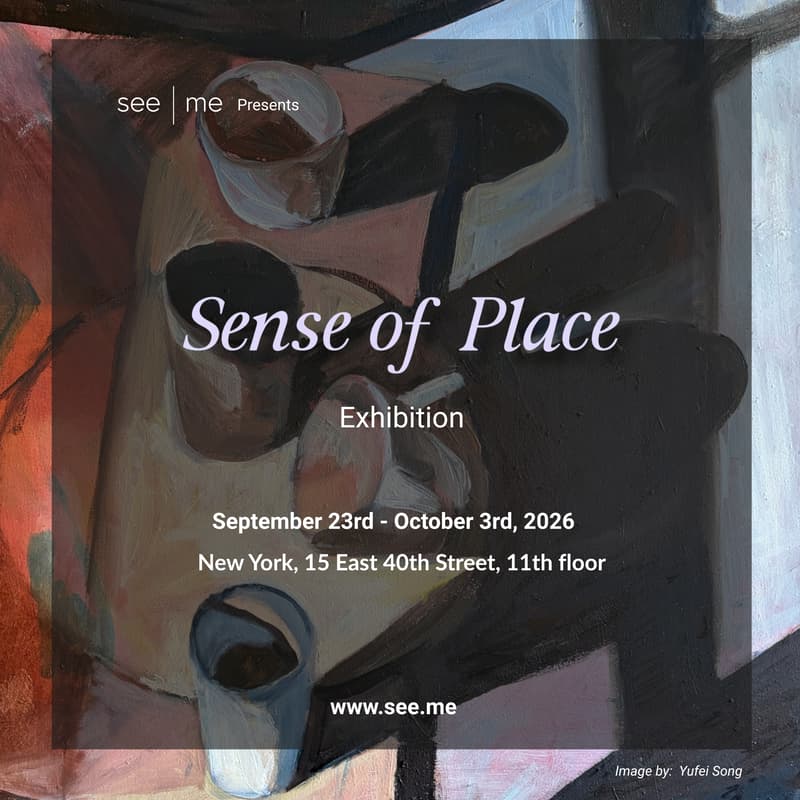

Sense of Place, Art Exhibition by SeeMe Gallery
On view: September 23rd - October 3rd, 2026
Closed Sundays and Mondays
Venue: The BLANC Art Space, 15 E. 40th Street, 11th floor New York, NY 10016
Opening Reception: September 23rd , 6 pm - 8 pm
SENSE OF PLACE
Contemporary perspectives on belonging, memory, displacement, and the unstable geography of home
What does it mean to belong to a place when ‘place’ itself is no longer fixed?
Sense of Place brings together eight contemporary artists who interrogate the complex and often contradictory relationships between geography, identity, memory, and belonging. Moving beyond the conventional idea of place as a fixed physical location, the exhibition considers place as a mutable psychological, cultural, and ecological condition—something inhabited, remembered, inherited, imagined, lost, and continually reconstructed.
At a moment defined by unprecedented mobility, migration, technological transformation, political instability, and environmental disruption, the idea of home has become increasingly fluid. The works in Sense of Place inhabit this uncertainty, asking how physical environments become entwined with personal identity and collective memory, and how those relationships persist when the landscapes around us—and our relationship to them—begin to change.
Place emerges here as both external territory and internal terrain. A landscape can become a repository for memory; an interior can function as an archive of lived experience; a city can embody both belonging and estrangement. The artists explore the ways streets, architecture, objects, natural environments, and sensory fragments accumulate meaning, becoming vessels through which individual and collective histories are preserved.
The exhibition also considers the experience of displacement as a state of being between worlds. Migration, relocation, and diaspora complicate the notion of a singular “home,” suggesting instead that belonging can be provisional, layered, and negotiated. Home may be a place we inhabit, a place we long for, or a place that exists primarily within us. We can now inhabit multiple places at once—or feel disconnected from the place immediately around us.
Underlying these shifting geographies is the recognition that ‘place’ is vulnerable. In this context, place becomes inseparable from questions of both cultural and ecological memory.
The Artists
The artists presented in Sense of Place approach these questions through distinct material and conceptual languages, collectively revealing the instability of the places we inhabit and the persistence of the places we carry within us.
Isabelle Huang examines place through the intertwined conditions of ecological change, cultural memory, and human experience. Drawing on her relationship to coastal communities and the ocean, her work considers how labor, heritage, adaptation, and belonging are affected as shorelines and marine environments shift. Place becomes an embodied and evolving entity—one shaped simultaneously by environmental forces and the communities that depend upon it.
Yufei Song approaches place through memory, atmosphere, and the psychological experience of returning home. Her paintings of Qingdao transform familiar winter landscapes—bare branches, crisp light, and quiet streets—into introspective spaces where physical surroundings become inseparable from emotional memory.
Kevin Currier investigates the instability of place through relief woodcuts that move between personal memory and imagined futures. In Geographic Memory, places altered or lost over time are reconstructed through the imperfect lens of recollection, while The Upper Anthropocene imagines a distant future in which contemporary infrastructure has become archaeological evidence—cell towers, roads, and industrial structures transformed into mysterious relics. His carved surfaces become meditations on time, cultural memory, technological inheritance.
Joshua YeheNara turns the idea of place inward, treating it less as geography than as a state of awareness. In ZEN—Organic Photography for the Digital Age, quiet, seemingly impossible scenes create a space between permanence and transience, gravity and liberation, while the sea becomes a metaphorical field for contemplation. His use of labor-intensive analogue photographic processes reinforces the work’s meditation on slowness, materiality, and the invisible connections between human beings and the natural world.
Jesse Brink explores place through form and material, creating solitary ceramic houses within austere, imagined landscapes. His works evoke spaces that are at once physical and psychological, using isolation and ambiguity to consider presence and the possibility of emotional sanctuary. Constructed of both natural and repurposed manufactured materials, Brink’s pieces appear simultaneously familiar and displaced, inviting viewers to imagine what it means to inhabit a place that exists somewhere between reality and memory.
Shohee Kang approaches place as an internal condition, using painting to examine identity and the complexity of interior worlds. Her canvases construct seemingly serene environments that contain an undercurrent of psychological tension, creating a dialogue between external calm and internal turbulence. Through this tension, Kang suggests that place can be less a physical setting than a reflection of the unstable landscape of consciousness itself.
Dan Goldman addresses place through the lived realities of migration, visibility, and belonging. His photographs of undocumented migrant workers examine the paradox of people who are essential to the communities in which they live while being compelled to remain unseen. By giving visual presence to lives shaped by movement, uncertainty, and systemic vulnerability, Goldman asks who is permitted to belong—and what it means to occupy a place while simultaneously being denied recognition within it.
Teresa Crawford-Cabral explores place as something suspended between memory, longing, and imagined futures. Her paintings and graphic works evoke the Portuguese concept of saudade, transforming spaces into sites of yearning where the past and future seem to overlap. Drawing upon the cultural mythology of Sebastianismo, she creates nebulous environments in which absence becomes presence and historical memory takes on the quality of a place that has yet to arrive—or may exist only in collective imagination.
Together, these practices reveal place not as a static backdrop to human experience, but as an active and shifting force. Across landscapes and interiors, memory and migration, ecological systems and imagined futures, the artists in Sense of Place demonstrate how geography becomes personal—and how the personal can, in turn, reshape our understanding of geography.
Rather than offering a singular definition of place, the exhibition embraces its contradictions. Place can be refuge and estrangement, inheritance and invention, permanence and disappearance. It can be located on a map or carried within the body; it can be remembered, reconstructed, or imagined.
Ultimately, Sense of Place asks us to reconsider the geography of belonging. Where do we locate ourselves when the places that formed us are changing, when home can exist across multiple geographies, and when memory itself becomes a kind of territory?
Honorable Mention Winners:
Diana Ocampo, Gabriela Santa, Megan Piunti, Jun Cruz, Sky Zhuang, Shuyuan Zhou, kip Harris, Aanchal Garg, Patrizia Mori, Carlos Aquilino, Keegan Carter, Timothy Butcher, Amaru May, Micael Duran, Hilary Bachelder, Yvette Kaiser Smith
About SeeMe
SeeMe presents contemporary art that engages with urgent cultural, social, and aesthetic questions while creating opportunities for artists to reach new audiences and collectors. Through exhibitions, curated projects, and artist-centered programming, SeeMe supports diverse artistic practices and fosters dialogue between artists, audiences, and the broader contemporary art community.
Exhibition Information
SENSE OF PLACE
SeeMe Gallery
@The BLANC Art Space
15 East 40th Street, 11th floor
Exhibition: September 23rd - October 3r
Opening Reception: September 23rd, 6pm - 8pm
Gallery Hours: Tues. - Fri: 1pm - 6pm; Sat, 12pm - 5pm
Website: www.see.me
Press Inquiries: Nerissa Bardfeld
nerissa@see.me, 917.602.3422