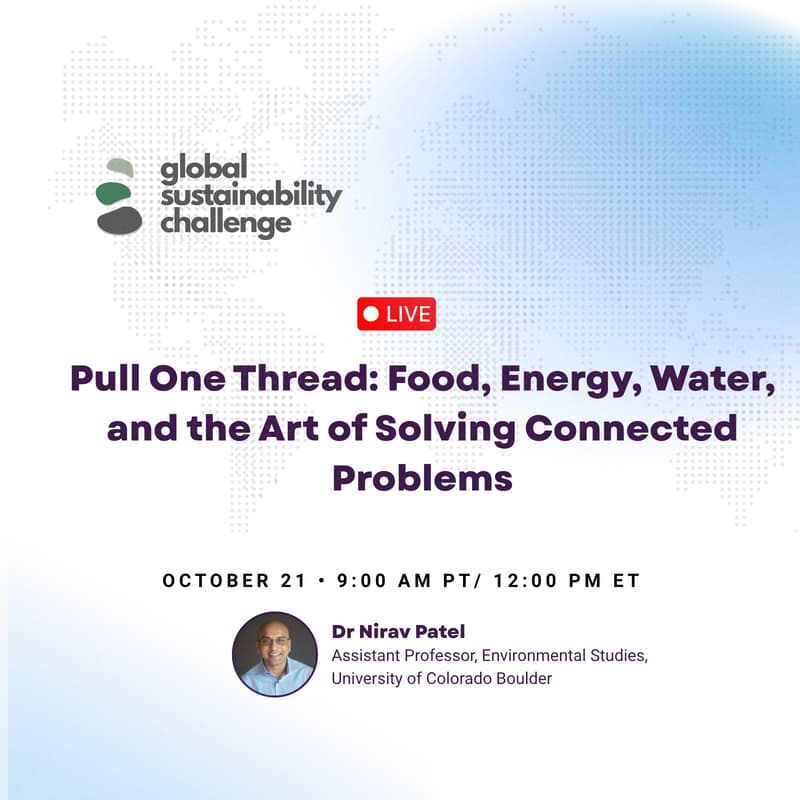

Pull One Thread: Food, Energy, Water, and the Art of Solving Connected Problems
The biggest sustainability challenges facing communities today, from drought and food insecurity to energy transitions and water contamination, rarely stay in one lane. A decision about irrigation affects energy demand. A shift in energy policy reshapes agricultural economics. A water quality crisis can ripple through food systems, public health, and local economies simultaneously. Understanding these connections is not optional for anyone who wants to design solutions that actually work.
This talk introduces the Food, Energy, and Water (FEW) Nexus as a framework for seeing these interdependencies clearly and using them to design more effective, more holistic responses to real problems. Rather than treating food, energy, and water as separate sectors, FEW systems thinking asks: where do these systems connect, where do they create tradeoffs, and where do interventions in one system create unintended consequences in another?
The session will walk through real examples of how these dynamics play out, from PFAS and microplastic contamination moving through food packaging into agricultural soils and water systems, to the tensions between solar energy development and farmland use in rural communities. It will also draw on projects developed by undergraduates tackling problems like post-wildfire soil remediation, agricultural microplastic filtration, and circular economy alternatives to conventional materials, illustrating how students at any level can use systems thinking to move from identifying a problem to designing a response that accounts for the full picture.
The talk will close with a practical discussion of the integrative skills, the ability to work across disciplines, engage stakeholders, and navigate competing priorities, that this kind of work demands and that employers and communities increasingly look for.
About the speaker:
Nirav S. Patel is an assistant professor in Environmental Studies at the University of Colorado Boulder focused on Coupled Natural and Human Systems (CNH). He holds a Ph.D. in Natural Resources from Cornell University, with training in sustainability, human dimensions of resource management, and program evaluation. His scholarship centers on the Food, Energy, and Water nexus, urban ecology, environmental communication, agrivoltaics, and the social acceptance of renewable energy in rural landscapes. His translational research spans PFAS contamination in food packaging and agricultural systems, workforce development for dual-use solar, and community-based initiatives such as hydroponic programs creating training and economic pathways for neurodiverse youth.
A national leader in civic and community-engaged pedagogy, Nirav served as SUNY's inaugural Chancellor's Fellow for Civic Education and Civil Discourse, leading workshops on integrating humanities-based inquiry into STEM curricula. He served on the AESS Board of Directors, chairs the CIRTL Alumni Leadership Group, and has contributed to national AI-in-STEM education standards. His teaching has been recognized with CU Boulder's Marinus Smith Award, the Chancellor and Provost Award for Innovative Teaching, and Cornell's Outstanding Teaching Achievement Award. Across research, teaching, and service, he advances an applied, outcomes-oriented approach connecting classroom learning to real-world environmental problem-solving and civic engagement.