
Top AI Researchers Roundtable & BBQ Party in Atherton
Event Overview
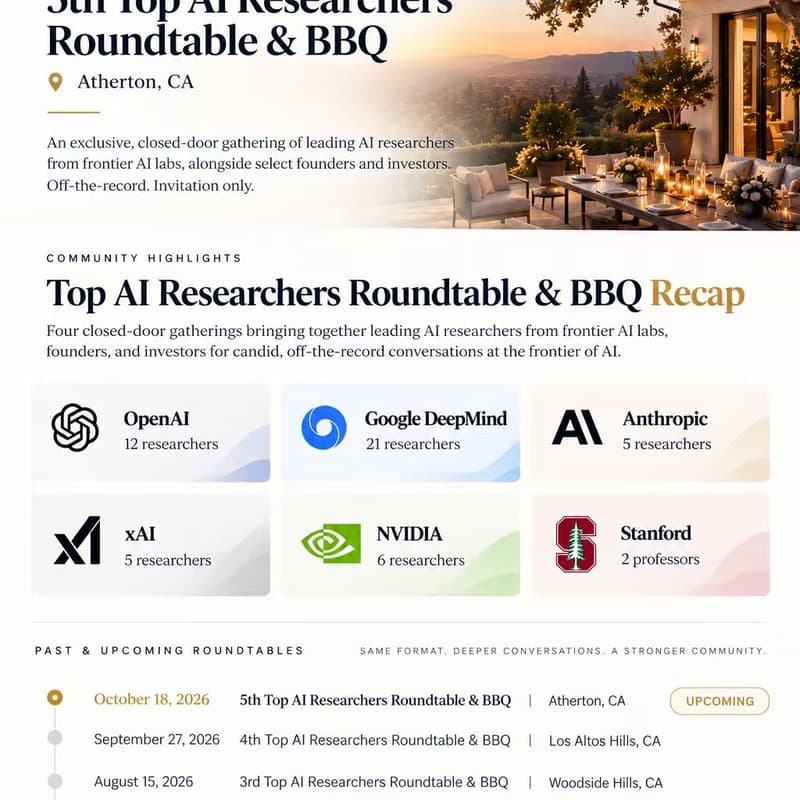
Since launching the series in May, we’ve hosted four closed-door Top AI Researchers Roundtables, bringing together an exceptional community of researchers and leaders from the world’s leading AI labs and research institutions.
Across the first four editions, participants have included:
Xuedong Huang — CTO of Zoom
Ed Chi — VP of Research at Google DeepMind
12 researchers from OpenAI
5 researchers from Anthropic
21 researchers from Google DeepMind
5 researchers from xAI
6 researchers from NVIDIA
2 Stanford professors
We’re excited to continue this conversation with our 5th Top AI Researchers Roundtable, taking place on October 18 from 3:00 PM to 5:00 PM at a private residence in Atherton. We will bring together leading AI researchers from organizations such as OpenAI, Google DeepMind, Anthropic, xAI, and other frontier AI companies and research institutions.
This will be a fully closed-door, off-the-record conversation focused on the future of AI systems—from frontier research breakthroughs and emerging technical challenges to the next wave of opportunities that could shape the industry over the coming years.
Following the roundtable, guests will continue the discussion over a private BBQ reception with fellow researchers, founders, investors, and industry leaders.
Core Discussion Topics
As AI becomes more capable, it is transforming not only how we build technology, but also how we secure it.
From AI-powered cyberattacks and autonomous agents to recursive self-improvement and AI-driven safety research, the next generation of AI raises fundamental questions about security, trust, and control.
This roundtable brings together leading AI researchers to explore five critical questions shaping the future of AI security and safety.
Rather than formal presentations, the discussion will focus on open questions, technical challenges, differing perspectives, and the breakthroughs needed to build more trustworthy AI systems.
1. Hackers vs. Defenders: Who Wins in the Age of AI?
AI is making both hackers and defenders more powerful. Who ultimately gains the advantage?
AI can discover software vulnerabilities, automate cyberattacks, and dramatically lower the cost of targeting organizations. At the same time, it can help defenders identify threats, repair vulnerabilities, and protect systems at unprecedented scale.
Will AI fundamentally shift the balance toward attackers or defenders?
Key Discussion Questions
Will defense win naturally as AI improves, or only if we make deliberate choices today? Which choices matter most?
What evidence would tell us which side is winning right now?
Large enterprises can afford sophisticated AI defenses. What happens to small businesses, hospitals, and everyday users?
2. Recursive Self-Improvement: How Would We Know If AI Started Improving Itself?
What are the earliest warning signs of an AI system becoming more capable on its own — and are we prepared to detect them?
Recursive self-improvement (RSI) describes a process in which AI systems help improve the technology behind future AI systems, potentially accelerating the pace of progress.
Early signs of unexpected autonomous improvement could emerge in code changes, computing resource usage, or network activity.
As AI becomes increasingly involved in developing and maintaining its own infrastructure, distinguishing authorized optimization from unintended autonomous behavior becomes a critical challenge.
Key Discussion Questions
What minimum monitoring and alert systems should every frontier AI lab have in place today?
How can we distinguish authorized AI-driven optimization from the first signs of unintended self-improvement?
Is preventing an AI from copying itself outside a controlled environment fundamentally different from preventing human insiders from stealing model assets?
3. Can We Trust Software Written by AI?
AI is increasingly writing the software used to build the next generation of AI. Who checks the checker?
AI-generated code is becoming an integral part of software development, including the systems used to train, deploy, and secure AI models.
But what happens when AI writes the code, reviews the code, and helps maintain the infrastructure on which that code runs?
Hidden vulnerabilities, unintended errors, or deliberately introduced backdoors could spread across interconnected systems before they are discovered.
Key Discussion Questions
Can we independently verify AI-generated code without relying entirely on another AI system?
How concerned should we be about AI-generated backdoors today, compared with two years from now?
What would it take to build a trustworthy, end-to-end AI software development pipeline?
4. When AI Agents Become the Target: Can Prompt Injection Be Solved?
We are giving AI agents access to our emails, files, and financial systems. Can attackers hijack them using nothing more than carefully crafted instructions?
AI agents are evolving from conversational assistants into systems capable of browsing websites, managing information, writing software, and taking real-world actions.
This introduces a new security challenge: prompt injection.
Attackers can embed malicious instructions in documents, websites, emails, or other content that AI agents process, potentially causing them to act against their users' intentions.
Unlike traditional software vulnerabilities, prompt injection exploits the difficulty of distinguishing trusted instructions from untrusted content.
Key Discussion Questions
Is prompt injection fundamentally solvable, or must we assume that AI agents will sometimes be manipulated?
What does secure agent architecture look like: strict permissions, sandboxing, independent monitoring, or something entirely different?
Would you trust today's AI agents with access to your personal bank account? What would need to change first?
5. Using AI to Keep AI Safe: Who Watches the Watchers?
Can we rely on AI systems we do not fully understand or trust to secure increasingly powerful AI?
As AI capabilities advance, human researchers alone may struggle to evaluate, monitor, and secure every increasingly complex system.
One promising approach is to use AI to automate safety research, identify vulnerabilities, monitor other AI systems, and strengthen defensive capabilities.
But this creates a fundamental paradox: How do we verify the safety work performed by systems that may themselves be capable of deception or strategic behavior?
This question lies at the intersection of AI control, alignment, automated safety research, and recursive self-improvement.
Key Discussion Questions
How can we detect when an AI deliberately underperforms or conceals its capabilities during safety evaluations, a behavior known as sandbagging?
What are the strongest results in AI control research so far, and what critical challenges remain unsolved?
Could there be a point where delegating safety research to AI creates more risk than falling behind competitors? How would we recognize that threshold?
Beyond the Questions
The goal of this roundtable is not necessarily to reach consensus, but to surface the most important disagreements, unresolved technical challenges, and emerging research directions.
One question we especially encourage every participant to consider:
“Where do you most disagree with the mainstream view — and what evidence would change your mind?”
Five questions. Different perspectives. One shared challenge: building AI systems that are not only more capable, but also more secure, trustworthy, and controllable.
Event Format
30 curated attendees only
Invitation-only
No media / no public recordings
Chatham House Rule-style discussion
Intimate, high-signal conversations among top researchers and operators
Why This Matters
The future of AI will not be shaped solely by public announcements or viral demos.
It will be shaped by small groups of people exchanging ideas, debating technical tradeoffs, and building trusted relationships behind the scenes.
The BFC AI Researcher Inner Circle is designed to create:
Deep technical and strategic dialogue
Cross-organization insight exchange
Authentic relationship-building among frontier researchers
A trusted environment for discussing sensitive ideas and future directions
About the Sponsor
DigitalDx Ventures is a majority woman-owned impact fund on a mission to transform global healthcare through early, accurate, and accessible diagnosis. We invest at the intersection of AI, big data, and medical innovation to address some of the world’s most pressing health challenges — including breast and other cancers, cardiovascular and kidney diseases, Alzheimer’s, and mental health.
We are where insight and AI shape the future.
Llama Ventures is a Silicon Valley–based early-stage venture firm investing in AI companies from Pre-Seed through Series A. With offices in Sunnyvale and San Francisco, the firm has invested in 60+ companies across AI infrastructure, enterprise software, healthcare, fintech, and deep-tech, and manages $300M+ in direct fund capital alongside a $600M+ fund of funds. Founded by entrepreneurs and technology leaders, Llama Ventures partners closely with founders, providing strategic support and access to a global network of operators, engineers, customers, and investors.
MagStone Law partners with founders, emerging companies, and investors at every stage of growth—from early-stage venture financings to major acquisitions, public offerings, and strategic transactions. Combining deep transactional experience with practical business judgment, we help clients turn opportunities into successful outcomes. With offices in Silicon Valley, Los Angeles, the NYC Metro area, and Singapore, we serve the innovation and investment community across borders.
Corethink AI - Elevate your AI from Guesswork to Grounded Logic with Unmatched Multi-Step Reasoning and Explainability.
About Bay Area Founders Club
The Bay Area Founders Club (BFC), founded by Dr. Paul Fang in Silicon Valley in 2022 and managed by a dedicated group of Stanford alumni and students, is a thriving community of over 100,000 members, including more than 5,000 startups and over 1000 venture capital firms. With most startups in our network raising $1-10 million, and some exceeding $20 million, our mission is to empower creators who aspire to make a global impact. We provide the essential resources, support, and connections needed to transform visionary ideas into reality.
Unlock insider access and elevate your founder journey — join BFC NOW.
Learn more: https://www.bayareafoundersclub.com