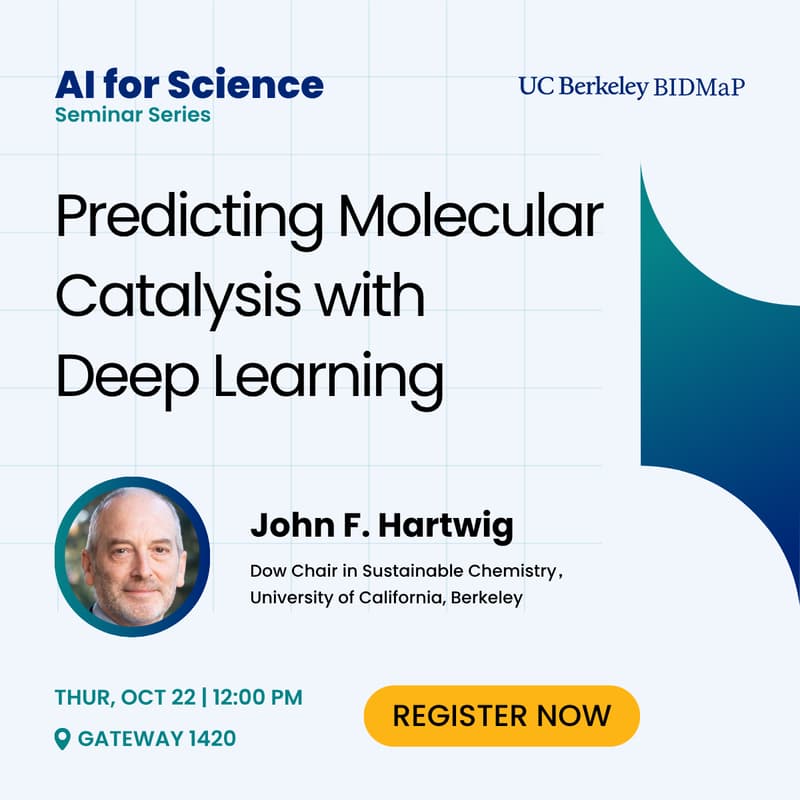

John F. Hartwig: Predicting Molecular Catalysis with Deep Learning
About this Seminar
Predicting Molecular Catalysis with Deep Learning
Approximately a third of the global GDP depends on catalysis, and our path forward to a healthier and more sustainable existence requires further advances in catalysis. Thus, we need to find ways to increase the pace at which we develop next-generation catalysts and new catalytic reactions. My group has worked on the development of catalytic processes and use of mechanistic studies to improve these catalysts for more than three decades. The catalysts we study are molecular, transition-metal complexes with complex and defined three-dimensional structures. For much of this time, we have contributed to and stayed aware of potential advances in high- throughput experimentation with molecular catalysts and methods to increase the pace by which we can design more active or selective catalysts. Now, tools of machine learning, and AI models more generally, have the potential to accelerate catalyst development further. This seminar will present the challenges and our recent approaches to use deep learning methods to create models that predict the selectivity of molecular catalysts for two classes of reactions that, previously, have eluded predictions by other approaches. The talk will close by presenting approaches to reveal the origins of the predictions made by these models.
https://bidmap.berkeley.edu/seminars/predicting-molecular-catalysis-deep-learning
Our Speaker:
John F. Hartwig
John Hartwig currently holds the Dow Chair in Sustainable Chemistry at the University of California, Berkeley after holding for 14 years the Henry Rapoport Chair. His research focuses on the discovery, development and mechanistic analysis of new reactions catalyzed by transition metal complexes, and he is well known for contributions to widely practiced cross-coupling chemistry that form aryl and allylamines, ethers, sulfides, and carbonyl compounds, for hydroaminations of alkenes, for the discovery of practical C-H bond functionalization reactions of small molecules and of polyolefins, and for creating artificial enzymes that enable laboratory chemistry to occur inside a protein, inside whole cells, and even inside biosynthetic pathways. On each of these topics, he has conducted detailed mechanistic analysis and revealed new elementary reactions of organotransition metal complexes. Recently, his research program as begun to use various forms of AI to enhance the development and understanding ofthese catalytic reactions. For this work, he has received the A.C. Cope Award, the ACS award in Organometallic Chemistry, the H.C. Brown Award for Synthetic Methods, the BBVA FoundationAward in the Basic Sciences, the Eni Award for Sustainable Solutions, and the Wolf Prize in Chemistry, among other recognitions. He was elected to the National Academy of Sciences in 2012 and the American Academy of Arts and Sciences in 2015. He is the author of the textbook “Organotransition Metal Chemistry: From Bonding to Catalysis.”
The Bakar Institute of Digital Materials for the Planet (BIDMaP) accelerates the discovery, development, and deployment of advanced materials to address some of the most urgent challenges facing our planet. By combining cutting-edge chemistry with artificial intelligence, machine learning, and robotics, BIDMaP is reimagining how materials can be designed and optimized for clean energy, clean air, clean water, advanced batteries, and sustainable chemical production.