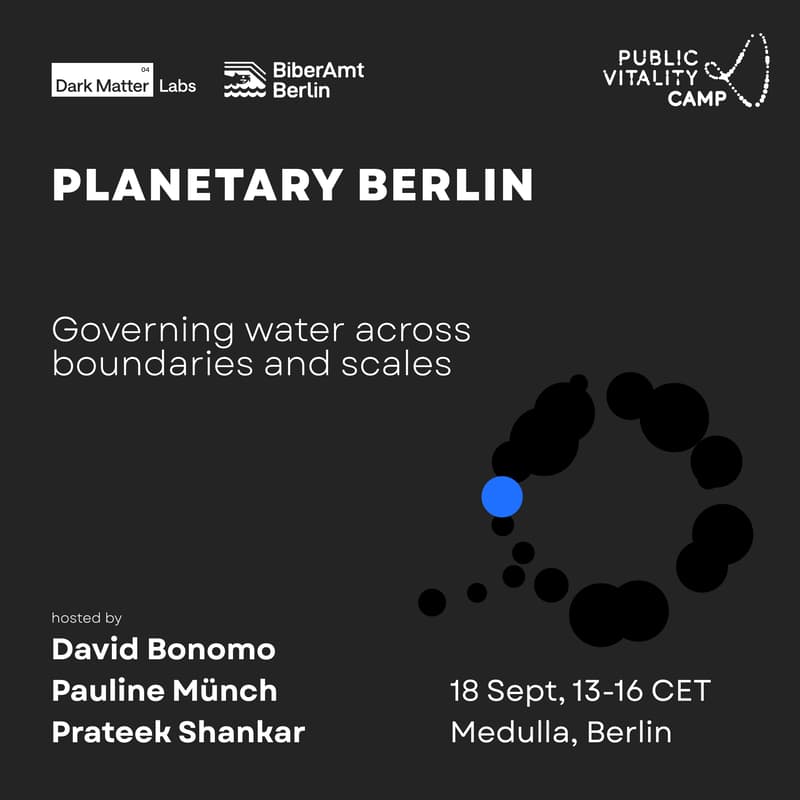

Planetary Berlin: Governing Hydrological Continuities
Planetary Berlin: Governing Hydrological Continuities
Governing water across boundaries and scales
This session is part of the Public Vitality Camp 2026 and is moderated by Prateek Shankar (Dark Matter Labs), Pauline Munch (BiberAmt Berlin), and David Bonomo, along with nextlearning e.V.
Berlin’s water flows beyond the city boundary. Groundwater, rivers, canals, wastewater and peatlands form a connected hydrological system, while responsibility is divided across jurisdictions, sectors and timescales. Decisions about supply, pollution, land use or climate adaptation can therefore shift consequences far beyond where they are made.
How can water be governed at the scale of its actual continuity, rather than at the limits of existing institutions?
In this scenario session, participants work with selected measures from Berlin’s Masterplan Wasser and related strategies. We trace how water, nutrients, carbon and responsibility move across the Berlin–Brandenburg system and beyond, then test what forms of institutional representation could make these dependencies more visible. The intention is to identify where current governance fragments the system – and what could help decisions better account for cross-border, downstream and long-term effects.
Welcome perspectives
The working language of this session is English, with openness to contributions in German. We particularly welcome perspectives on water, governance and interconnected ecological systems, including:
water utilities and water management
Berlin and Brandenburg administrations
river-basin and regional planning
climate adaptation and drought resilience
wetlands, peatlands and biodiversity
environmental law and rights of nature
institutional and governance design
No prior knowledge of planetary governance is required. Particularly valuable are experiences from situations where ecological processes cross the administrative, sectoral or temporal boundaries through which decisions are normally made.
Important notes
The Camp format is a volunteer-developed prototype and intentionally simple in how it is organised. Please bring your own food and drinks, and feel free to bring something to share.
Friday of the Public Vitality Camp will be based out of Medulla, our shared resilience space on the Kreuzberg/Mitte border at Dresdener Straße 113B.
The Public Vitality Camp is a shared learning space for people already working on societal, institutional, technological and ecological challenges. Across the sessions, we work on concrete questions and tensions and explore what enables people, institutions and communities to remain capable of acting under increasingly difficult conditions – and how decisions made today expand or constrain future possibilities.
Here you can discover further sessions and register or apply to participate.