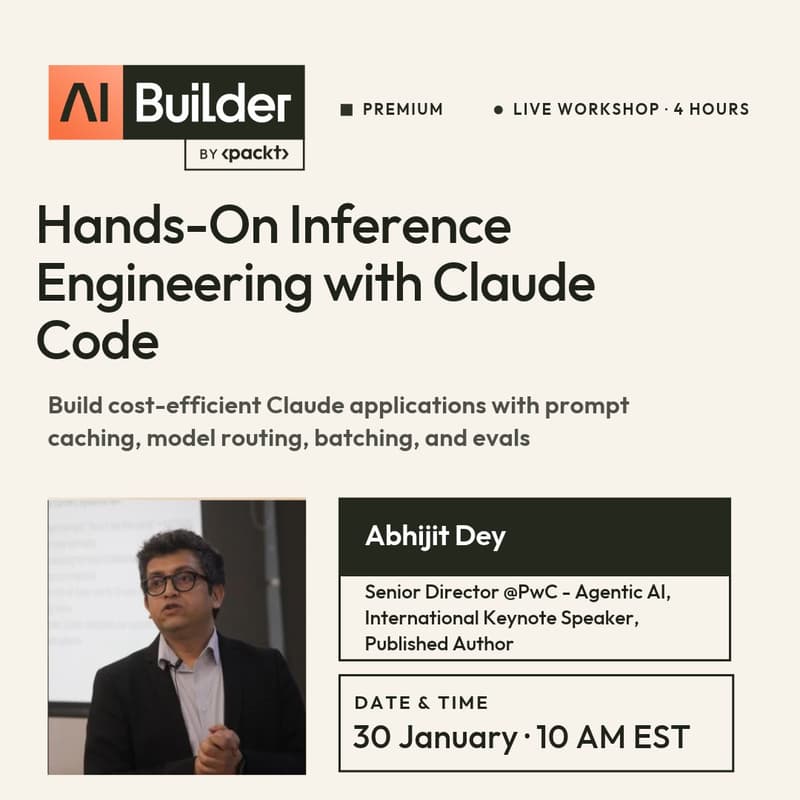

Hands-On Inference Engineering with Claude Code
Optimize Claude API inference with caching, model routing, effort control, batching, and evaluation while maintaining quality and speed.
In this session you take a working Claude workload and engineer its inference: what it costs, how fast it answers, and how good the answers stay. You measure a baseline before changing anything, then apply one lever at a time (prompt caching, model tiering, effort control, batch processing and streaming) and keep only the changes the numbers support. You leave able to show, for your own workload, the cheapest setup that still meets your quality bar and your latency target.
A workshop seat is a one-time investment. The same workload built carelessly can cost ten times more to run, every month, with no gain in quality.
About the instructor
Abhijit Dey is a banking technology and AI leader who has taken agents into regulated production. As Product Lead for AI and API Banking, he deployed more than 100 live AI agents enterprise-wide. He has helped professionals build hands-on AI expertise through his courses and workshops, and shares his practical experience as a Packt author. He brings insights from real-world Claude implementations: what worked, what didn't, and the engineering practices he uses to keep inference fast, reliable and affordable at scale.
What you will learn:
During the workshop, you will learn how to:
Measure before you optimise. Read the usage data on every Claude call and turn it into cost per correct outcome and time to first token, measured against a labelled test set, so every later change has a fixed baseline.
Stop paying for the same tokens twice. Apply prompt caching to shared instructions and reference text, measure the hit rate and saving, and diagnose the silent mistakes that break a cache.
Count tokens the way the bill does. Account for input, output, cached and thinking tokens, and for tokenizer differences between models, so cost comparisons are real.
Choose the smallest model that does the job. Compare Haiku, Sonnet and Opus on the same work, find exactly where the cheaper model fails, and route each request to the model that handles it correctly.
Control how hard Claude thinks. Use effort levels and adaptive thinking as a cost and speed dial, and spend extra reasoning only on the requests that need it.
Match each request to the right delivery mode. Send work that can wait to the Batch API at half price, stream work that a person is waiting for, and know when paying more for speed is worth it.
Run inference as a production service. Add rate-limit handling, fallbacks, spend ceilings, data-residency settings and cost monitoring, and see what each one costs and protects.
Write the inference plan your team can sign off. Produce a one-page plan with your chosen model mix, caching and batch strategy, cost per thousand requests, latency targets and the quality bar that blocks further cuts.
Who should attend this workshop:
This is a hands-on masterclass for developers who already build with the Claude API and are under pressure to deliver more for less. Is this call costing more than it should? Which requests really need the big model? What happens to the bill at ten times the volume?
It is best suited for:
AI/ML Engineers and Application Developers building features and services on top of LLM APIs.
Software Engineers and Tech Leads responsible for the running cost, speed and reliability of AI features in production.
AI Platform Engineers and LLMOps Engineers setting standards for model choice, caching, batching and monitoring across teams.
Solution Architects sizing and designing high-volume AI workloads.
Engineering Managers and FinOps practitioners who need to explain, forecast and control AI spend with real numbers.
AI Startup Founders and SaaS Product Leads whose margins depend on what each AI request costs.
You should be comfortable writing and running Python code and calling an API. You will need your own Claude API key: the hands-on exercises make live calls, with a small, capped spend per attendee.
Upskilling a team rather than just yourself?
Explore group seats, private workshops, and tailored training programmes with Packt.
What you will leave with:
You will leave with practical assets you can adapt to your own Claude workloads:
A working repository you can point at your own requests after the workshop.
A measurement harness that reports cost, tokens, latency and quality for every call, against a labelled test set.
A reusable method for finding the cheapest setup that still meets your quality bar.
Working patterns for prompt caching, including how to check it is actually hitting and how to diagnose misses.
A model-routing approach that sends each request to the smallest model that handles it correctly, with effort levels tuned per task.
A batch and real-time split, with code for both the Batch API and streaming.
An operational layer covering rate limits, fallbacks, spend ceilings, data residency and cost monitoring.
A before-and-after cost and quality baseline for the same workload, which you can reuse when estimating future AI features.
A one-page inference plan with your own measured figures for cost per outcome, latency, quality and the trade-offs you chose.
Cut the Bill. Keep the Quality.
The practical system: a high-volume support-ticket processor
The system processes a stream of customer support tickets for a fictional software company. Every ticket is classified, prioritised and routed; urgent tickets also get a drafted reply for a human agent to review. All of it is checked against the same long set of support policies and product documentation.
The workload has two very different paths. Most tickets can wait until morning and should cost as little as possible. A few are urgent, a person is waiting, and speed matters more than price. A handful are genuinely hard and need careful reasoning. That mix makes it the right workload for showing every inference lever, and the trade-offs between them.
You will start from a straightforward version that works but is expensive, measure it against a labelled ticket set, and then re-engineer its inference one change at a time, checking cost, speed and quality after each step.
The ticket processor is the practical example, but the engineering patterns are transferable. They apply wherever an application sends large volumes of requests to a model: document extraction, content moderation, code review, search, summarisation, or any agent that runs at scale.
You'll leave with more than a cheaper pipeline: a measurement harness, proven cost and latency patterns, and the skills to size, tune and defend the inference cost of any Claude workload.