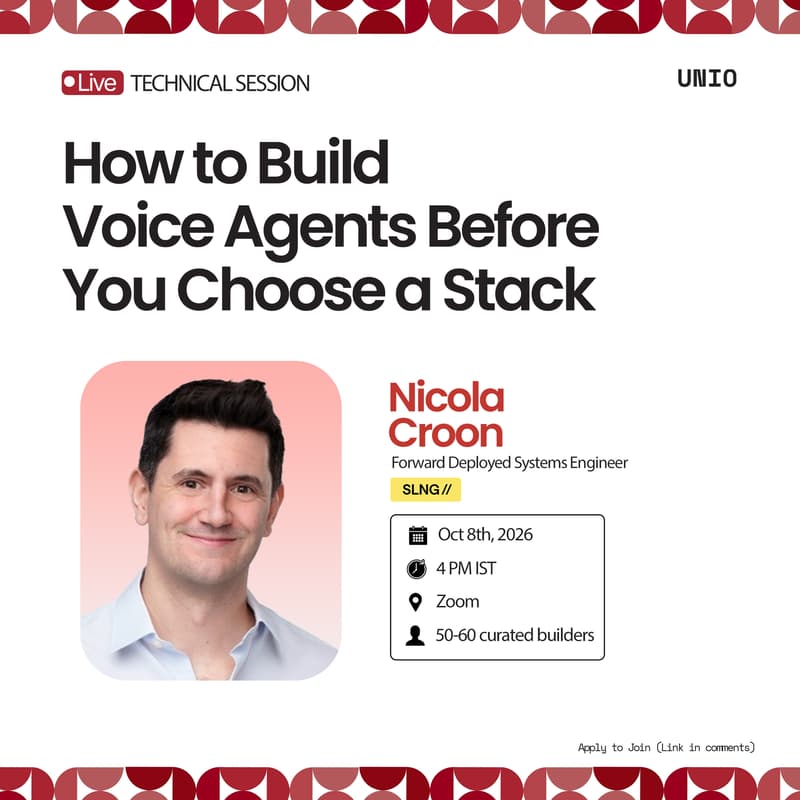
How to Build a Voice Agent Before You Choose a Stack
Most voice agents get written against a runtime. You pick LiveKit or Pipecat on day one, and every decision after that is shaped by it. Then a customer asks for data to stay in India, or a better Hindi model ships, or you need to move runtimes, and you end up rebuilding work you already did.
Unmute flips the order. You describe the agent once, in YAML and Markdown, then compile it to whichever runtime you need and deploy it wherever it has to run.
Nicola Croon from SLNG, who builds Unmute, is joining us to show how it works in practice, including where the abstraction holds and where it breaks.
What you'll get
→ A clear line between what belongs in a portable agent definition and what is genuinely runtime-specific
→ One definition compiled to Pipecat and to LiveKit, side by side, with the output compared live
→ An honest look at where it leaks: turn detection, interruption handling and telephony behave differently per runtime
→ How manifests keep model and region policy separate from the agent, so the person writing it and the person approving it can be different people
→ The same agent deployed self-hosted, on managed cloud, or pinned to an India region for DPDP
→ Swapping Indic models (Hindi, Tamil, Kannada) as a config change instead of a code change
→ What it takes to add your own compile or deploy target, and what a mergeable contribution looks like
→ The open design questions the team has not resolved, where your opinion can actually change the direction
Who this is for
Engineers already shipping voice agents in production or close to it. Anyone on LiveKit or Pipecat who has felt locked in. Platform teams supporting several agent builds across a company. You should be comfortable with Python or TypeScript, YAML and a CLI.
This is not a beginner session. We'll assume you know what STT, turn detection and barge-in are.
Speaker
Nicola Croon, Forward Deployed Systems Engineer at SLNG. Builds Unmute.
Details
📅 Wednesday, 8 October 2026
🕓 4:00 PM IST
💻 Live on Zoom
Unmute is MIT licensed and open source. Everything covered is usable without any commercial product. SLNG builds it and runs a commercial platform underneath, but nothing in this session requires it. We're here for contributors, not customers, particularly on new compile targets and Indic language coverage.
Hosted by Unio, the Voice AI Community.