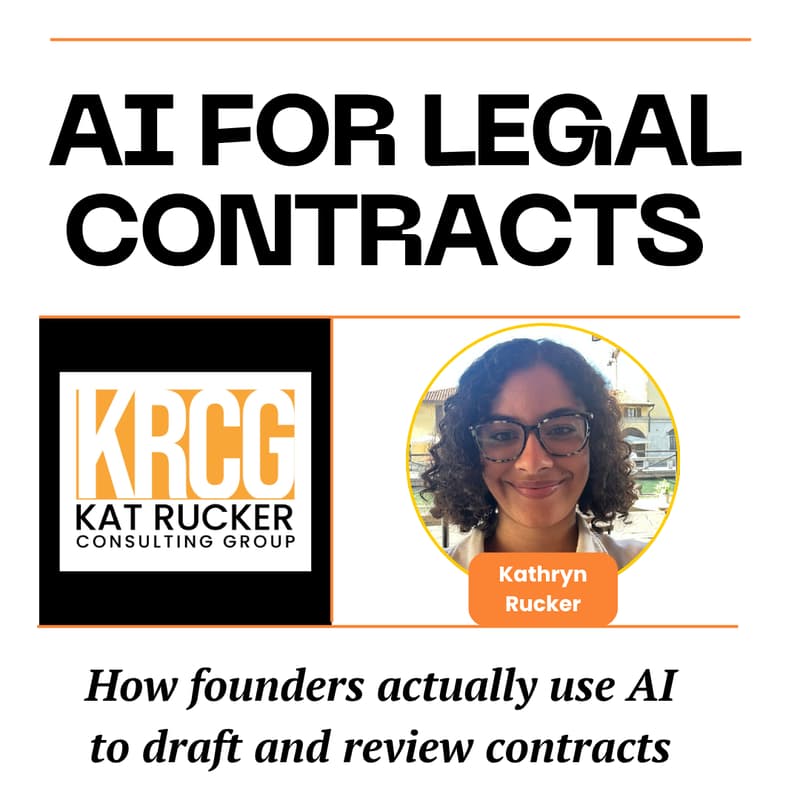

AI for Legal Contracts: A Practical Workflow for Founders and Operators
AI for Legal Contracts
A practical workshop on how founders and operators actually handle contracts using AI, templates, and basic due diligence
📅 Monday, April 27, 2026
⏰ 3:00–4:00 PM PT
📍 Virtual (Zoom)
I am not an attorney, and this information is for educational purposes only. It should not be considered legal advice.
Most early-stage companies aren’t sending every contract to a lawyer.
They’re starting with templates (LegalZoom, past agreements, etc.), Googling clauses, and increasingly using AI to draft and refine documents.
But that doesn’t mean it’s being done well.
A lot of people are either:
overpaying for things they could prep themselves
or blindly trusting templates and AI without understanding what’s actually in the contract
In this live, one-hour workshop, we’ll walk through how to handle contracts in a practical, real-world way using a mix of templates, AI, and basic due diligence.
The goal isn’t to replace lawyers—it’s to use them more effectively and avoid unnecessary spend.
This session is designed to be practical and grounded. You’ll see how to approach contracts step-by-step, what to actually look for, and where people tend to make mistakes.
What we’ll cover
1. Where to start (and why most people overcomplicate this)
-Why you shouldn’t start from scratch
-Using templates (LegalZoom, prior contracts, etc.) effectively
-What a “good enough” starting point actually looks like
2. Using AI to draft and refine contracts
-How to use AI to rewrite, clarify, and customize agreements
-What AI is actually good at (and what it’s not)
-Common mistakes when relying too heavily on AI
3. The key clauses you should always understand
-Scope of work, payment terms, and timelines
-Intellectual property and ownership
-Termination and liability
-What to look for vs what to flag
4. Basic due diligence (that most people skip)
Making sure you’re contracting with the right entity (LLC checks, etc.)
Why this matters more than people think
Simple ways to verify who you’re actually working with
5. When to bring in a lawyer (and how to use them efficiently)
When it’s worth paying for legal review
Drafting vs reviewing (and why this matters for cost)
Where paralegals can be a more cost-effective option
Typical cost ranges and how to think about them
Who this is for
- Founders handling contracts without a full legal team
Fractionals and consultants working across multiple clients
Operators who want a more structured way to approach contracts
What you’ll walk away with
- A clear, repeatable way to handle contracts without starting from scratch
A better understanding of what actually matters in an agreement
More confidence using AI and templates responsibly
A practical framework for when to bring in legal support
About the host
Kathryn Rucker is the Founder of KRCG and a Fractional VP of Sales and Marketing. She works with early-stage companies to build go-to-market systems and operational processes. Through her workshops, she shares practical, execution-focused approaches to running and scaling a business.