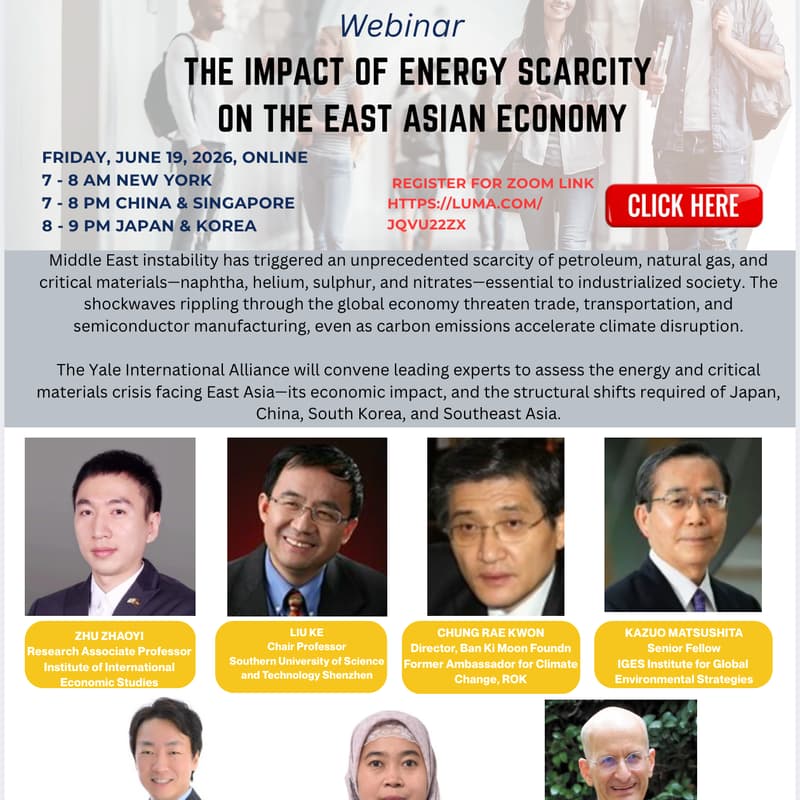

The Impact of Energy Scarcity on the East Asian Economy
Mounting instability in the Middle East has created an unprecedented scarcity of petroleum, natural gas, and materials like naphtha, helium, sulphur and nitrate compounds critical for industrialized society. We have just started to see the shockwaves racing through the global economy, which could dramatically impact trade, transportation, and the manufacture of semiconductors and other manufactured goods.
On June 19, the online seminar "The Impact of Energy Scarcity on the East Asia Economy" will feature experts from Yale community in China, Japan, South Korea, and Southeast Asia. The discussion will examine the implications of this energy and critical materials crisis for East Asia, considering the concrete impact on the economy, and the long-term strategic shifts Japan, China and South Korea may need to make in response to a new environment—with profound implications for everything from supply chains to transportation and agriculture.
Speakers
CHINA
Zhaoyi Zhu
Former Visiting Scholar, Yale Law School's Paul Tsai China Center
Research Associate Professor, Institute of International Economic Studies
Zhaoyi Zhu is a leading Middle East expert in China who serves as Executive Director of the Institute of Middle East Studies at Peking University HSBC Business School and has an affiliation at the Institute of International Economic Studies. He was a Visiting Scholar at the Paul Tsai China Center in Fall 2022.
Ke Liu
Chair Professor, Southern University of Science and Technology
Ke Liu is Chair Professor at the Southern University of Science and Technology in Shenzhen and former associate director of the National Institute of Clean and Low-Carbon Energy. He also serves as a director at the Center for China and Globalization. He is involved in research on energy issues and the formulation of policy related to the transition away from carbon in China.
JAPAN
Kazuo Matsushita
Senior Fellow, Institute of Global Environmental Strategies (IGES) Institute for Global Environmental Strategies
Professor Emeritus, Kyoto University
Kazuo Matsushita is a Senior Fellow at the Institute of Global Environmental Strategies (IGES) and a Professor Emeritus of Kyoto University. He is also Chairman of the Japan Society for Gross National Happiness (GNH) Studies, Co-Chair of the Think 7 (T7) Japan 2023, and former President of the International Academic Society for Asian Community (ISAC). He served as a Professor at the Graduate School of Global Environmental Studies (Global Environmental Policy) at Kyoto University between 2001 to 2013.
Arino Yusuke
Senior Researcher, The Asia Institute
Guest Associate Professor, Faculty of Environment and Information Studies, Keio University
An expert on Japanese energy policy, Arino Yosuke conducts research on the long-term transition strategy of mitigation and adaptation required for climate resilient development in Asia. He consults on climate vulnerability, resilience, and adaptation to climate change, with a focus on energy issues.
SOUTH KOREA
Ambassador Chung Rae Kwon
Director, Ban Ki Moon Foundation
Ambassador Chung Rae Kwon has served as the leading advocate for a meaningful response to climate change and a rational energy policy in Korea, and globally. As Director at the Ban Ki Moon Foundation, he serves as Chairman of the Steering Committee of the New Climate Innovation. He served previously as the first Ambassador for Climate Change of the Republic of Korea and Director for Environment and Development Division of United Nations Economic and Social Commission for Asia and the Pacific (ESCAP).
INDONESIA
Ambiyah Abdulla
Senior Economist
ASEAN Center for Energy
Ambiyah Abdullah is a Senior Economist at the ASEAN Centre for Energy (ACE), where she leads regional initiatives on energy transition, energy investment, and decarbonization pathways across ASEAN. With more than nine years of international experience in climate change, environment, and energy policies, she has managed flagship regional studies, including ASEAN energy investment initiatives and EUsupported decarbonization initiatives, while supporting regional policy dialogue across ASEAN.
Prior to joining ACE, she worked on carbon markets and Article 6 initiatives at the Global Green Growth Institute in Seoul, Korea, and held research positions at international institutions in Japan, focusing on climate change policy and sustainable development. She holds a PhD in Development Economics from Nagoya University.
The Moderator
Emanuel Pastreich '87
President, The Asia Institute
Emanuel Pastreich is President of the Asia Institute, a think tank that builds bridges across Asia for cooperation in policy and strategy to respond to climate change, the impact of technological change on human society, and the rapidly shifting nature of international relations.
Event Time
Friday, June 19, 2026
China & Singapore Time:
7:00 pm-8:00 pm
Japan & South Korea Time:
8:00 pm-9:00 pm
US East Coast Time:
7:00 am-8:00 am
Participation Format
Registration is required to receive the ZOOM access link, which will be sent shortly to your registered email or phone number. Please enter the Zoom room 15 minutes before the starting time. Once the Zoom room reaches full capacity, latecomers will not be able to join the event.
The language of the event will be in English.