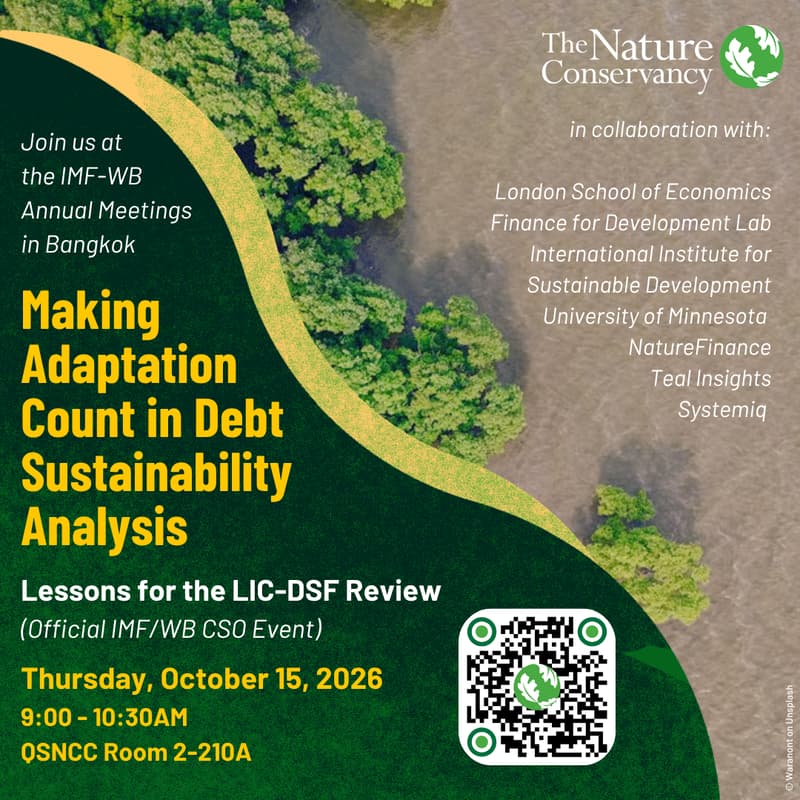
Making Adaptation Count in Debt Sustainability Analysis: Lessons for the LIC-DSF Review (Official IMF/WB Civil Society Policy Forum Event)
The IMF and World Bank have undertaken the most significant review of the Low-Income Debt Sustainability Framework (LIC-DSF) in nearly a decade. The new framework will include a Long-Term Module which will enable country teams to better model both climate risks and adaptation and resilience (A&R) investments.
This session was chosen to be part of the official IMF/WB Civil Society Policy Forum to unpack the operationalization of the Long-Term Module and dive into examples of how A&R investments, including nature-based solutions, can reduce economic losses, improve fiscal outcomes, and strengthen debt sustainability.
Speakers will discuss how adaptation benefits can (and can’t) be reflected in debt sustainability analysis and how the revised LIC-DSF can both better capture and support resilient development and financing.
Speakers:
Frank Rijsberman (moderator), Global Head for Policy and Public Funding, The Nature Conservancy
Mark Flanagan, Deputy Director, Strategy, Policy, and Review Department, International Monetary Fund
Manuela Francisco, Global Director for Fiscal Policy and Growth, World Bank Group
Nicola Ranger, Executive Director, Earth Capital Nexus, The London School of Economics
Sam Mugume Koojo, Assistant Commissioner for Macroeconomic Policy, Uganda Ministry of Finance; Co-Chair - Coalition of Finance Ministers for Climate Action
Organizers: The Nature Conservancy, London School of Economics, NatureFinance, Teal Insights, Systemiq, Finance for Development Lab, the University of Minnesota, International Institute for Sustainable Development