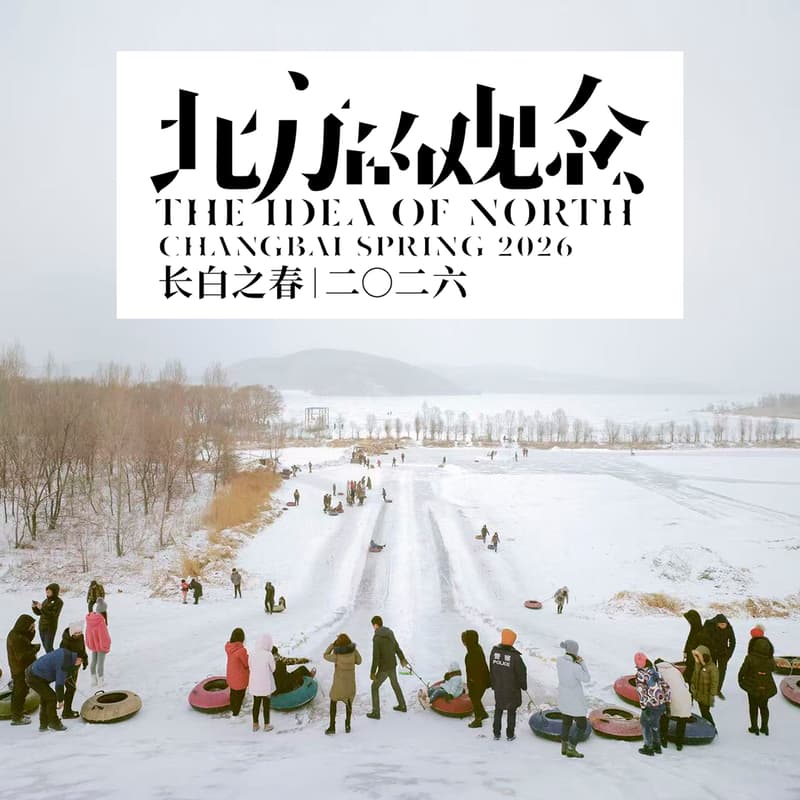

Changbai Spring 2026: The Idea of North
The moral equivalent for us is going north.
——Walter McClean, The Idea of North
In 1967, Glenn Gould launched his contrapuntal radio documentary, The Idea of North, on CBC Radio. This was the result of his first trip to Canada’s subarctic, where he interviewed people who had worked and traveled in that vast northern hinterland, all the while experimenting with the Bachian counterpoint method in his recordings and editing. For Gould, “North” did not refer to the relative position of a person or country, but rather to the Earth’s absolute position—the high latitudes of the Northern Hemisphere, a.k.a. the geographical “Grid North.”[1] In this uninhabited North, the harshness of nature feels like a formidable enemy that the enterprising humans seem to be waging a war against. The swirling snow, the train hurtling toward the desolate, frozen land, and the insignificant human figures provided Gould with symbols for contemplating the solitude. His documentary is a kind of polyphonic, sonic writing, generating his “Idea of North” on both a philosophical and cultural level.
Changbai Spring is a series of research residency programs initiated by the Northeast Asia Art Archive, covering the geographical range of Northeast Asia, with the theme for 2026 being Gould’s “The Idea of North.” Here, Northeast Asia encompasses: the southeastern region of East Siberia and the northern region of Russia’s Far East (which includes the Primorskaya Oblasts and Sakhalin Island); the eastern part of the Mongolia; northeastern Inner Mongolia, and the three provinces of Liaoning, Jilin, and Heilongjiang in northeast China (also known as Dongbei); the Korean Peninsula; and the Japanese Archipelago. This roughly corresponds to the concept of Northeast Asia proposed by Japanese anthropologist Torii Ryuzo in 1924 and the demarcation of Northeast Asia by American historian Robert Kerner in 1932.[2] Considering its cold climate, Northeast Asia can also be considered more broadly a part of the high latitudes.
The high latitudes include the northern United States, all of Canada, all of Europe, and northern Asia. At their northernmost part lies the Arctic Circle, encompassing the territories of eight countries—namely the United States, Canada, Denmark, Iceland, Norway, Sweden, Finland, and Russia—located above the 66th parallel north. Within the Arctic Circle, the average temperature in July is below 10°C, placing it within the North Frigid Zone. Beyond the Arctic Circle to the 38th parallel north lies the subarctic, cold temperate, and temperate zones, with the coldest winter temperatures dropping below 0°C. These generally cold conditions, coupled with human migration, have led to the emergence of similar cultures across this vast region.
Research has shown that the DNA of Ancient Paleo-Siberians is closely related to contemporary Native Americans, with approximately two-thirds of Native American ancestry tracing back to this group.[3] This confirms the hypothesis that the Inuit, now found in Alaska, northern Canada, Greenland, and Iceland, may have originated from Siberia. Their ancestors crossed the thin land bridge across the Bering Strait to enter the Americas around the end of the Pleistocene (over 10,000 years ago) and then spread eastward. The Sámi people of northern Scandinavia are also said to have originated from Siberia.[4] These two groups, the first and second largest in population among Arctic indigenous peoples, both inherit Mongoloid traits and share similar animist beliefs with the indigenous peoples of Siberia, the Russian Far East, Sakhalin Island, Hokkaido of Japan, Northeast China, and the Korean Peninsula. In the high latitudes, indigenous peoples have a variety of shamanic practices. While the rituals and paths are varied, all belong to a way of communicating and responding to the cold, powerful, and mysterious forces of nature.
Likewise, while languages of different ethnic groups in Northeast Asia are unintelligible to each other, they nonetheless share similar grammatical structures. The Tungusic, Mongolic, and Turkic languages of the early 17th century all had numerous affixes and particles that served to anchor words within sentences, leading them to once be grouped into an “Altaic” language family.[5] Earlier, both Japan and Korea used Classical Chinese as their writing system. Japanese Kana, which originated in the 9th century, evolved from the cursive and regular scripts of Chinese characters. Korean Hangul, which originated in the 15th century, was inspired by the Mongolian ʼPhags-pa script and was mixed with Chinese characters for a long time. These languages and scripts are the result of a longue durée of what anthropologist Anna Lowenhaupt calls “contamination” across this region’s populations.
These commonalities provide the historical genes for the possible emergence of an entirely new, transnational cultural ecology of the North in our contemporary era. Unlike the concepts of “Global North/Global South,” which are anchored in neoliberal economic development, we seek to explore the possibility of a regional cultural assemblage. After using the term “contamination” to describe the interactions between different species, Anna Lowenhaupt Tsing further replaced the anthropocentric “community” with the concept of “assemblage,” emphasizing “open-ended gatherings,” “unintentional coordination,” and “polyphonic juxtaposition.”[6] This ecologically based “assemblage” represents the intellectual exchange and cultural generation we anticipate within the global high latitudes. It is spontaneous, organic, and internal, rather than an externally “othered” region due to curiosity and gaze, or even romanticization and labeling.
In the late 19th and early 20th centuries, Scandinavia witnessed a surge of literary and artistic movements, including Symbolism, Impressionism, Naturalism, Decadence, and Neo-Romanticism. This movement was once labeled “Borealism,” a term derived from Boreas (Βορέας), the god of the north wind in Greek mythology. Much like Edward Said’s “Orientalism” critique of imaginary visions of the Far East, it also embodies the exoticism and stereotypes imposed on the Nordic region, the “internal others in Europe,” from the perspective of Greco-Roman centrism based in the Mediterranean. In the ’85 New Wave art movement in China, the Dongbei-based “Northern Art Group” advocated the concept of “post-culture of cold zones” characterized by “solemnity, grandeur, indifference, and tranquility” based on the “inherent tendency of world civilization towards colder zones”.[7] Is the North inhospitable, barbaric, violent, and turbulent? Or is it solitary, sublime, pure, and enlightened? It may not be so simply defined, but it requires a deeper and more nuanced, embodied understanding.
The Changbai Spring project, based on the iconic Mount Changbai in Northeast Asia, welcomes artists and researchers from around the world, particularly those from high latitudes, to visit Northeast China in 2026 for ten days of workshops, mutual learning, and ways of creating, sharing, and exchanging to construct diverse “Ideas of North.” This field trip in 2026 will primarily be conducted in Yanbian Korean Autonomous Prefecture, Jilin Province, along with select urban and rural areas of Heilongjiang Province, such as Mohe Beiji Village, China’s northernmost point. Research will focus on the relationship between climate, soil, and agriculture; the living spaces and autonomous experiments of indigenous and immigrant communities; and the history of borders and geopolitical conflict. The results of the residency and field research will be presented in the following exhibition and publication at the Northeast Asia Art Archive in New York.
Over the next few years, our field research will gradually expand from Northeast China to the Russian Far East, the Korean Peninsula, and the Japanese Archipelago. We look forward to exploring Northeast Asia through ever-expanding field visits, just like Torii Ryuzo:
Five visits to Korea, three to Manchuria
and once again, wandering in the former Qing Empire
Neither official, nor businessman, nor monk
Lingering everywhere
Escaping the summer heat in Vladivostok
and traveling along the Primorskaya Oblasts
Snow piled on the top of Changbai Mountain
and the trees along Amur River triggered a cool autumn.[8]
[1] North, as indicated by a compass, is called “Magnetic North,” while north as located by the North Star is called “True North.”
[2] Torii Ryuzo, On Northeast Asia, from an Anthropological and Ethnographic Perspective (Tokyo: Oka Shoin, 1924); Robert Kerner, Northeastern Asia, A Selected Bibliography: Contributions to the Bibliography of the Relations of China, Russia, and Japan (Philadelphia: B. Franklin, 1968).
[3] Sikora, M., Pitulko, V. V., Sousa, V. C. et al. “The Population History of Northeastern Siberia since the Pleistocene,” Nature 570, 182–88 (2019).
[4] Pan Min, Researching Arctic Indigenous People (Beijing: Current Affairs Press, 2012).
[5] Li Narangoa and Robert Cribb, Historical Atlas of Northeast Asia, 1590-2010: Korea, Manchuria, Mongolia, Eastern Siberia (Columbia University Press, 2014)
[6] Anna Lowenhaupt Tsing, The Mushroom at the End of the World: On the Possibility of Life in Capitalist Ruins (New Jersey: Princeton University Press, 2015). The Dialectics of Image: Art of Shu Qun, ed. Huang Zhuan (Guangzhou: Lingnan Art Publishing House, 2009), 465.
[7] Shu Qun, “The Birth of a New Civilization” (1984), “Reflections on Northern Civilization” (1985). See also Huang Zhuan ed., The Dialectics of Image: Art of Shu Qun (Guangzhou: Lingnan Art Publishing House, 2009).
[8] Quoted from Motoyama Hikoichi’s farewell poem for Torii Ryuzo's Northeast Asia expedition. See: Torii Ryuzo, On Northeast Asia, from an Anthropological and Ethnographic Perspective.
Invited Guest Participants
CAO Baoming, researcher and writer. Changchun.
DONG Bingfeng, curator and researcher. Beijing.
NiNi DONGNIER, choreographer and Artist. New York.
Yining HE, researcher and curator. Tianjin/Birmingham.
JIN Dongxuan, documentary filmmaker, member of Icebreaking. Harbin.
Renan LARU-AN, curator and researcher. Berlin.
LI Jiudan, co-founder of Wayfarer Parlor. Harbin.
LI Kuizhe, artist. Changchun.
LIU Chuang, artist. Shanghai.
Tessa MORRIS-SUZUKI, historian and writer. Canberra.
MA Chi, co-founder of Wayfarer Parlor. Harbin.
Kyong PARK, curator, artist, architect, and writer. Seoul/New York.
PI Li, curator. Hong Kong/Shenzhen.
Leandro PISANO, curator, writer, and researcher. San Martino Valle Caudina.
SHU Qun, artist. Chengdu.
SUN Xun, artist. Beijing.
WANG Hongzhe, media historian. Beijing.
WANG Songke, filmmaker. Hangzhou.
WANG Zijian, film researcher. Shenyang.
XU Shengzhe, photographer and artist. Beijing.
ZHAO Zhi, photographer and artist. Harbin.
Feifei ZHOU, spatial and visual designer. Bangkok/Nanjing.
Research Residency fellow
The residency will accept around ten applicants for their on-site participation. NAAA will provide all participants with full on-site and online resource access to NAAA's collections, and complimentary program materials, translation support, local drinks, and supplies; as well as a merit of $1500 each, extended as recognition to two outstanding participants – advised and nominated by the invited guest participants upon the conclusion of the residency. The participant is responsible for their travel expenses on arrival and departure to the program location, as well as a local hospitality contribution of $1320. This contribution supports essential arrangements, including local accommodation, meals, transportation, admissions, and hospitality. It directly benefits family-run restaurants, small vendors, and other local partners involved in the cultural exchange, and helps sustain the local ecosystem that makes this program possible.
Important Dates
Changbai Spring 2026 Residency Dates
May 17 (Arrival) – May 28 (Departure) (GMT+8)
Application Timeline
Application Deadline: Feb 15, 11:59 PM(GMT+8)
Notification of Acceptance by: Mar 17 (GMT+8)
Zoom Information Session
Jan 18, 11:00 AM – 12:00 PM (GMT+8). Watch the full recording here (passcode: 5!q8Ce8+).
How to Apply
Submit your applications here.
Please note that you must submit an application before being considered for approval, while registering here on LU.MA is not required.
We will be updating the latest program details on sessions, field trips, and schedules here at this event page. Be sure to check back!
FAQ
Please visit our website for FAQs and Participant Handbook.