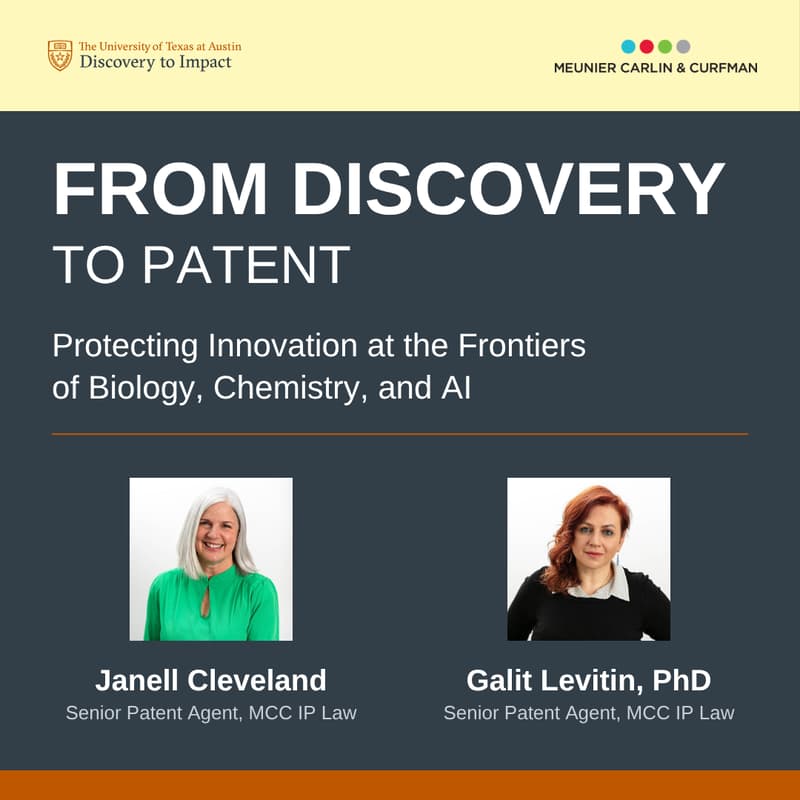

From Discovery to Patent: An IP Lunch & Learn with MCC IP Law
Some of the most important scientific advances don't fit neatly into the Patent Office's definition of an "invention." A newly identified biomarker can be characterized as a natural correlation. A breakthrough built from known components can look obvious in hindsight. And discoveries made using AI raise questions the case law is only beginning to answer.
Janell Cleveland and Galit Levitin, Senior Patent Agents at MCC IP Law, walk through what recent USPTO shifts mean for researchers in these areas and how experimental design, comparative data and unexpected results strengthen the path from a discovery to a defensible patent. Janell spent four years as a USPTO patent examiner and works in biotechnology and biomarkers; Galit holds a PhD in physical chemistry and works in chemistry, green energy, batteries and medical devices.
Who this is for: UT faculty PIs, postdocs, grad students and early-stage teams in the life and physical sciences. You don't need a filed application or a finished invention disclosure — an active project and a question are enough.
What we'll cover:
What the USPTO treats as a "naturally occurring" product or method, and how to draft claims around that
Patenting biomarkers and diagnostics
Inventions built from known components, and the obviousness problem
New case law on AI use in the lab
Where the USPTO has recently become more flexible, and how to use it
Lunch provided.
Texas Innovation Center, EER 2.518 — Engineering Education and Research Center, 2501 Speedway. In person only. Enter EER on the second floor and take a left; TXIC is on your right across from O's Cafe.
Parking: Speedway Garage or San Jacinto Garage.
Rideshare drop-off: Speedway and Dean Keeton.