
Subscribe to this Calendar for Event Updates
VAM! Talks: AI Optimization & Multimodal Reasoning
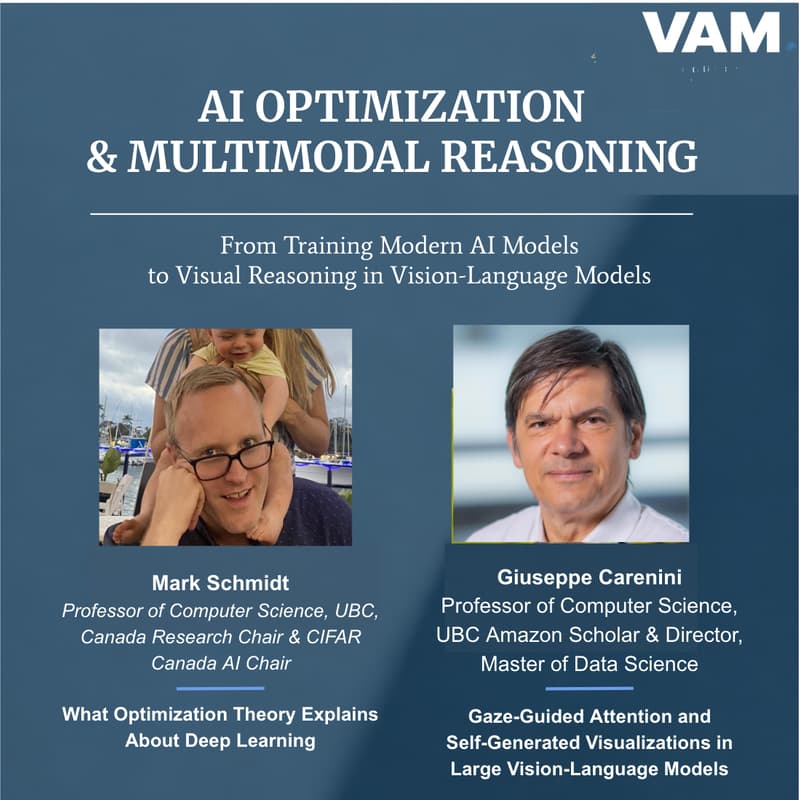
AI Optimization & Multimodal Reasoning
In this event, we will explore how optimization theory informs the training of modern AI models and how vision-language models interpret and reason with visual information.
The two talks will cover the following themes:
📈 Optimization Theory and AI Training: We will explore how optimization principles explain training choices such as Adam and Muon, batch sizes, normalization, and skip connections. We will also discuss the gap between theoretical guarantees and empirical performance.
👁️ Multimodal Learning and Visual Reasoning: We will explore how human eye-gaze can improve chart understanding and whether self-generated visualizations help AI solve mathematical problems. We will examine improvements in accuracy and robustness, alongside recurring reasoning failures.
The event welcomes researchers, engineers, data scientists, founders, product developers, students, and anyone interested in current AI research.
🗓️ Program
5:30 PM to 5:40 PM | Arrival and networking
Doors close at 5:35 PM.
5:40 PM to 5:50 PM | Issam Laradji
Welcome and opening remarks
5:50 PM to 6:40 PM | Mark Schmidt
What Optimization Theory Explains About Deep Learning
6:40 PM to 6:50 PM | Break
6:50 PM to 7:30 PM | Giuseppe Carenini
Gaze-Guided Attention and Self-Generated Visualizations in Large Vision-Language Models (LVLMs)
7:30 PM to 7:55 PM | Closing remarks and networking
🍽️ After 7:55 PM | Optional social gathering
We will head to The Rec Room on Granville Street for food, drinks, games, and further conversation. Everyone is welcome to join.
Talk slots include time for questions. Timing is approximate.
ℹ️ Venue Information
🥤 You are welcome to bring food and a water bottle. A water fountain is available.
🅿️ Paid parking is available nearby, including EasyPark.
🐕🦺 Service animals are welcome. Other pets are not permitted.
🚲 Bicycles are not permitted inside the building.
🕠 Doors close at 5:35 PM, so please arrive before then.
🏢 An organizer will be in the lobby before 5:35 PM to direct you to the event space on the 14th floor.
🎤 Speaker 1: Mark Schmidt
Professor, Computer Science, UBC | Canada Research Chair | CIFAR Canada AI Chair, Amii
Mark Schmidt is a professor in the Department of Computer Science at the University of British Columbia. His research focuses on developing faster algorithms for large-scale machine learning, and exploring applications of machine learning. He is a Canada Research Chair, Alfred P. Sloan Fellow, NSERC Arthur B. McDonald Fellow, Dorothy Killam Fellow, CIFAR Canada AI Chair with the Alberta Machine Intelligence Institute (Amii). Along with Nicolas Le Roux and Francis Bach, Mark was awarded the 2018 SIAM/MOS Lagrange Prize in Continuous Optimization.
What Optimization Theory Explains About Deep Learning
Talk's Abstract
We are seeing more numerical optimization theory papers published than ever before. These papers often make unrealistic assumptions or propose algorithms that never get adopted. So is all this optimization theory largely useless?
In this tutorial I show how some surprisingly simple optimization ideas can explain a wide variety of the implementation choices we make when training modern deep learning models. Some of these ideas might have let us skip some generations of grad-student descent, or have led to state-of-the-art tricks in modern architectures. On the other hand, I will highlight how some important practical ideas are not explained by optimization theory and where we can go from here.
Here is a list of keywords to get you (and your LLM sidekick) interested in attending: Adam and Adam*, Muon and its friends/enemies, critical-ish batch size, the RMSnorm and skip connection love affair, dead ReLUs and living SwiGLU, Schedule-Free and WSD and muP and max_grad_norm = 1.0, variance reduction and shuffle=True, and maybe edge-of-stability/catapults/feature-learning. I may also tell you why your second-order stochastic optimization method did not work.
🎤 Speaker 2: Giuseppe Carenini
Professor, Computer Science, UBC | Amazon Scholar | Director, Master of Data Science
Giuseppe Carenini is a Professor in Computer Science, an Amazon Scholar and the Director of the Master in Data Science at UBC (Vancouver, Canada). His work on natural language processing and information visualization to support decision making has been published in over 160 peer-reviewed papers (including best paper at UMAP-14, ACM-TiiS-14 and Sigdial-24). Dr. Carenini was the area chair for many conferences including for ACL '21 in “Natural language Generation”, as well as Senior Area Chair for NAACL '21 and EMNLP '26 in “Discourse and Pragmatics”. Dr. Carenini was also the Program Co-Chair for IUI 2015 and for SigDial 2016. In 2011, he published a co-authored book on “Methods for Mining and Summarizing Text Conversations”. In his work, Dr. Carenini has also extensively collaborated with industrial partners, including Amazon, Microsoft, Google, Salesforce, ServiceNow, Huawei and IBM. He was awarded a Google Research Award in 2007 and a Yahoo Faculty Research Award in 2016.
Gaze-Guided Attention and Self-Generated Visualizations in Large Vision-Language Models (LVLMs)
Talk's Abstract
Natural language and information visualization are critical when humans and AI systems collaborate on complex, data-intensive problems. In this talk, I will explore the potential and current limitations of such synergy in the era of LVLMs through two recent research directions. The first grounds large vision-language models in human eye-gaze, introducing ChartGaze, a new eye-tracking dataset along with a gaze-guided attention refinement method that jointly improve chart question-answering accuracy, interpretability, and robustness to misleading chart designs. Then, the second direction, presented through the VAMPS benchmark, tests whether LVLMs can benefit from constructing and reasoning over their own visualizations the way human problem-solvers do in algebra and calculus problems. We find, counter-intuitively, that direct analytical reasoning outperforms tool-enabled visual solving for most models, even on problems where plotting is a natural strategy, and diagnose why by identifying four recurring failure patterns.
🎙️ Opening Remarks: Issam Laradji
Adjunct Professor, UBC
Issam will give a 10-minute welcome, introduce the speakers, and outline the evening’s program.
🌲 About
Vancouver AI Meetup (VAM!) is a community of researchers, engineers, founders, students, and AI practitioners who come together to learn, share ideas, and discuss the latest developments in artificial intelligence.
Northeastern University was founded in 1898 and is a global research university and a leader in experiential learning. With campuses across the U.S., U.K., and Canada, its global network connects students, researchers, and industry partners around the world.
Located in downtown Vancouver, the Vancouver campus offers master's-level technology programs, including pathways for students from non-STEM backgrounds to pursue graduate studies in technology.
Subscribe to this Calendar for Event Updates