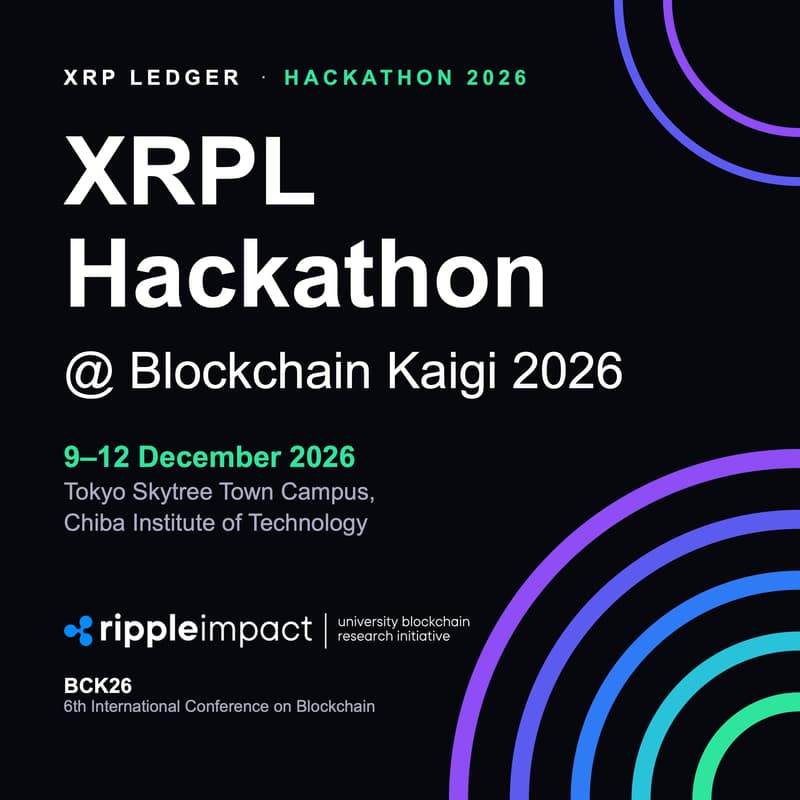

BCK2026 Blockchain Hackathon (Tokyo)
Hackathon Theme: Disaster Relief Disbursement with Time-Bound Aid
Teams build a working proof of concept that turns disaster relief money into programmable, expiring, auditable aid on the XRP Ledger (XRPL), settled in Ripple USD (RLUSD). The success consists in a demo in which aid reaches a verified survivor in minutes rather than months, every yen or dollar must be traceable end to end, and idle money recycles itself instead of sitting in a backlog.
After earthquakes, floods, cyclones and heatwaves, aid is slow, opaque and often leaky. For example, full disaster aid takes about seven years on average to flow in Canada. The €30 billion Ahr valley fund was one-fifth allocated five years on. FEMA paid an estimated $1 billion (16%) in improper or fraudulent Katrina/Rita claims because identity and address were never validated upfront. After the 2024 Noto earthquake, Ishikawa authorities could not identify who needed help.
Your proof of concept must address the four following failure modes:
Speed
Problem: Assessment, application and approval are sequential and manual
What the PoC must show: Release within minutes under encoded rules
Targeting and leakage
Problem: No upfront identity or address validation, or so much that nothing is paid
What the PoC must show: Identity-linked eligibility resolved against a victim database
Donor opacity
Problem: Pooled funds, no donor can show where its money landed
What the PoC must show: Each donor layer separately traceable to the same beneficiary
Idle capital
Problem: Unclaimed allocations stay locked in dead programmes
What the PoC must show: Time-bound allocations that expire and revert automatically
The four layers to implement are:
Verified eligibility. An AI-assisted damage oracle fuses satellite and geospatial assessments (flood extent, shake intensity, land surface temperature) with ground sensors, weather and geolocated reports into a per-zone damage score. A mock government digital identity check confirms the claimant lives in an affected zone.
Programmable disbursement. XRPL Escrow releases a defined RLUSD amount to the verified wallet under per-programme rules: base grants, household caps, severity tiers, top-ups for repeat-hit households.
Layered donor flows. National, prefectural and international donor contributions each carry their own conditions (geography, victim category, spending window, permitted use) and settle into the same beneficiary while staying separately traceable.
Expiry and reversion. Every allocation is time-bound. Unclaimed escrowed funds revert to the pool or originating donor when the window closes. This is the feature that distinguishes the design from a faster bank transfer.
Tracks and example scenarios (pick one or propose your own)
Track 1. Urban earthquake
Zone scoring from shake intensity, elderly and low-connectivity beneficiaries, repeat-disaster top-ups, offline or delegated claiming
Track 2. Riverine flood
Fast small grant and slow large tranche on one rail; municipal, state and federal layers with different conditions
Track 3. Coastal storm
High-volume disbursement under fraud pressure; duplicate-claim detection across two overlapping disasters
Tack 4. Heatwave
Pre-identified vulnerable cohort, small behavioural payouts, days-long expiry windows, reversion at scale
Suggested deliverables
XRPL escrow and settlement logic deployed on Testnet. Test funds can be obtained from the XRPL faucet at xrpl.org/resources/dev-tools/xrp-faucets.
Damage oracle and identity bridge, with data sources and the fusion or scoring method used
Layered-donor rule engine with at least two donors carrying different conditions
Dashboard for donors and administrators showing allocation, release, expiry and reversion
Short written note on assumptions, threat model, and what would need to be true for a real deployment
Teams should be able to state in one sentence which XRPL primitive does work that a conventional payment system cannot do as well. Solutions that would run equally happily on a database will be marked down.
Participation Criteria
The hackathon is open to all, regardless of geographic location. Registration is mandatory, and remote participation is allowed.
The teams may have up to 1-6 members and may mix industry and academia. All team members register individually on Luma under a common team name.
All participants MUST attend the opening, pitching, and closing sessions in person.
The proof of concept must use the XRPL protocol, deployed on XRPL Testnet. No mainnet value transfer.
Teams must submit a screen recording of their demo (3 to 5 minutes) for review by the judges.
All four layers of the challenge (verified eligibility, programmable disbursement, layered donor flows, expiry and reversion) must be present in the demo video, including at least one live expiry and reversion.
Teams must share a GitHub repository link for their codebase, together with the written note on assumptions and threat model.
Virtual machines or containerised builds are recommended. Solutions that minimise deployment effort during evaluation receive special consideration.
The jury judges feature coverage with minimum reliance on off-chain logic. Only mock or synthetic identity data may be used.
Registration & Timeline
December 1, 23:59 - Registration closes
December 9, 14:00-16:40 - Hackathon Kickoff
December 10-11 10:30AM-5PM - Coding sessions with scheduled mentor hours
December 11, 23:59 - Submission deadline
December 12, 11:00-11:40 - Pitches from 10 shortlisted teams.
December 12, 12:50-13:20 - Hackathon Awards Ceremony
All times are Japan Standard Time (JST, UTC+9).
Know About the XRPL Protocol
The XRP Ledger is a public, decentralised layer-1 blockchain designed for payments. Transactions settle in 3 to 5 seconds with deterministic finality, meaning they either confirm or expire and never sit pending. Fees are a fraction of a cent and are known in advance.
The following resources will help you get started and support you throughout the hackathon.
Learn to code on the XRPL at learn.xrpl.org.
Documentation and the Testnet and Devnet faucets are available at xrpl.org.
XRPL Commons offers a community along with GitHub and YouTube channels at xrpl-commons.org.
The XRPL Developer Discord is the place to ask protocol questions during the hackathon.
XRPL Basics at docs.xrpl-commons.org/xrpl-basics.
Teams may also wish to explore the XRPL AI Starter Kit (Agentic Transactions), released by Ripple on June 9, 2026. It lets AI agents and AI-assisted developers build, fund and operate XRPL wallets and payments directly from their coding tools. See https://xrpl.org/resources/dev-tools/ai-tools.
Awards
Three winners are selected from the ten teams that pitch on December 12:
First prize: $2,500
Second prize: $1,500
Third prize: $1,000
All ten pitching teams receive a certificate of participation.
Hosts and Sponsors
This Hackathon is co-hosted by Kyoto University, Chiba Institute of Technology, with assistance from XRP Asia, a non-profit dedicated to supporting the growth of the XRP Ledger ecosystem in APAC.
Prizes are sponsored by the Ripple Impact - University Blockchain Research Initiatives (UBRI) programme.
Enquiries
Venue details will be visible to approved registrants.
For any queries, please contact Rafik HADFI at rafik dot hadfi at i.kyoto-u.ac.jp.