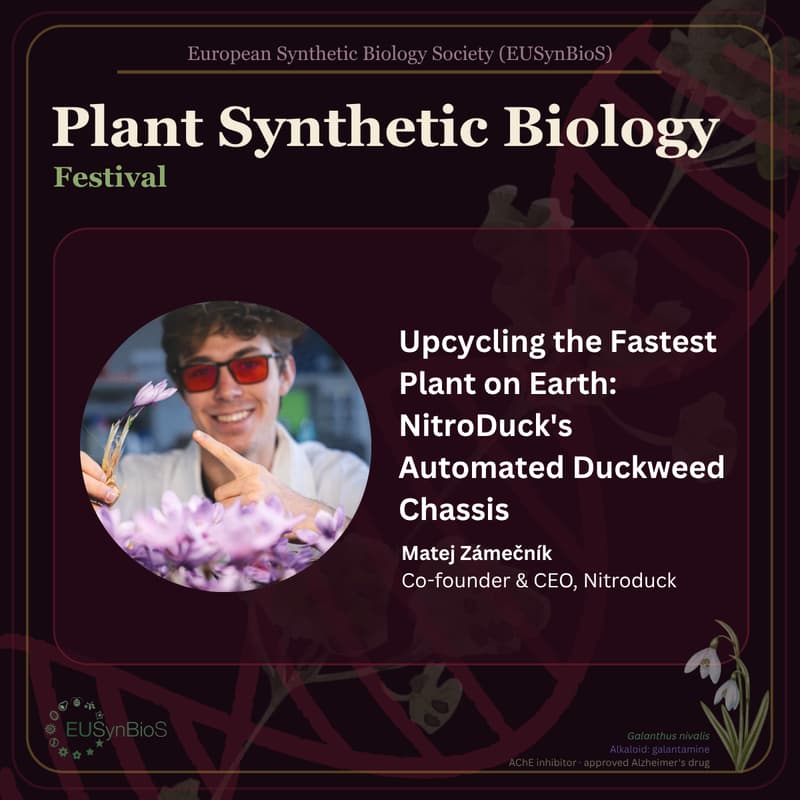

Upcycling the Fastest Plant on Earth: NitroDuck's Automated Duckweed Chassis
Join iGEM 2025 Grand Prize winners NitroDuck as they unpack how synthetic biology and machine learning are turning the world's fastest-growing plant into a high-throughput manufacturing engine. See how their automated pipeline sidesteps centuries of selective breeding, speeding up genetic engineering fivefold to churn out scalable, AI-designed cyclic peptides built to outpace evolving crop pathogens.
Speaker Bio
Fresh off winning the Grand Prize at the iGEM 2025 Grand Jamboree in Paris, NitroDuck is one of synthetic biology's most talked-about new ventures. Born out of the Brno, Czech Republic iGEM team, the company also placed 3rd at the European SynBio Hackathon before spinning out as a TechBio startup.
Co-founders Matej Zámečník (CEO), Matúš Grieš (Head of TechBio), and Miroslav Rosputinský (Head of SynBio) are turning duckweed (Spirodela), the fastest-growing plant on Earth, into a next-generation bio-manufacturing chassis. Duckweed already rivals soybeans for protein density, but has missed out on millennia of selective breeding. NitroDuck closes that gap with a synthetic biology platform that accelerates duckweed's genetic engineering fivefold.
What began as a solution to agricultural nitrogen pollution, upcycling manure runoff in vertical automated farms, has grown into something bigger: an automated pipeline paired with machine learning to design antifungal cyclic peptides. Because duckweed naturally has the cellular machinery to cyclize and stabilise these complex molecules, NitroDuck is turning it into a scalable, low-cost host for producing crop protection and fungicides that can evolve as fast as the pathogens they target.