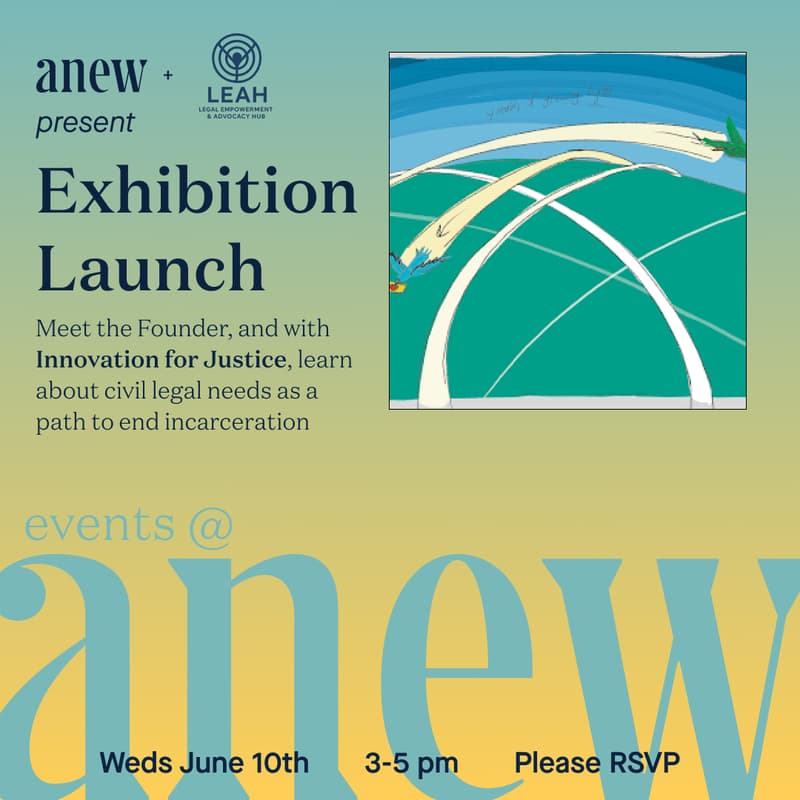

LEAH's Exhibition Walkthrough + Discussion: Civil Legal Needs as a Path to End Incarceration, with Innovation for Justice
What if ending incarceration requires us to look not only at criminal courts, prisons, and punishment — but also at the everyday civil legal needs that push people and families deeper into crisis?
Join LEAH Founder Jhody Polk and Stacy Rupprecht Jane, Director of Innovation for Justice, for a creative table conversation on civil legal needs, jailhouse lawyers, and legal empowerment. Together, Jhody and Stacy will share reflections from their research collaboration, Jailhouse Lawyers: Legal Empowerment and Civil Legal Problem-Solving, which explores the civil legal knowledge and problem-solving potential of jailhouse lawyers.
This will not be a traditional panel. We will gather around a table, make art, share conversation, and reflect together on how issues like housing instability, family separation, health care, debt, benefits, and legal isolation are connected to incarceration — and how community-rooted legal empowerment can help interrupt those cycles.
Come sit with us, create with us, and imagine what justice can look like before harm becomes punishment.
You can find the collaboration and the report here.
Walkthrough
As part of this event, join LEAH for an in-person walkthrough of the Flashlights Timeline, a living archive honoring the history, labor, wisdom, and resistance of jailhouse lawyers.
During this experience, guests will be invited to move through framed timelines displayed throughout Anew Cafe, read letters from incarcerated members, sit with printed quotes, and use tablets to listen to testimonies featured on the Flashlights digital archive.
This walkthrough offers a rare opportunity to encounter the stories behind the Jailhouse Lawyer Initiative — not as abstract history, but as living memory. Through letters, timelines, oral histories, and member reflections, guests will learn how jailhouse lawyers have used the law to survive, advocate, teach, organize, and build power from inside prisons.
The Flashlights Timeline invites us to ask: What histories have been hidden, who has carried the law when systems failed, and what becomes possible when incarcerated legal workers are recognized as community legal empowerment leaders?
The Legal Empowerment & Advocacy Hub (LEAH) was founded in 2019 with the mission to ensure isolated communities have access to legal empowerment, education and peacebuilding.
Jhody Polk is the founder of the Legal Empowerment & Advocacy Hub (LEAH). LEAH was founded in 2019 with the mission to ensure isolated communities have access to legal empowerment, education and peacebuilding. LEAH’s first program was the Jailhouse Lawyers Initiative (JLI), housed at the Bernstein Institute for Human Rights at NYU School of Law. Jhody is a 2025 David Prize Winner and a 2024 Global Freedom Fellow. She is recognized as a formerly Incarcerated Jailhouse Lawyer, a Community Paralegal and Community Peacebuilder.
Innovation for Justice (i4J) is a social justice legal innovation lab jointly housed at the University of Arizona James E. Rogers College of Law and University of Utah David Eccles School of Business that engages in access to justice research with nonprofit, government, and private sectors to advance equitable systems-level change at both service and policy levels. Our research methodology combines qualitative and quantitative methods and prioritizes design thinking, systems thinking and Participatory Action Research (PAR). In practice and organizational policy, this translates to a commitment to the compensation of and deep respect for the shared time and expertise of lived experience experts, system actors, collaborators, and project partners in our work. The i4J Approach is a data-driven process that requires regular robust community engagement, reflection, and iteration. The i4J Approach is effective because it combines a deep understanding of the needs of individuals experiencing the problem with a thorough analysis of the complexity of the system that the problem lies within. This dual approach allows us to leverage the strengths of both design thinking and systems thinking to work with system actors within communities to design high-impact solutions. Since 2018, i4J has engaged over 2,350 individuals and organizations as project collaborators. Our research teams are trained to recognize how cognitive and implicit biases can impact communication, collaboration, problem-solving, and community-engaged research. Our research teams are also trained in trauma-informed community engagement with an emphasis on the agency, resilience, and individuality of the community members we work with. We believe, and our work demonstrates, that well-designed, accessible, usable, and useful interventions can mitigate existing access to justice barriers and create a more equitable and simplified justice system.
Stacy Rupprecht Jane is the Director of i4J (Scholar, University of Arizona; Adjunct Professor, University of Utah) and has two decades of experience in community advocacy and expanding the reach of civil legal services for under-represented populations. Her research focuses on the application of human-centered design, systems thinking, and participatory action research to social justice issues including eviction, debt collection, and domestic violence. Advancing legal empowerment through regulatory reform of the legal profession is also a core component of Stacy’s research. Prior to launching i4J , she worked in the United States District Court for the District of Arizona and served as an adjunct professor at the University of Arizona James E. Rogers College of Law. Stacy has been appointed to the Arizona Supreme Court's Access to Justice Commission since 2021. She received the Rebuilding Justice Award from the Institute for the Advancement of the American Legal System in 2026 for her work to expand access to justice and elevate the voices of those too often unheard. Stacy received the Association of American Law Schools' Deborah L. Rhode Award in 2022, which honors the contributions, service, and leadership of Deborah Rhode by recognizing new trailblazers in legal education and the legal profession. She was named a University of Arizona Woman of Impact in 2022. Stacy received the Arizona State Bar Award of Special Merit in 2020 for her contributions to the furtherance of public understanding of the legal system. Stacy earned a B.A. from Trinity University and a J.D. from the University of Arizona.
Anew is a gathering space and discovery center for the social impact community.
Anew’s Entrepreneur in Residence program hosts nonprofit entrepreneurs who are architecting creative social impact solutions to real world problems. Every six months, we support a new group of change makers with a customized curriculum to take their organizations to the next level.